


Generated by AI

Diplomacy in the Name of Peace: Tokayev’s Initiative to Halt Hostilities and Resume Negotiations
The Kazakh president’s proposal envisages a shift from military escalation to an updated Istanbul format with the participation of mutually agreed international guarantors
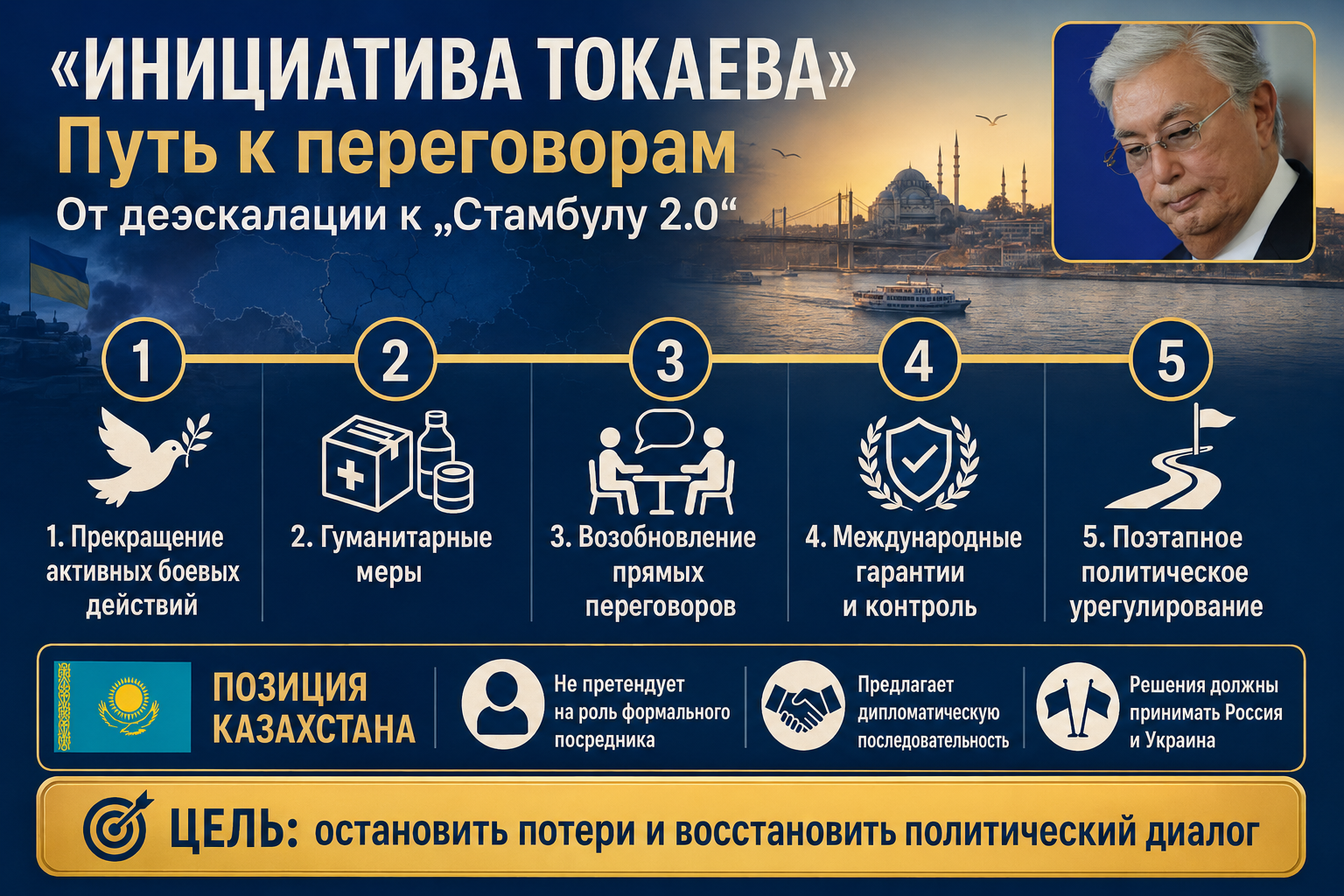
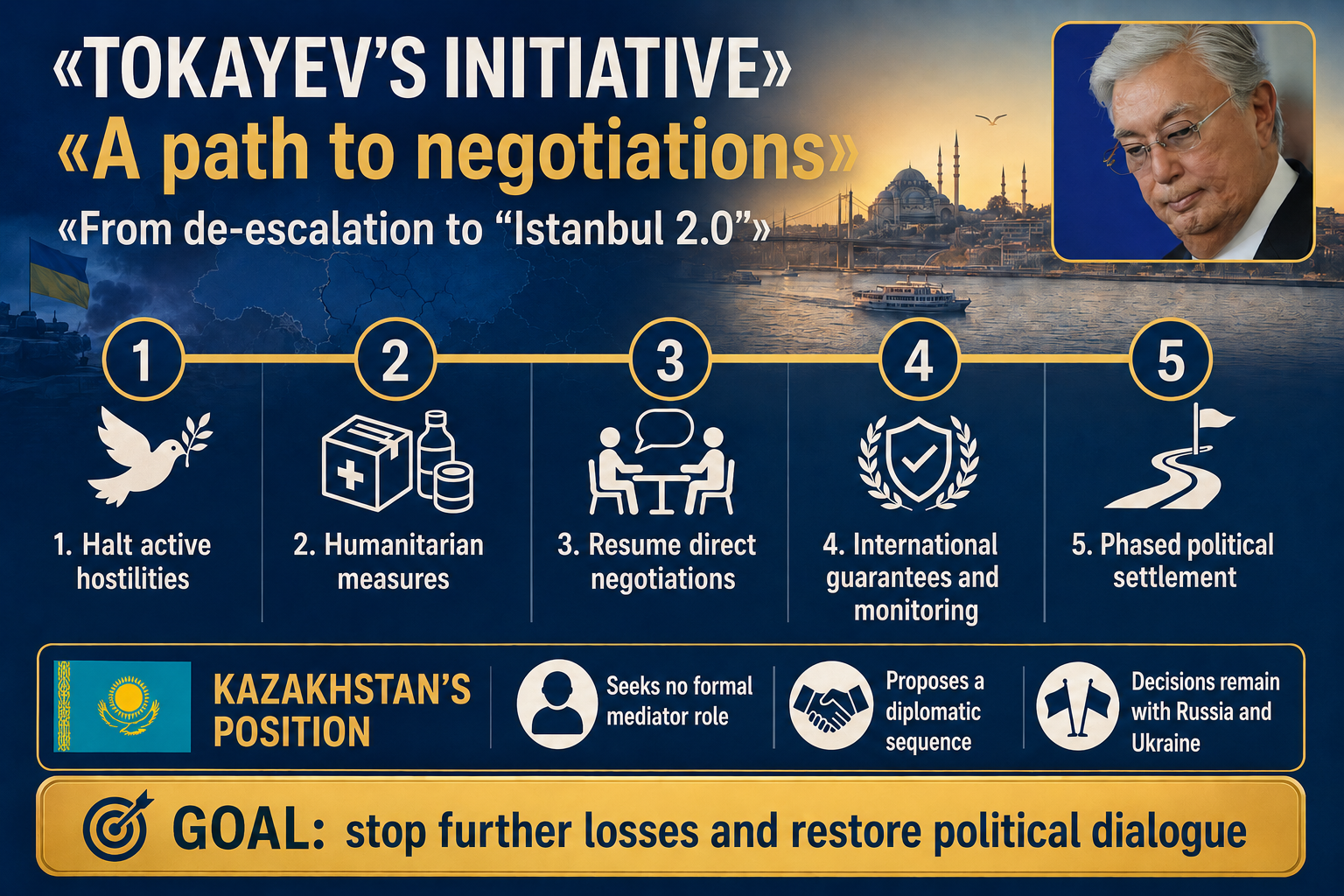
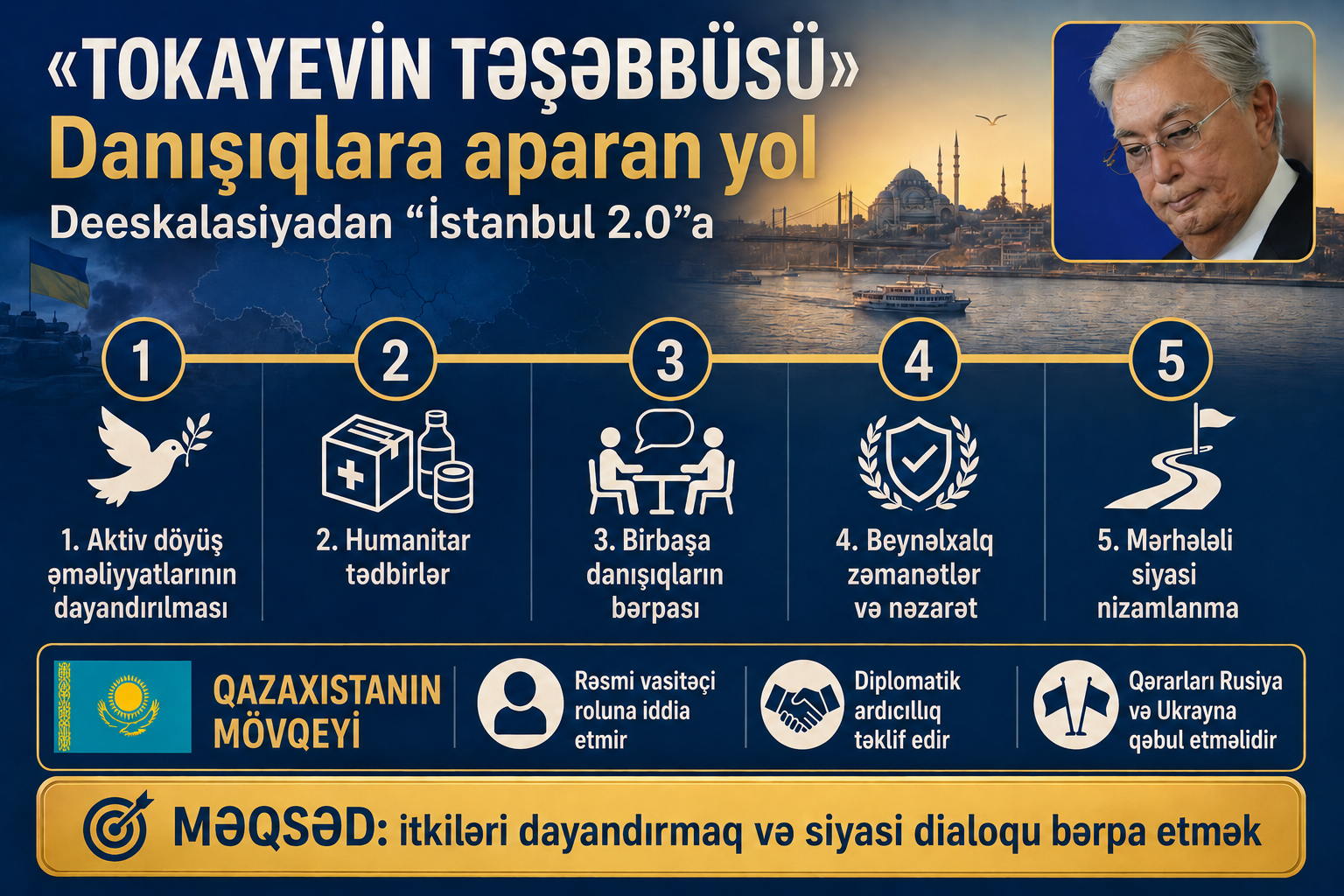
Kazakh President Kassym-Jomart Tokayev’s proposal to suspend active hostilities between Russia and Ukraine and return to an updated Istanbul negotiating format has outlined a possible sequence for moving from armed confrontation to a political and diplomatic process.
Speaking in Omsk on July 25 during a meeting with Russian President Vladimir Putin, the Kazakh leader proposed considering a freeze in the conflict and a return to the “Istanbul Formula 2.0.” He said further movement toward peace could proceed under guarantees from leading powers. Tokayev also stressed that Kazakhstan was not seeking a formal role as mediator. His remarks were published on the official website of the president of Kazakhstan.
The substance of the initiative points to three interconnected stages: reducing the intensity of hostilities, resuming direct negotiations, and preparing a sustainable settlement model backed by international guarantees.
This is not a ready-made peace plan or a draft agreement defining the final terms of a settlement. It is primarily a political appeal to restore negotiating channels and create a space in which the direct participants can address their existing differences through diplomacy.
Preserving Human Life as the Starting Point
The humanitarian dimension is central to the Kazakh president’s proposal. Tokayev drew attention to the continuing loss of young lives and called for further casualties to be prevented.
Continued hostilities inevitably entail not only casualties among military personnel and civilians, but also the destruction of energy and transport facilities, housing, and social infrastructure. At the same time, the range of long-term humanitarian problems is expanding: locating missing persons, returning displaced people, exchanging prisoners of war, clearing mines, and restoring essential life-support systems.
A temporary halt or substantial reduction in the intensity of hostilities will not, by itself, resolve these issues. It could, however, create more favorable conditions for addressing them in sequence.
Practical humanitarian cooperation could become one of the first tools for rebuilding a minimum level of trust. Exchanges of prisoners of war, the return of civilians, the protection of humanitarian routes, and agreed measures to safeguard critical infrastructure could be pursued even before a comprehensive political agreement is reached.
Such sequencing would make it possible to begin with matters in which both sides have an interest, without postponing the protection of human life until difficult negotiations on the full range of political and security-related issues have been completed.
De-escalation Is a Beginning, Not the Final Goal
The proposal to suspend active hostilities should not be viewed as a substitute for a full political settlement. Its primary purpose is to create conditions for dialogue.
In international practice, a ceasefire can serve as a transitional mechanism between armed confrontation and negotiations. For such a mechanism to be viable, it must include clear and mutually agreed parameters: the time it enters into force, its geographical scope, rapid communication channels, procedures for reviewing possible incidents, and monitoring instruments.
Without such mechanisms, even an agreed pause may remain vulnerable to local clashes, mutual suspicion, and differing interpretations of commitments.
Tokayev’s initiative effectively separates two tasks. The first is urgent and concerns preventing further losses. The second requires a sustained negotiating process on political, legal, territorial, humanitarian, and security-related issues.
This approach recognizes that the entire set of contradictions cannot be resolved by a single decision. Yet the absence of an immediate comprehensive agreement should not rule out more limited arrangements capable of reducing human suffering and lowering the risk of the conflict expanding further.
Decisions Must Be Made by the Direct Participants
The Kazakh initiative does not contain a pre-formulated model for a final settlement. Nor does it set preconditions that could predetermine the substance of future agreements.
The parameters for halting hostilities, the agenda for political dialogue, and the final terms of peace must be agreed by Russia and Ukraine. International partners can assist the process, provide venues for meetings, help develop monitoring mechanisms, and serve as guarantors of the decisions reached. They cannot, however, substitute for the political will of the direct participants.
The long-term durability of any agreement will depend on the extent to which its provisions are accepted by the parties, how clearly the obligations are defined, and how effective the implementation mechanisms prove to be.
Recognizing the central role of the parties to the conflict is especially important while their positions on several fundamental issues remain different. The proposed diplomatic logic does not require all disagreements to be eliminated in advance. It calls for a process within which those disagreements can be discussed step by step.
What “Istanbul 2.0” Could Mean
The “Istanbul 2.0” formula suggests using the accumulated experience of negotiations while taking into account the changes that have occurred since the previous rounds of contacts.
Russia and Ukraine held negotiations in Istanbul in 2022 and then resumed direct meetings at the same venue in 2025. Those contacts did not produce a comprehensive agreement, although individual tracks — including humanitarian issues and prisoner-of-war exchanges — demonstrated the possibility of limited practical cooperation. Reuters reported that Tokayev had proposed returning specifically to an updated, rather than the previous, negotiating formula.
“Istanbul 2.0” therefore does not necessarily mean a mechanical return to documents discussed earlier. Circumstances have changed, new factors have emerged, and the substance of any future agenda must be determined on the basis of the parties’ current positions.
An updated format could theoretically include several parallel tracks:
- ceasefire parameters and monitoring mechanisms;
- humanitarian measures and exchanges of detainees;
- the safety of civilian and energy infrastructure;
- incident prevention and the maintenance of direct communication channels;
- discussion of security guarantees;
- preparation of a phased road map for a political settlement.
Dividing the negotiations into separate tracks would keep the entire process from depending on immediate agreement on the most difficult issues. Progress in one area could continue even if disagreements persisted in another.
At the same time, the substance, venue, and composition of an updated format can be determined only by mutual agreement between Russia and Ukraine.
International Guarantees and Monitoring Mechanisms
International guarantees occupy a distinct place in Tokayev’s proposal. The Kazakh president said further movement toward peace could take place under guarantees from major powers, including Russia.
The purpose of such guarantees would extend beyond political support for future agreements. They could include specific mechanisms designed to increase predictability and reduce the risk of renewed escalation.
Depending on the model agreed by the parties, the guarantees could include ceasefire monitoring, rapid investigation of incidents, support for humanitarian measures, assistance with information exchange, and regular consultations in crisis situations.
For such a system to be effective, the parties would need to define the guarantors, the scope of their obligations, the limits of their responsibility, and the procedure for responding to possible violations. External actors cannot establish these parameters unilaterally.
The possible involvement of leading powers could strengthen confidence in the agreements reached, but international guarantees will work only if there is an agreed document, clear procedures, and sustained interaction between the parties.
Kazakhstan Offers Assistance, but Claims No Monopoly on Mediation
Tokayev separately stated that Kazakhstan was not seeking to become a formal mediator. This position reflects the cautious nature of the initiative: Astana is offering a diplomatic idea, but is neither imposing its own scenario nor competing with existing platforms.
Declining a formal mediation role does not exclude possible practical assistance. If the parties make an agreed request, Kazakhstan could help maintain contacts, provide a venue for consultations, or participate in international humanitarian efforts. Any such decision, however, must come from the parties themselves.
This approach is consistent with Kazakhstan’s multi-vector foreign policy: the country maintains strategic cooperation with Russia, preserves relations with Ukraine, and develops partnerships with European, American, and Asian states.
The value of Astana’s position lies not in a claim to an exclusive role, but in its effort to offer a clear diplomatic sequence: first prevent further losses, then restore negotiations, and only after that move toward broader agreements.
The Initiative’s International Significance
The consequences of the conflict have long extended beyond the territories directly affected. They influence security in Europe and Eurasia, energy markets, food supplies, transport routes, and the overall resilience of the global economy.
For Central Asian countries, the stability of transit corridors, predictable trade, and preventing further fragmentation of international economic ties are especially important. European states have an interest in reducing military risks and restoring a durable security architecture. For Asian countries and states in other regions, stable supplies, accessible transport routes, and reduced global uncertainty matter greatly.
Creating conditions for negotiations therefore serves broader international interests without implying support for the political demands of either side.
The response to the proposal showed that the idea of reviving the diplomatic process remains a subject of international debate. Ukrainian Foreign Minister Andrii Sybiha called Tokayev’s statement realistic and timely, Euronews reported. At the same time, the parties’ positions on the conditions for halting hostilities remain different. This underscores the need not only for political appeals but also for detailed diplomatic work.
Restoring Diplomacy to a Central Role
Kassym-Jomart Tokayev’s proposal promises no quick solution and does not remove the existing contradictions. Its significance lies elsewhere: it suggests beginning with an achievable, humanitarian goal — preventing further loss of life and restoring political dialogue.
An updated Istanbul format could represent not a return to the past, but the use of earlier experience to develop a new and more flexible negotiating framework. Its durability will depend on Russia’s and Ukraine’s consent, the clarity of monitoring mechanisms, and the readiness of international partners to support the agreements reached.
The Kazakh initiative rests on the premise that ending armed confrontation should not revolve around identifying winners and losers. Its diplomatic logic is a gradual transition from de-escalation to humanitarian cooperation, and from there to discussion of political and security-related issues.
Amid continuing tensions, such an approach does not guarantee an immediate breakthrough. It does, however, provide a practical foundation on which the negotiating process could be restored, if the parties have the political will, and a step-by-step movement toward lasting peace could begin.
Media Consulting and Services


Post-Soviet region
-
Systematic Ukrainian drone strikes on Wildberries warehouse complexes have marked a new direction in Kyiv’s campaign deep inside Russia. While earlier attacks mainly targeted oil refineries, fuel depots, defence plants, airfields and transport...
-
Across the Caspian to a New Asia: How Azerbaijan Is Redrawing the Boundaries of Regional Cooperation An informal meeting of Central Asian leaders in Cholpon-Ata showed that a region long caught between the interests of larger powers is trying to...
-
On the shore of Lake Issyk-Kul, where mountain ranges are reflected in the dark water, the presidents of Azerbaijan and Kyrgyzstan exchanged their countries’ highest honors, spoke of shared Turkic roots and called each other friends. But behind the...
-
Worsening relations between Armenia and Russia are pushing Yerevan to accelerate its rapprochement with the European Union, develop trade with Turkey and Azerbaijan and expand energy cooperation with Iran. But Armenia’s heavy dependence on the...


Leave a review