


Generated by AI

How citizens participate in urban planning and environmental decisions in Azerbaijan
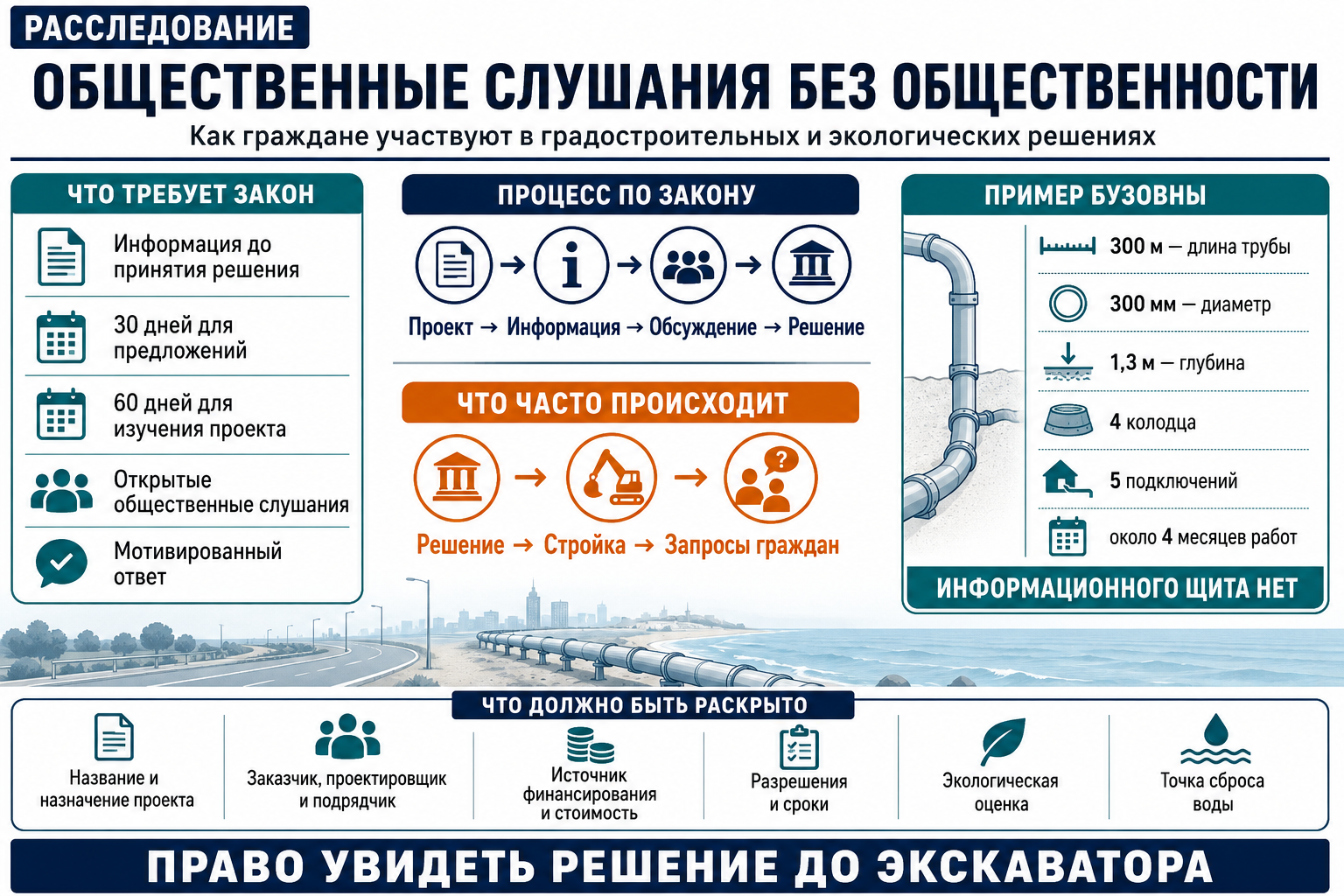
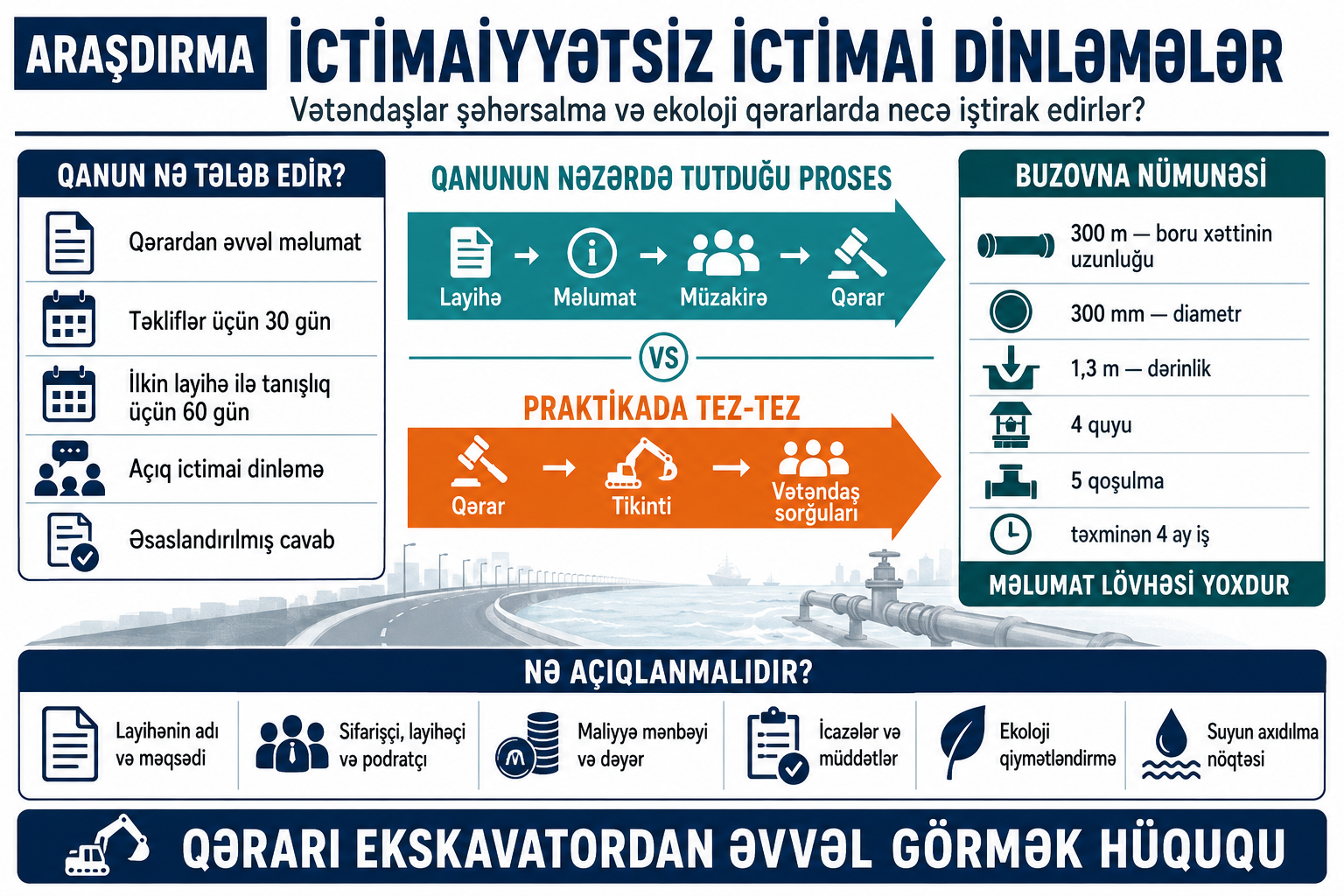
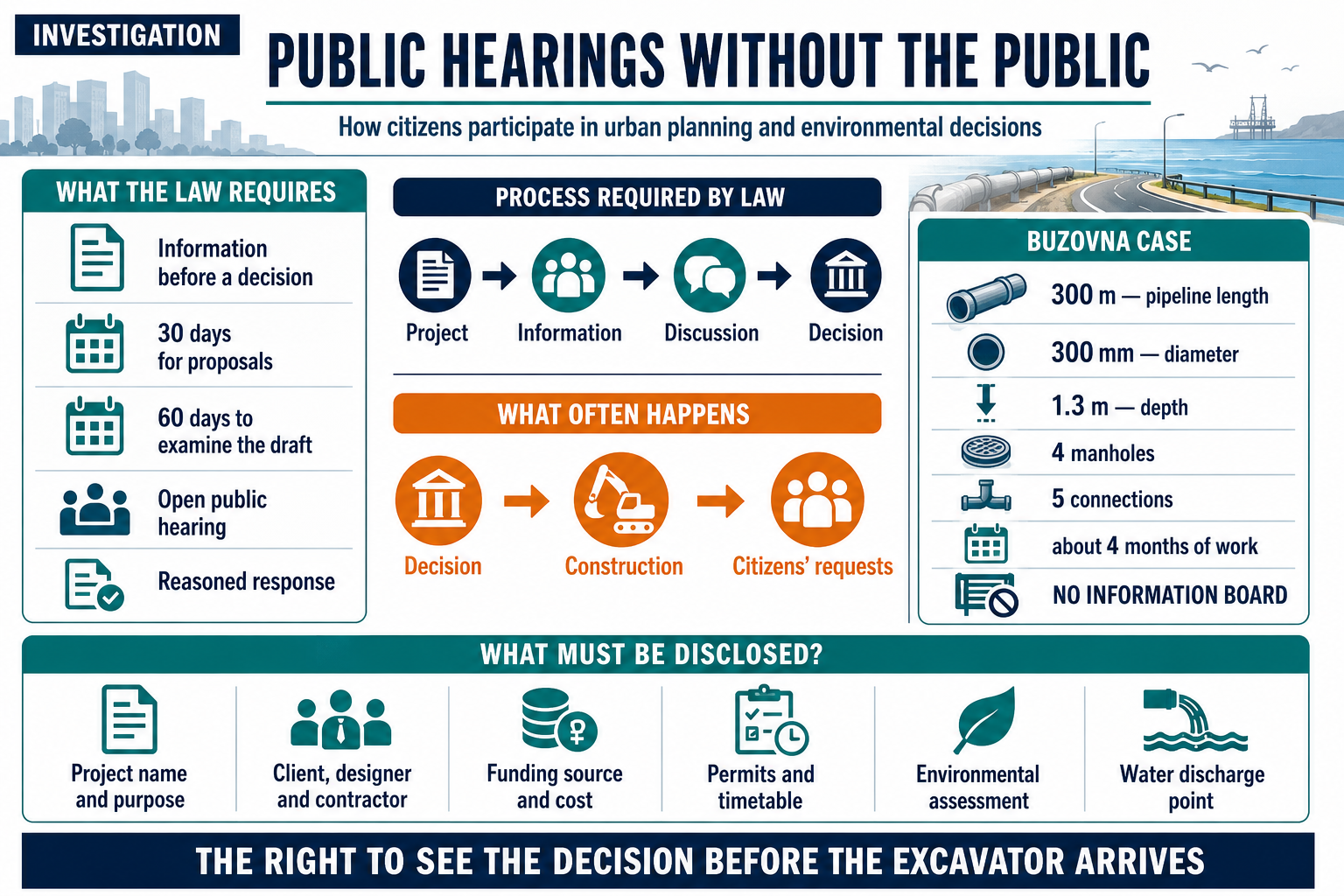
The law requires projects to be disclosed in advance, residents to be heard and the rejection of their proposals to be explained. Yet an almost invisible gulf remains between the legal right of citizens to participate and their ability to influence decisions in practice.
In Buzovna, the pipe appeared before the information about it did.
A plastic gravity-flow pipe approximately 300 metres long and 300 millimetres in diameter was laid at a depth of about 1.3 metres. Four manholes and five connections were installed along the route. The work continued for roughly four months. Hydraulic tests were then conducted, but the asphalt surface remained unrepaired for a long time.
What was missing from the site was the most basic element: an information board displaying the project’s name, the client and contractor, its source of financing, cost, permits and construction timetable. Residents could see the trench, pipes and machinery, but they could not find out who had made the decision, who was paying for the work or where the water would be discharged.
Requests sent on May 25, 2026, to the Ministry of Ecology and Natural Resources, the State Water Resources Agency, the State Committee on Urban Planning and Architecture, the Confederation of Trade Unions and the Khazar District Executive Authority raised straightforward questions. According to Turan’s reporting, no answers followed. After a complaint was submitted on June 23, the Human Rights Commissioner placed the matter under review.
The story of the Buzovna pipeline may appear to be a local issue. But it is precisely through such small cases that a larger system becomes visible: citizens discover a project only after the decision has been taken, machinery has arrived and the work has been financed or nearly completed.
Public participation does not begin with a discussion. It begins with an attempt to find out what is happening at all.
The law promises more
On paper, Azerbaijan’s system of public participation appears relatively detailed.
The Urban Planning and Construction Code identifies informing the public as one of the fundamental principles of urban planning. State bodies and municipalities are required to provide information about every stage in the preparation of urban planning documents and about construction intentions of public significance.
Territorial planning documents must be open for inspection. Citizens must be given an opportunity to submit comments, objections and proposals. The law provides for several stages:
- an initial 30-day period for submitting proposals;
- 60 days of open access to the preliminary draft;
- a public discussion of the final version;
- an explanation of the changes made and the reasons why proposals were rejected.
Separate provisions require people directly affected by a project to be notified by registered letter. Information must also be published in the media, on official websites and on visible public information boards.
The Law on Public Participation requires interested parties to be informed, possible alternatives to be discussed and the results of hearings to be communicated to the public. Hearings must be open, and every participant has the right to speak. An announcement must be published at least seven working days in advance.
The Law on Environmental Impact Assessment requires the project client to hold hearings with residents, legal entities and property owners in the area where the proposed activity will take place. The principles of openness and consideration of public opinion are written directly into the law.
Finally, Azerbaijan joined the Aarhus Convention in 2000. The convention establishes three related rights: access to environmental information, participation in decision-making and access to justice.
None of these laws, however, gives residents an automatic right of veto. Public participation does not mean that every project must be stopped at the first objection. It means something else: information must be disclosed before a decision is taken; people must have a meaningful amount of time to study the documents; alternatives must be discussed; comments must be considered; and any rejection must be explained.
It is this sequence that is most often disrupted — not necessarily in formal terms, but in practice.
A construction project without a name
There is no information board at the Buzovna construction site displaying the project’s name and purpose, the client, designer, contractor, source of financing, permits and duration of the work.
This raises questions about compliance with the principle of informing the public under paragraph 7.0.6 of the Urban Planning and Construction Code, as well as paragraph 6.1.9 of the AzDTN 1.6-2 Construction Organisation Standard.
Under the standard, the client must install an information board in a visible location before construction begins. It must identify the authority that authorised the work, the purpose of the project, the client, designer and contractor, the construction timetable and the project’s principal specifications.
This is the most basic form of public disclosure — it is not yet a public hearing or even a consultation. But in Buzovna, even this was absent.
The possibility that groundwater is being discharged into the Caspian Sea makes the disclosure of environmental documents, as well as construction information, essential. The public should be able to find out precisely where the water is being directed, whether its composition has been analysed, whether treatment is planned and whether the effect of the discharge on the coastal ecosystem has been assessed.
Without project documentation, it is impossible to establish the purpose of the pipe independently. Judging by its outward characteristics, it may be part of a system designed to divert groundwater or rainwater towards the Caspian Sea. But the absence of official information makes it impossible to verify whether treatment has been provided for, environmental studies have been conducted or the necessary approvals have been obtained.
Not every drainage project automatically requires a full environmental impact assessment: this depends on its technical characteristics and legal classification. But a possible discharge into the sea raises questions that concern environmental information of public significance and cannot be treated as the contractor’s internal business.
On the basis of Article 50 of the Constitution of the Republic of Azerbaijan, which guarantees the freedom to seek and obtain information by lawful means, the Law on Access to Information, the Urban Planning and Construction Code and the AzDTN 1.6-2 standard, the following information was requested from the state authorities:
- the project’s official name and purpose;
- the names of the client, designer, contractor and organisation responsible for technical supervision;
- the source of financing and the total cost of the work;
- the authority that approved or authorised the construction, together with the date and reference number of the relevant document;
- the starting date and planned completion date;
- the reasons why a relatively small project has continued for approximately four months;
- the pipeline layout, technical specifications, number of connections and final water discharge point;
- information about the composition of the groundwater being discharged and the results of laboratory tests;
- the existence of a treatment system or other environmental safety measures;
- whether an environmental review and an environmental impact assessment were conducted;
- whether public hearings were organised and how Buzovna residents were informed;
- who is responsible for restoring the road surface and when that work must be completed.
None of these questions concerns a state or commercial secret. They seek basic information about a project being carried out in a public space, affecting road infrastructure and possibly involving the discharge of water into the Caspian Sea.
The absence of answers turns a local construction project into an example of a broader problem: citizens are forced to seek through several state institutions and the Human Rights Commissioner information that should have been displayed at the construction site before the excavator arrived.
The four-month duration of the work reveals another feature of the system. Responsibility is divided among agencies dealing with water, environmental protection and urban planning, as well as the local executive authority. For a citizen, this means travelling around an administrative circle. Each institution may be responsible for only one part of the project, while none acts as a single source of complete information.
Hearings inside a government building
The Ministry of Ecology and Natural Resources regularly reports that public hearings have been held on construction projects.
In April 2023, the State Environmental Expertise Agency discussed a residential complex in the Lokbatan settlement and the relocation of trees in Baku. The official statement said the purpose of the event was to ensure transparency and take environmental requirements into account.
In November 2024, the same agency held hearings on projects in the Yasamal, Nizami and Surakhani districts. The published report listed independent environmental specialists and representatives of state bodies, construction companies, non-governmental organisations and the media.
The fact that such meetings take place is important. It demonstrates that the mechanism exists and is being used. But official reports leave unanswered the questions required to assess its effectiveness:
- whether residents of the buildings directly neighbouring the construction sites attended;
- when and where the initial announcement was published;
- whether citizens could download the project and environmental documents in advance;
- what specific objections were raised;
- which proposals were accepted;
- which proposals were rejected and why;
- whether the project was changed after the discussion.
The absence of this information from press releases does not prove that residents were absent or that their comments were ignored. It demonstrates something else: on the basis of the published information, the public cannot verify whether the hearings affected the final decision.
There is also the question of location. The law on environmental impact assessment requires the participation of residents of the area where the activity is to take place. A meeting with experts and company representatives inside the central office of a government institution may be a useful additional stage. But it should not automatically replace an accessible local discussion with the people who will live next to the construction project, road, quarry or industrial facility.
The problem is not that public hearings never take place. The problem is that their public record often makes it impossible to establish who was heard, what those people said and what changed as a result.
The Master Plan: a window for letters
The discussion of the Baku Master Plan demonstrates a more developed form of public consultation.
In 2020, the State Committee on Urban Planning and Architecture opened a 60-day virtual exhibition. Citizens were invited to study the preliminary plan and submit comments by email. The committee said that all proposals received would be registered and assessed.
The Master Plan, covering the period up to 2040, was approved by the government in December 2023.
This cannot be described as an absence of public participation. Citizens were genuinely given access to the project and a channel for submitting comments. But the official pages examined for this article did not appear to contain a consolidated report showing:
- how many proposals were received;
- which districts and problems they concerned;
- how many were accepted in full or in part;
- which provisions of the Master Plan were changed;
- why the remaining comments were rejected.
Without such a report, participation becomes one-way correspondence. The state knows what citizens told it. Citizens do not know what the state did with their submissions.
That is the difference between being allowed to speak and being allowed to participate. An email address for submissions is the entrance to the process. But without a public response, the exit cannot be seen.
Soyudlu: when dialogue begins after protest
In the summer of 2023, residents of Soyudlu village in the Gadabay district protested against the construction of a second mineral-processing waste storage facility near a gold-mining operation. They raised concerns about health, water, land and safety.
Police dispersed the protest. According to Human Rights Watch, dozens of people were injured, access to the village was restricted and journalists faced interference with their work. The authorities created a commission to investigate the situation.
Anglo Asian Mining later published the results of an independent study it had commissioned from the international consultancy Micon. The study said it had found no significant contamination that would make the existing waste storage facility a source of fundamental technical danger.
But its conclusion about the causes of the conflict was no less important. A statement on the findings said residents’ opposition was connected to a lack of proactive communication, unresolved land-use issues and a failure to follow accepted international public consultation procedures.
In other words, even a study commissioned by the company acknowledged that the problem was not confined to chemical measurements. It concerned trust and the process by which decisions were made.
After the crisis, the company created a department responsible for relations with the local community and began implementing the audit’s recommendations, according to its corporate governance page.
Soyudlu shows the price of delayed public participation. When residents learn about a project only after it appears to have become a settled decision, a technical discussion can quickly turn into a political conflict. Commissions, investigations and new channels of communication are then created — but only after a confrontation.
How the public disappears from public hearings
The mechanism rarely breaks down at a single point. More often, it gradually loses its meaning.
First, an announcement is published in a place where the residents most directly affected are unlikely to see it. They are then given seven days to study a complex project that is either unavailable to the public or consists of hundreds of pages of technical documentation.
At the meeting, the client presents the project, answers questions and participates in preparing the final document. The minutes, transcript and written objections may not be published. Later, a brief press release appears: the hearing took place and opinions were heard.
What happened to those opinions remains unknown.
In such a system, even a conscientious official is not required to show the public the full chain from a citizen’s proposal to the final decision. As a result, it becomes impossible to distinguish a genuine consultation from a ceremony held to satisfy a formal requirement.
What could change the system?
There is no need to create another advisory institution. A substantial share of the necessary principles already exists in the law. What is needed is a process that can be verified.
Every urban planning or environmentally significant project should have a single public page containing a map, information about the client and contractor, the source of financing, cost, permits, a non-technical summary, the full environmental impact assessment and the timetable for the decision.
Residents of neighbouring areas should receive direct notifications. An announcement on a government website should not be considered sufficient if the people living next to the project never learn about it.
After a hearing, a video recording, minutes and a table of comments should be published. The table should show the substance of every proposal, the decision taken and the reasoning behind it. Personal data can be protected without concealing the substance of the discussion.
If a project affects several districts, hearings should be held in each of them. The environmental review, any change in zoning and the granting of construction permission should not be completed before the public consultation ends.
Finally, breaches of procedure should have consequences. If the project was not disclosed or residents were not notified, the decision should be suspended until the violation is remedied. Otherwise, the obligation to consult remains a recommendation whose implementation depends on the goodwill of the project client.
The right to see the decision before the excavator arrives
Public participation does not guarantee that residents will always obtain the result they want. Roads will still have to be built, trees may sometimes have to be relocated, and industrial facilities must be placed somewhere.
But participation should give people an opportunity to see a decision before it materialises in concrete, pipes or fencing.
In Buzovna, it would have been enough for the state to name the project, publish the plans, explain the purpose of the pipe and disclose the permits. Instead, citizens had to approach several government institutions and the Human Rights Commissioner to obtain information that should have appeared on a roadside board.
This is the central paradox of public hearings without the public. The law invites citizens into the process. In practice, the door often opens only after the decision has been taken — and behind it, the excavator is already at work.
Previous article:
Four-month drainage works in Buzovna prompt an appeal to the ombudsman


Social
-
Work to drain groundwater in the centre of Baku’s Buzovna settlement has entered its final stage about six months after it began, but state institutions have yet to disclose the project’s cost, source of financing, client, contractor or documents...
-
The protected-area system: what lies behind the map? The institutional protection of wildlife in Azerbaijan dates back to the 1930s, when the Goygol, Zagatala and Gizilaghaj nature reserves were established. Today’s network consists of three legal...
-
Falling births, fewer marriages and the concentration of people around Baku are turning demography from an abstract statistic into a long-term economic risk. The Great Return may partly reshape Azerbaijan’s settlement map, but constructing houses is...
-
Azerbaijan is expanding its network of inclusive classrooms, but a substantial gap remains between a child’s right to learn alongside their peers and the daily realities of school life. A ramp and an enrolment order do not necessarily mean that a...


Leave a review