


Generated by AI

The film industry in Azerbaijan is currently at an important transitional stage. Deep-rooted traditions inherited from the Soviet era, strategic gaps that emerged during the years of independence, and strengthened state financial support in recent years have together shaped an industry that carries both significant potential and serious systemic challenges.
Although the increase in public investment is viewed as a positive trend, systemic issues in script quality, private investment conditions, regional infrastructure, the animation sector, and mechanisms for international cooperation remain unresolved.
Historical Stages of Development of Azerbaijani Cinema
The history of Azerbaijani cinema began in 1898, just two years after the first cinematographic screenings in Europe. At that time, Baku was a global center for oil exports. The language of cinema was initially used primarily to reflect industry itself: the operation of oil fields, the silhouette of the Caspian coast, and the blazing oil wells.
The defining characteristic of this period was the overlap between technical innovation and commercial interest. Baku, as the most dynamic city in the Caucasus, quickly became one of the region’s cinematic centers. Although the first productions were documentary in nature, they played an extremely important role in shaping an audience.
During Soviet rule, cinema became an ideological instrument. Azerbaijanfilm Studio operated on the basis of a centralized state model, supported by stable financing, a professional training system, and a strong technical foundation.
It was during this period that a school of directing was formed, producing artists such as Huseyn Seyidzade, Rza Tahmasib, and Rasim Ocaqov, who contributed to world cinema culture.
Films were shown not only in cinemas, but also at factories, collective farms, schools, and clubs. This became the main mechanism for the mass expansion of cinema audiences.
During the Soviet period, Azerbaijan produced dozens of films annually. Each film was created under state commission, and production costs were covered by the budget. While this model restricted creative freedom, it made a serious contribution to building technical and professional infrastructure.
With the collapse of the Soviet Union, the film industry suffered a deep financial crisis. The state commission mechanism collapsed, cinema networks fragmented, and professional staff moved into other sectors. By the end of the 1990s, Azerbaijan’s film industry was effectively inactive.
From the 2000s onward, the recovery process began through state programs. The emergence of private production companies, particularly the rise of television serials, revived the sector. However, this did not mean a full restoration of the institutionalized cinematic infrastructure of the Soviet period.
Current Situation
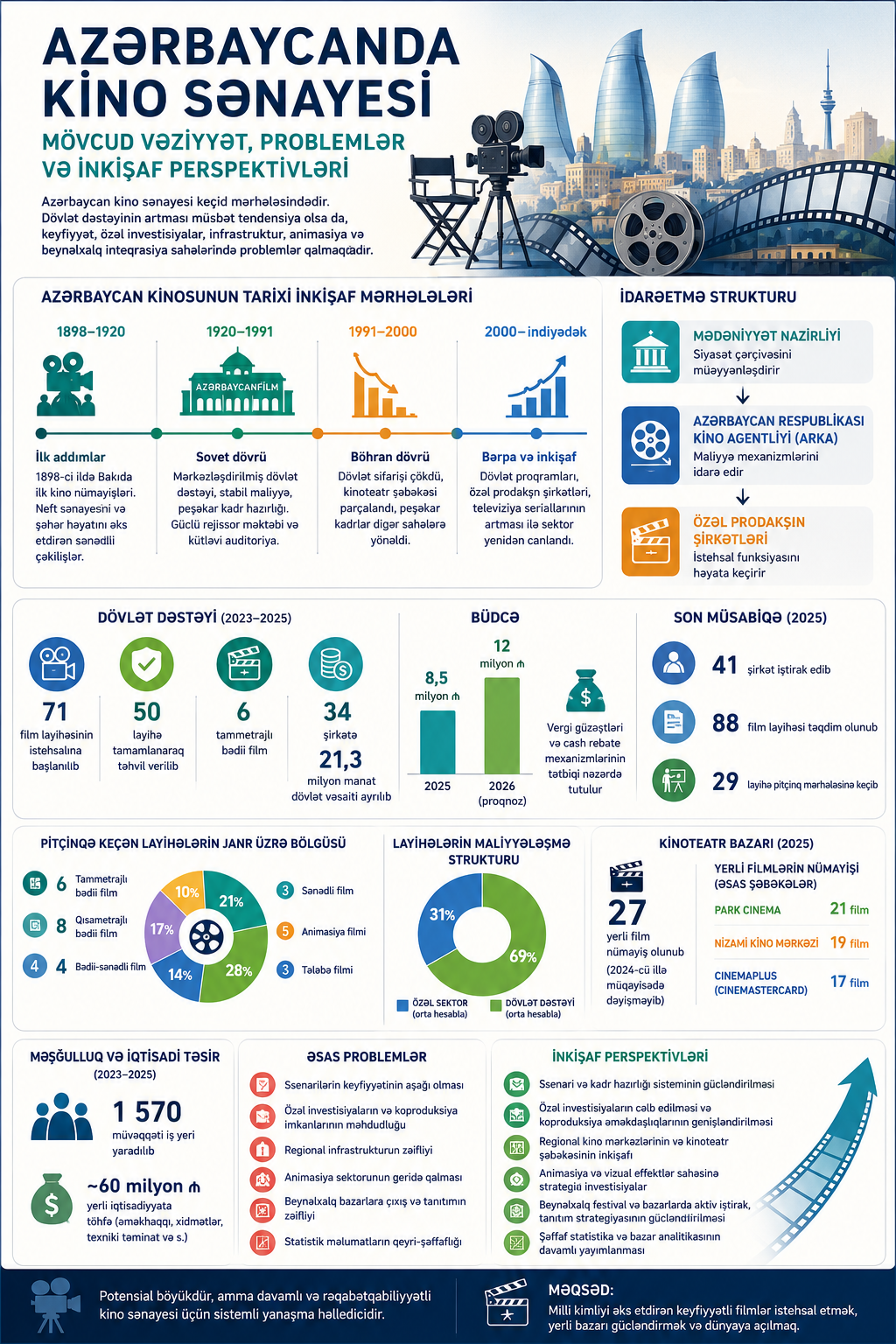
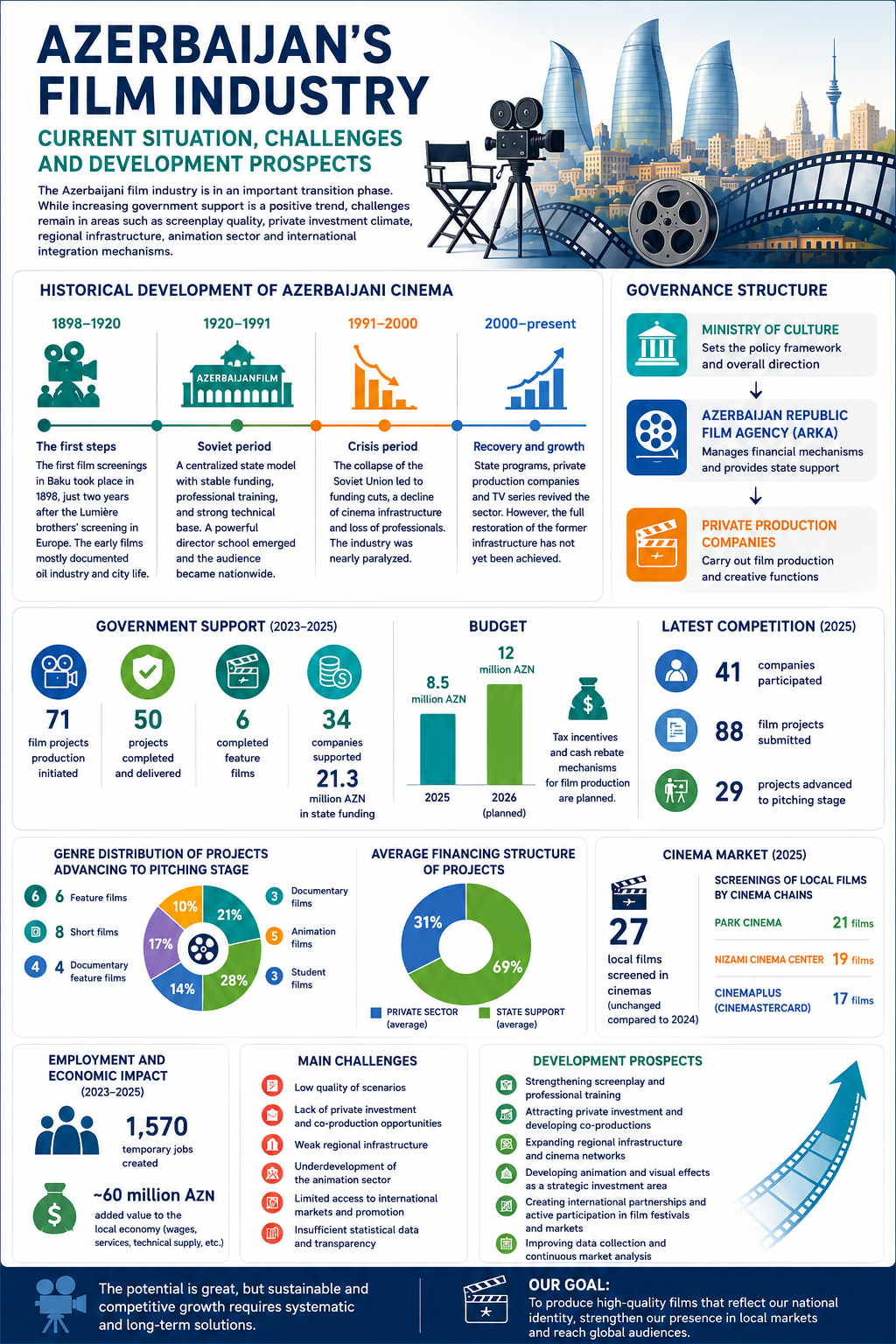
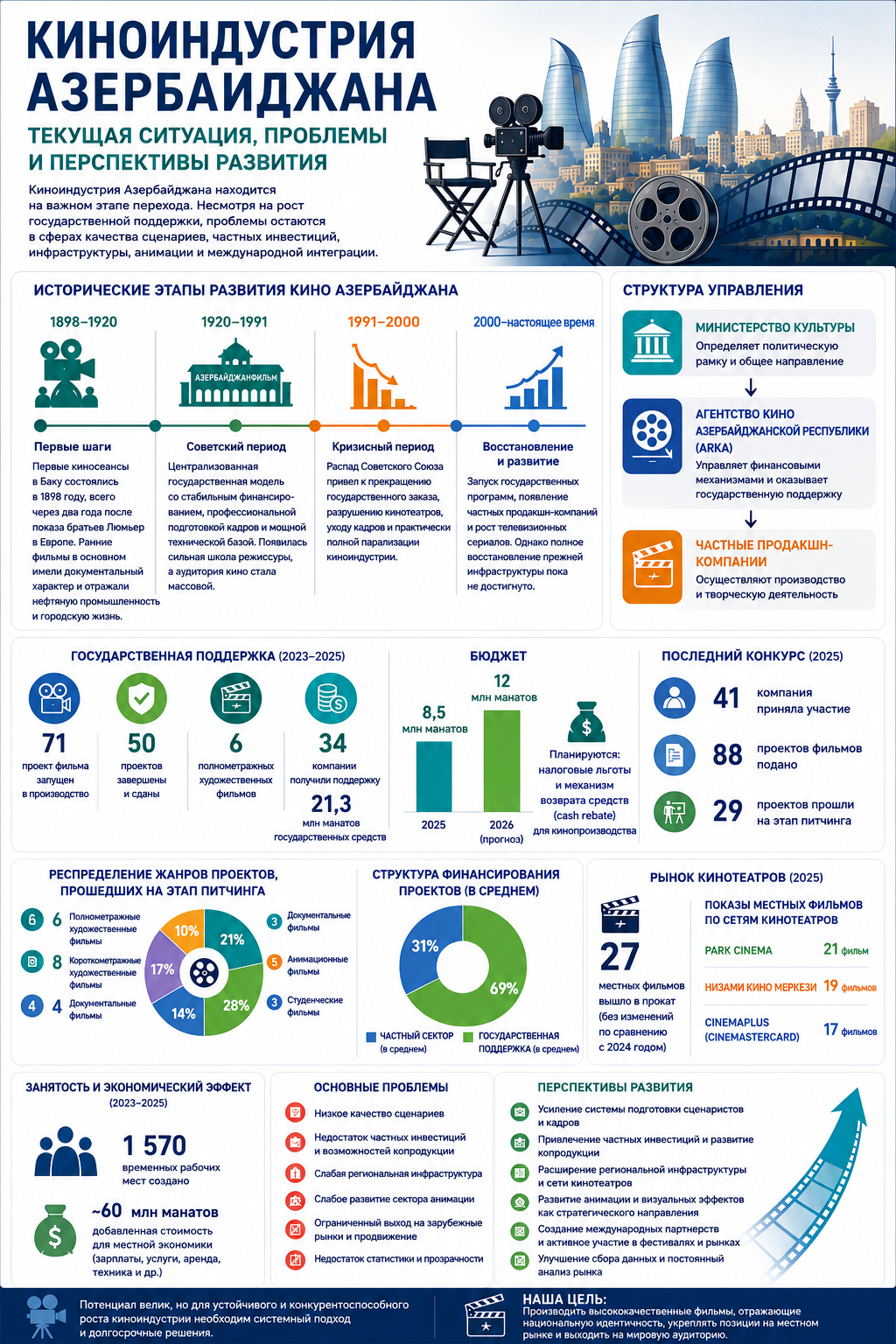
The management structure of Azerbaijan’s film industry consists of three levels: the Ministry of Culture of Azerbaijan defines policy frameworks, the Azerbaijan Cinema Agency manages financial mechanisms, and private production companies carry out direct production functions.
The new grant mechanism introduced by the Azerbaijan Cinema Agency after 2022 has expanded the sector’s financial base. Between 2023 and 2025, production began on 71 film projects with state support, of which 50 have already been completed and delivered. Six of these completed projects were feature-length films. A total of 21.3 million manats in state funding was allocated to 34 companies for project implementation.
In 2025, the Agency’s budget amounted to 8.5 million manats, while 12 million manats have been requested for 2026. In addition, tax incentives and cash rebate mechanisms for film production are planned.
In the latest state support competition organized by the Agency, 41 companies participated and submitted 88 film projects. Of these, 29 advanced to the pitching stage. Among the shortlisted projects were 6 feature films, 8 short films, 4 hybrid fiction-documentary films, 3 documentaries, 5 animated films, and 3 student films.
An analysis of the financing structure of these projects shows that on average 31 percent of budgets are formed by the private sector and 69 percent by state support. This demonstrates that state financing still plays a dominant role in the sector.
Cinema Market
In 2025, 27 local films were screened in Azerbaijan’s cinemas. This figure remained unchanged compared to 2024, indicating that opportunities for the distribution of domestic productions remain limited.
The screening figures by cinema chains were as follows:
- Park Cinema — 21 films
- Nizami Cinema Center — 19 films
- CinemaPlus (Cinemastercard) — 17 films
At the same time, significant statistical gaps remain in the sector. In Azerbaijan, annual box office revenues, the number of tickets sold, the total turnover of cinemas, and the market share of domestic films are not published openly. This makes it difficult to assess the real economic scale of the market.
The share of local films in the cinema market remains limited compared to foreign productions, mainly from Hollywood and Turkey.
The structural reasons behind low audience attendance are multifaceted:
Economic factors: the ratio of ticket prices to average household income Technological competition: Netflix, YouTube, and pirate content platforms Content quality: lack of genre diversity and low trust in local productions Geographical accessibility: absence of cinema infrastructure in regional districts
Employment and Economic Impact
Over the past two years, 1,570 temporary jobs have been created within the framework of film projects implemented in Azerbaijan. In 2026, an additional 800 jobs are expected to be created through projects planned for execution.
Analysis of available data shows that the number of active production companies in Azerbaijan’s film industry fluctuates between 30 and 40, while employment across projects exceeds 2,000 people.
These figures indicate that the film sector is gradually taking shape as a separate branch of the creative economy.
Animation Sector
Azerbaijani animation has deep historical roots. During the Soviet period, animation produced in Azerbaijan, especially children’s films, was considered strong in terms of quality. However, today this sector remains at an early stage of development.
By the end of 2025, the number of members of the Azerbaijan Animation Association had reached 50, of whom 46 were individuals and 4 were companies. During the year, 7 new members joined the association.
The inclusion of animation films as a separate category in the latest competitions organized by the Azerbaijan Cinema Agency can be considered an important step toward revitalizing the sector.
At the same time, production volume remains statistically very low. Countries such as Turkey, France, South Korea, and Japan generate billions of dollars annually in export revenues from animation, while Azerbaijan has yet to make use of its historical opportunity in this field.
Human Capital and Professional Training
Azerbaijan State University of Culture and Arts remains the country’s main institution for training film professionals. Bachelor’s and master’s degree programs exist in television directing, film directing, cinematography, and screenwriting.
However, the system has several structural shortcomings. The technical base of education often lags behind modern industry standards, the involvement of international teachers and experts is limited, and practical production experience has not yet become an integral part of the curriculum.
The shortage of specialists in the sector covers several critical areas:
Screenwriters: Dramaturgical quality remains a serious issue. Professional approaches to genre literature, dialogue writing, and character development remain limited.
Producers: There are very few professional producers capable of overseeing all stages of film production — creative, financial, and distribution.
Visual Effects (VFX) specialists: The VFX sector is almost non-existent, which hinders the development of genres such as science fiction, historical films, and animation.
Editors: Specialists proficient in modern non-linear editing technologies are limited.
Sound directors: Sound design, one of the core elements of post-production, requires specialized expertise, but this field remains underdeveloped.
In recent years, the migration of young Azerbaijani film professionals abroad has become a visible trend. A large number of Azerbaijani students admitted to film schools in cities such as Moscow, Istanbul, Paris, and Los Angeles do not return after graduation.
This represents not only a loss of talent but also a weakening of the industry’s ability to renew itself. Without an effective strategy to address brain drain, state investments in cinema will not solve this structural problem.
Turan Analytical Service believes that the most effective way to counter this is by creating “return programs.” International examples include the model of international diploma recognition used by Georgia’s film academy and the system in Turkey, where state scholarships for students studying abroad are tied to their return to the sector.
Creative Environment: Subject Selection and Genre Diversity
The most commonly used genre in Azerbaijani cinema is comedy. Everyday life stories, family dramas, occasional historical films, and war-related themes are among the main directions producers tend to pursue.
This choice partly reflects commercial interests, partly state commissioning policies, and partly traditional audience preferences.
At the same time, several genres and directions are practically absent in Azerbaijani cinema:
Science fiction — due to limited technical infrastructure and weak VFX capabilities.
Psychological drama — this genre requires deep character exploration, which is hindered by the weakness of the screenwriting base.
Crime genre — public sensitivity toward social themes restricts this field.
Social realism — issues such as economic inequality, migration, and marginalization are rarely addressed.
Biographical films — there are very few serious artistic works dedicated to national historical figures.
The Balance of Creative Freedom
The state commission model creates tension between creative freedom and strategic objectives. This is not unique to Azerbaijan — similar dynamics exist in countries such as China, Iran, and even France, where state support often comes together with certain content policies.
In open societies, the optimal model for maintaining this balance is based on one principle: the state finances infrastructure, not creative content itself.
In this context, transparent evaluation of how the grant mechanism of the Azerbaijan Cinema Agency operates is an important policy issue.
Private Sector
In recent years, the number of private production companies in Azerbaijan has increased. These companies are mainly established for commercial films, advertising production, and television serials.
However, serious private investment in artistic feature films remains extremely limited.
The main reasons for private investors’ lack of interest in the film industry are:
- the long return-on-investment period (3–7 years)
- the small size of the domestic cinema market
- the absence of international distribution channels
- the lack of tax incentives.
Participation in International Festivals
Azerbaijani films are periodically represented at festivals such as the Cannes Film Festival, the Berlin International Film Festival, Karlovy Vary International Film Festival, the Busan International Film Festival, and the Moscow International Film Festival.
However, this participation is not systematic. Budgetary support remains limited, and participation in international film markets such as Cannes Market, EFM, and AFM is almost non-existent.
The co-production sector also holds significant potential. Countries such as Turkey, Georgia, Kazakhstan, and various European states could become strategic co-production partners for Azerbaijan.
Yet this potential has not been systematically utilized.
The establishment of a Film Commission model — a mechanism designed to attract foreign film productions into the country — could become an important step in strengthening regional competitiveness.
International Comparison
To evaluate Azerbaijan’s film industry in a regional context, the Turan Analytical Service presents the following strategic comparison framework:
| Country | Annual Film Output | International Position | Market Reach |
| Azerbaijan | ~27 | Limited | Regional |
| Georgia | ~40–50 | Strong | International |
| Kazakhstan | ~60–80 | Medium-strong | Regional / International |
| Turkey | ~150+ | Very strong | Global |
Georgian cinema holds significantly stronger positions in the international festival arena than Azerbaijan. The hybrid financing model of the Georgian Film Center — combining state grants with private investments — has proven effective. Georgian films are regularly included in the official program of the Cannes Film Festival.
Azerbaijan could learn from this model by directing part of its state grants toward international co-productions, planning festival strategies on a long-term basis, and establishing a dedicated state program for film exports.
Kazakhstan, over the last decade, has declared cinema a strategic investment sector. The modernization of its studios, the establishment of a Film Commission system for foreign productions, and the integration of filming into urban infrastructure policies are among the factors that have positioned Kazakhstan ahead in regional competition.
Systemic Problems
The Turan Analytical Service summarizes the key structural problems of the industry, their urgency, and recommended solutions as follows:
| Problem | Level of Urgency | Recommended Solution |
| Screenwriting crisis | High | Strengthening national screenplay competitions |
| Staff shortage | High | Overseas education programs, development of local academies |
| Lack of private investment | High | Tax incentives, co-investment funds |
| Regional infrastructure | Medium | Establishing cinema centers in the regions |
| Decline of animation sector | Medium | Dedicated animation grants, technical infrastructure |
| International sales mechanisms | Medium | Film Commission, export agencies |
| Weak film studies ecosystem | Low–Medium | Professional journals, criticism platforms |
The Depth of the Screenwriting Crisis
The most serious structural problem of Azerbaijani cinema is the weakness of its screenwriting base. Many film subjects are developed without sufficient research, with weak character arcs and artificial dialogue.
This is a problem that cannot be solved through technical investment alone. It requires a long-term culture of writing, the development of screenwriting literature, and stronger dramaturgical education.
For comparison, Iran has achieved significant international recognition despite limited budgets. This success is based on intellectual depth in scripts and strong directorial vision.
Increasing Azerbaijan’s film budgets without improving script quality will not create a real qualitative breakthrough.
Strategic Recommendations
Short-term priorities (2025–2027)
Creation of a Film Development Fund
The current mechanism of the Azerbaijan Cinema Agency should be transformed into a Film Fund model in order to reduce dependence on the state budget.
This fund should have a multi-source financing architecture, including:
- a percentage of cinema ticket sales
- state contributions
- private sector contributions
This model would provide a more sustainable financial foundation for the industry.
Screenwriting Development Program
An annual national screenplay competition should be established, with winning scripts receiving professional development support and opportunities to participate in international screenplay laboratories.
This could become the first systemic step toward solving the screenwriting crisis.
Tax Incentive Package
Providing tax incentives to companies investing in film production would be one of the most effective short-term tools for attracting private capital into the industry.
Medium-term Goals (2027–2030)
Establishing a Film Commission System
A unified one-stop service should be created for foreign production companies seeking to shoot in Azerbaijan.
This system should include:
- simplified filming permits
- tax rebate mechanisms
- administrative support
This would mean direct foreign currency inflows, transfer of technical knowledge, and employment opportunities for local professionals.
Creation of Regional Cinema Centers
In major regional hubs such as Ganja, Lankaran, Shaki, and Nakhchivan, multifunctional cinema centers should be established.
This would both expand the audience base and foster film culture in the regions.
Activation of Co-production Funds
Bilateral co-production agreements should be signed with the film agencies of Turkey, France, Georgia, and Kazakhstan, with joint funds created under these agreements.
Long-term Vision: National Cinema Strategy 2035
For the sustainable long-term development of Azerbaijan’s film industry, a strategic national document must be prepared.
This document should cover the following priority directions:
Creation of an Animation Cluster
A technical infrastructure base should be established in Baku, including animator training centers and export-oriented children’s content development.
Film Export Program
For Azerbaijani films, it is necessary to create:
- an international sales agency
- state support for subtitling
- professional management of festival strategies
Transforming Azerbaijan into a Regional Film Hub
The geopolitical position of Baku offers a unique opportunity to access post-Soviet, Muslim-world, and European markets simultaneously.
Using this advantage could transform the country into a strategic regional center for film production.
Institutionalizing Film Studies
It is necessary to establish:
- a scientific journal on cinema
- a national film archive
- professional criticism platforms.
Final Assessment
Azerbaijan’s film industry possesses a strong foundation both in terms of historical legacy and future potential. The institutional memory of the Soviet era, increased state investments in recent years, and the emergence of a young creative generation are all part of the essential conditions for growth.
At the same time, existing challenges — the screenwriting crisis, shortage of professional staff, weak private investment, lack of regional infrastructure, and absence of international sales mechanisms — require a systematic political approach.
The comparative analysis of the Turan Analytical Service shows that countries such as Georgia and Kazakhstan have advanced more quickly in areas where Azerbaijan could gain strategic competitive advantages.
Closing this gap requires not only financing, but also institutional reform, the preservation of intellectual capital, and open support for the creative environment.
If implemented correctly, Azerbaijan could become the leading film production center of the South Caucasus. This would not only represent cultural prestige, but also serve as a powerful instrument for the development of the creative economy, tourism, and soft power policy.


Social
-
Field observation conducted on the coast near the settlement of Pirshaghi. August 2026 “It’s not as if this is your place...” This analysis begins not with figures, but with an ordinary observation. On the Caspian coast, near the settlement of...
-
Looking down on the northern Absheron coast, it is difficult not to notice a pattern. Azerbaijan's most restricted government compound — the presidential residence in Zagulba — is located neither in central Baku, nor amid the oilfields, nor even on...
-
The Road from Absolutism to Constitutional Government The Iranian Constitutional Movement (Mashruteh), which unfolded in the early twentieth century, is regarded as one of the most important turning points in the political modernization of the...
-
Higher education continues to improve a person’s chances of finding work. However, the gap between academic programmes and employers’ needs, the lack of practical experience and the limited number of quality jobs make it difficult for young...


Leave a review