


Generated by AI

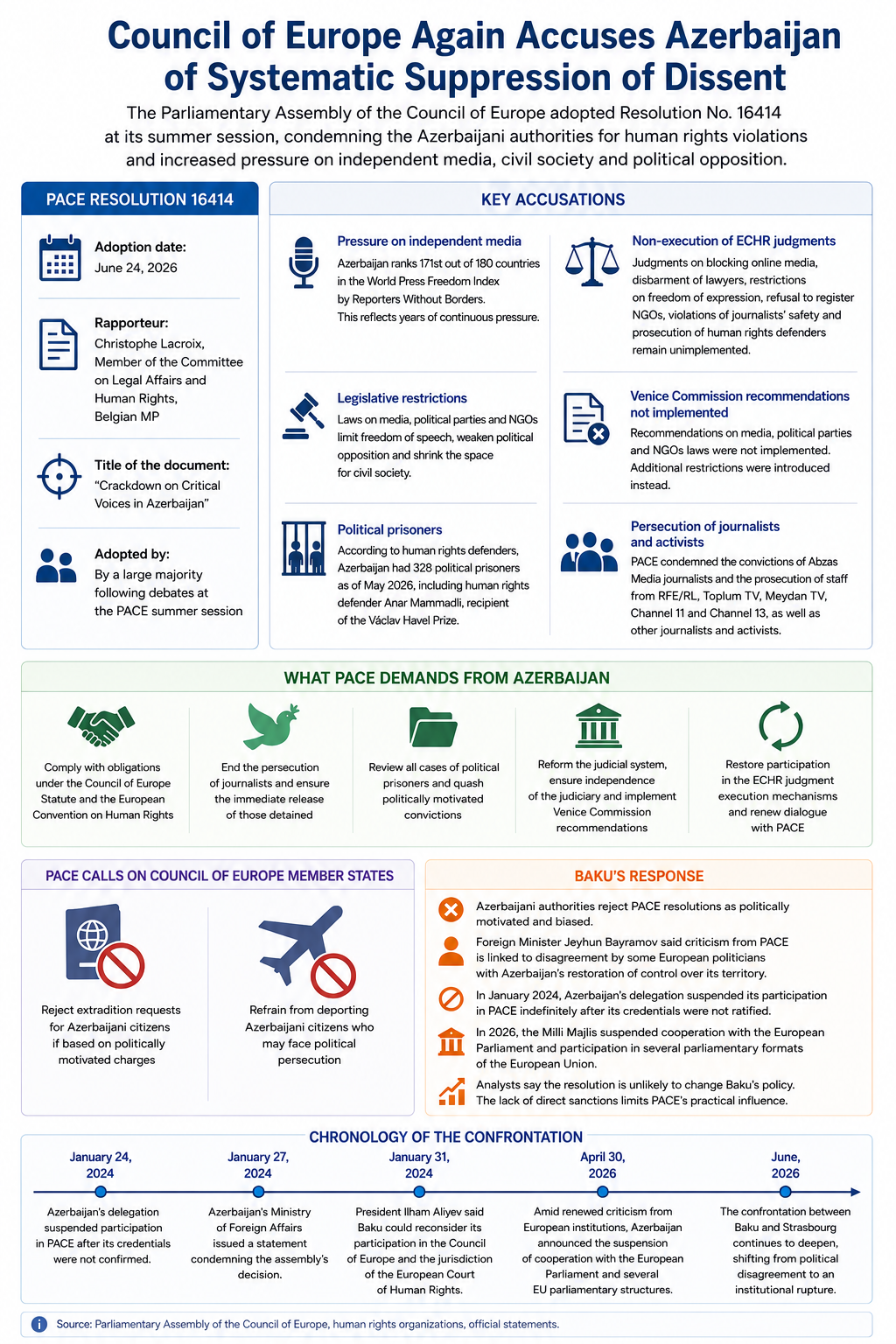
The Parliamentary Assembly of the Council of Europe adopted Resolution No. 16414 during its summer session, condemning the Azerbaijani authorities for human rights violations, increasing pressure on independent media, civil society, and political opposition.
The document, titled “Crackdown on Critical Voices in Azerbaijan,” was prepared by Christophe Lacroix, a member of the Committee on Legal Affairs and Human Rights, and was approved by a majority of the assembly following debate.
In the adopted resolution, the assembly said it was “deeply dismayed by the systematic practice of suppressing dissent and independent voices,” which it said had become firmly entrenched in Azerbaijan.
The document notes that Azerbaijan ranks 171st out of 180 countries in the annual World Press Freedom Index published by Reporters Without Borders. According to PACE, this ranking reflects years of continuous pressure on independent media and constitutes evidence of systematic violations of freedom of expression guaranteed under Article 10 of the European Convention on Human Rights.
The assembly expressed concern over legislative restrictions introduced through laws on media, political parties, and non-governmental organizations. According to the resolution, these measures have weakened independent journalism, reduced the political space for opposition, and restricted the activities of civil society organizations.
The document states that Azerbaijan currently has no independent media outlets operating in the country and that 36 journalists and media workers are in detention.
PACE also said it regretted Baku’s decision to suspend participation in the assembly instead of implementing the recommendations outlined in Resolution 2527 (2024) concerning compliance with human rights obligations.
Particular attention in the document is given to Azerbaijan’s longstanding failure to implement judgments of the European Court of Human Rights. These include cases related to unlawful blocking of online media, arbitrary disbarment of lawyers, misuse of criminal law to restrict freedom of expression, unlawful refusal to register civil society organizations, violations of journalists’ safety, and criminal prosecution of human rights defenders.
The assembly stressed that implementation of these judgments requires not only redress for the individual applicants, but also institutional reforms aimed at preventing similar violations in the future.
PACE also noted that none of the recommendations of the Venice Commission concerning the laws on media, political parties, and non-governmental organizations had been implemented.
Instead, according to the resolution, further restrictions have been introduced, including simplified procedures for shutting down foreign media branches, stricter rules on media registration and naming, and effective barriers preventing non-governmental organizations from obtaining international funding.
The assembly said these measures have intensified pressure not only on media organizations but on the broader civic space in Azerbaijan.
A separate section of the resolution addresses political prisoners. According to human rights defenders cited by PACE, Azerbaijan had 328 political prisoners as of May 2026.
Among those mentioned is Anar Mammadli, recipient of the Václav Havel Human Rights Prize.
The assembly also condemned the convictions handed down to journalists of independent outlet Abzas Media and expressed concern over the continued prosecution of staff from other independent media organizations, including Radio Free Europe/Radio Liberty, Toplum TV, Meydan TV, Channel 11, and Channel 13.
The resolution also lists journalists, bloggers, opposition activists, and human rights defenders whose arrests have raised concern within PACE, including Gubad Ibadoghlu, Akif Gurbanov, Alasgar Mammadli, Ruslan Izzatli, Farid Mehralizade, Bakhtiyar Hajiyev, and Ali Karimli.
In response, PACE urged Azerbaijan to comply with its international obligations under the Statute of the Council of Europe and the European Convention on Human Rights, to end the prosecution of journalists, review the cases of political prisoners, reform the judicial system, and restore participation in mechanisms overseeing the implementation of European Court of Human Rights judgments.
The assembly also called on the Milli Majlis to resume dialogue with PACE in order to address the concerns outlined in the resolution.
In addition, the document calls on Council of Europe member states to reject extradition requests for Azerbaijani citizens if they are based on politically motivated charges and to refrain from deporting individuals who may face political persecution.
Baku’s Response
Azerbaijani authorities have consistently rejected such resolutions, describing them as politically motivated and biased.
Foreign Minister Jeyhun Bayramov has previously said criticism from PACE reflects disagreement among some European politicians over Azerbaijan’s restoration of control over its territory.
Baku’s practical response to the confrontation with PACE was its decision in January 2024 to suspend its delegation’s participation indefinitely after its credentials were not ratified.
In 2026, the confrontation widened. Following another round of criticism from European institutions, the Milli Majlis suspended cooperation with the European Parliament and participation in several parliamentary frameworks of the European Union.
Analysts say the latest resolution is unlikely to alter Baku’s policy course. Despite repeated criticism from Strasbourg, the absence of direct enforcement mechanisms significantly limits PACE’s practical influence on Azerbaijan’s domestic policy.
Timeline of Confrontation
January 24, 2024 — Azerbaijan’s delegation suspended participation in PACE after its credentials were not confirmed.
January 27, 2024 — Azerbaijan’s Foreign Ministry issued a statement condemning the assembly’s decision.
January 31, 2024 — President Ilham Aliyev said Baku could reconsider its participation in the Council of Europe and the jurisdiction of the European Court of Human Rights if the delegation’s rights were not restored.
April 30, 2026 — amid renewed criticism from European institutions, Azerbaijan announced the suspension of cooperation with the European Parliament and several European Union parliamentary structures.
As of June 2026, the confrontation between Baku and Strasbourg continues to deepen, shifting from political disagreement toward a broader institutional rupture.


Express analysis
-
Trials involving politicians, civil society representatives and journalists 1. On August 6, the Narimanov District Court, chaired by Judge Gultekin Asadova, considered a submission from Correctional Facility No. 10 concerning detained civic activist...
-
The high figure in the state employment system points not only to demand for workers, but also to gaps in pay, skills, geography and the expectations of labour market participants. Azerbaijan’s Ministry of Labour and Social Protection said more than...
-
Azerbaijani President Ilham Aliyev has signed a decree establishing a Media and Broadcasting Council, a single state body that will assume the powers of the abolished Media Development Agency and Audiovisual Council. The authorities present the...
-
Azerbaijani President Ilham Aliyev has ordered the creation of an organising committee for the Azerbaijan International Investment Forum, signalling an effort to turn the event into a regular platform for engagement with global investors and to...


Leave a review