


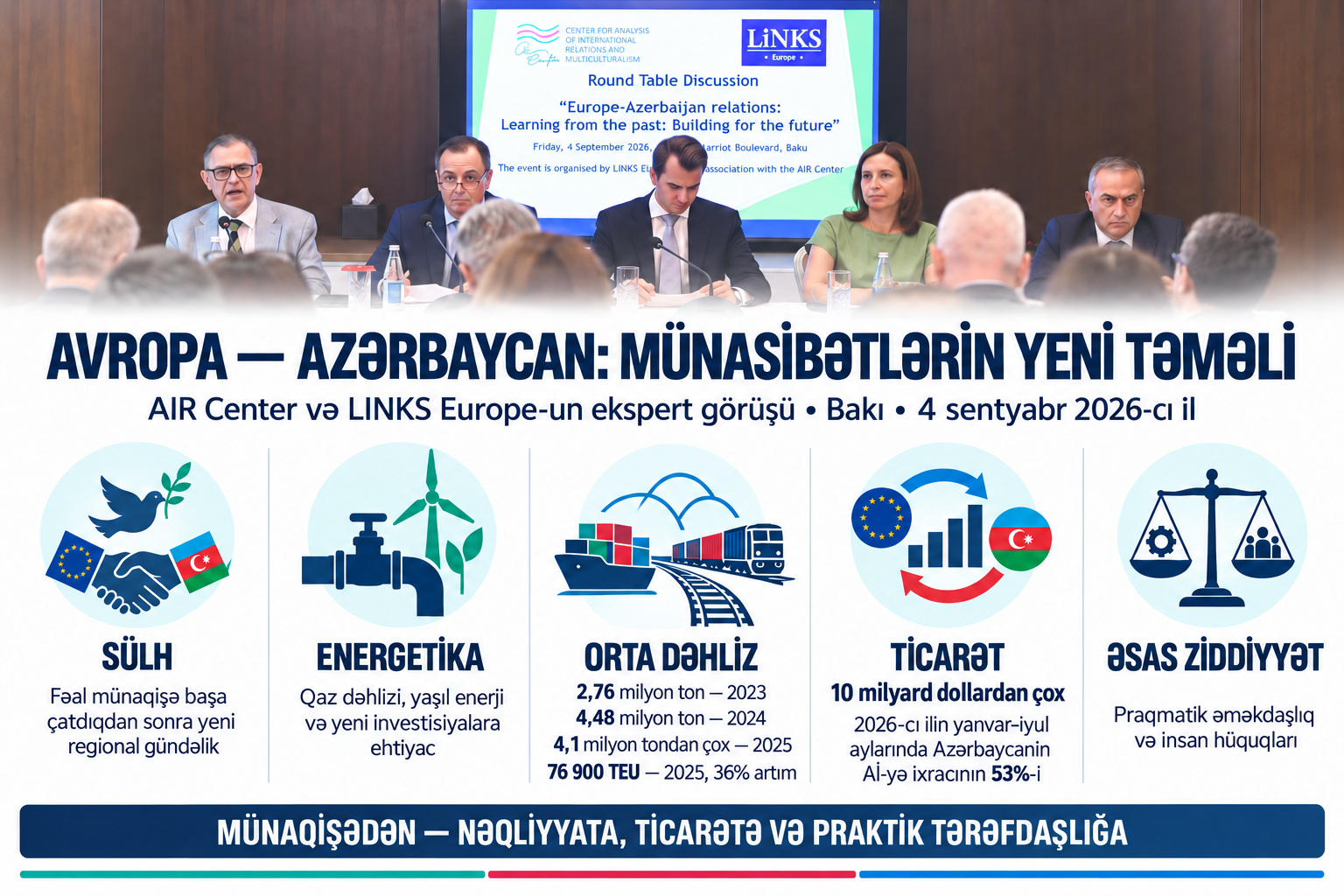
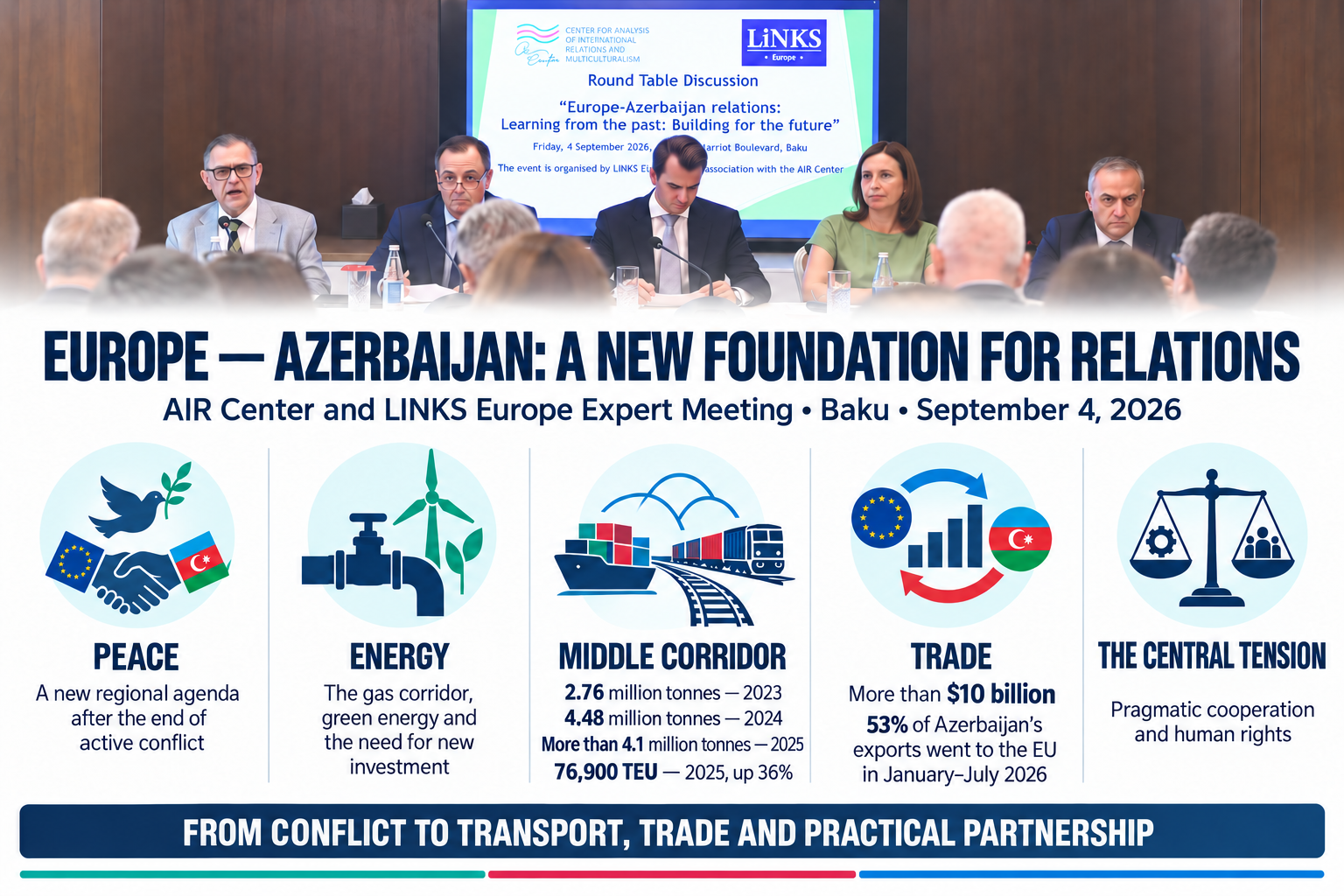
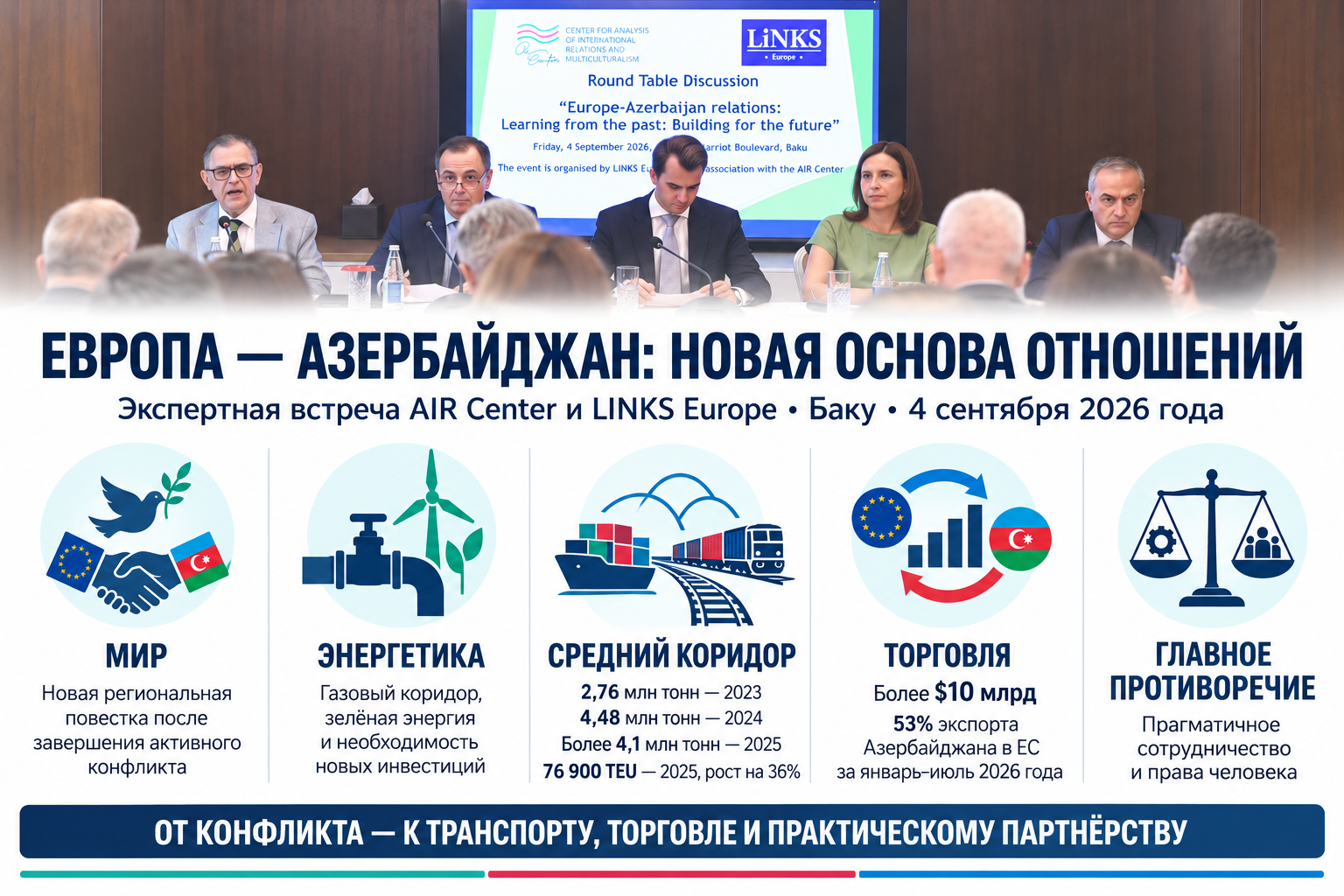
Round table "Europe—Azerbaijan: learning from the past, building the future". The background is created by AI

Europe and Azerbaijan Seek a New Foundation for Relations — Between Gas, Peace and Human Rights
At an expert meeting in Baku, Azerbaijani and European representatives spoke of the end of an era defined by conflict and the beginning of one centered on transport and economic cooperation. But the most difficult questions — a new agreement with the European Union, political freedoms and the limits of pragmatism — remained outside the boundaries of public consensus.
For nearly three decades, Azerbaijan’s relationship with Europe developed in the shadow of the conflict over Karabakh. Discussions about energy, trade and political reform inevitably returned to war, displaced people and attempts at international mediation.
At an expert meeting held in Baku on Sept. 4, organizers proposed viewing the relationship differently: not through the prism of the conflict of the past, but through the opportunities that peace might create.
The roundtable, “Europe-Azerbaijan Relations: Learning From the Past, Building for the Future,” was organized by Azerbaijan’s Center of Analysis of International Relations, known as the AIR Center, and the LINKS Europe Foundation. It brought together diplomats, government officials, academics and experts to discuss energy, trade, the Middle Corridor, Baku’s relations with Brussels and the prospects for peace between Azerbaijan and Armenia.
Yet beneath the optimistic language of a new beginning lay a more complicated reality. Azerbaijan and the European Union increasingly need each other, but their visions of the future partnership remain different.
Europe needs non-Russian energy supplies, access to Central Asia and a stable route across the South Caucasus. Azerbaijan is seeking European investment, technology, markets and recognition of its growing regional role. But Brussels continues to raise questions about human rights, judicial independence and press freedom, while Baku insists on equality, noninterference in domestic affairs and the rejection of political conditions.
The meeting demonstrated how far the two sides have progressed in defining their common interests — and how carefully they continue to navigate their disagreements.
A New Chapter After Three Decades of Conflict
Dennis Sammut, the director of LINKS Europe, who first visited Azerbaijan in 1996, recalled how different the country looked at the time: The consequences of war shaped its domestic politics, its relations with its neighbors and its engagement with Europe.
For nearly 30 years, he said, the conflict between Armenia and Azerbaijan defined the region’s political agenda. Now, the prospect of peace offers a chance to open “a new chapter.”
Mr. Sammut called for Europe-Azerbaijan relations to be built on shared interests, economic opportunity, stability and peace. He also acknowledged that the European Union should have established a stronger and more lasting presence in Azerbaijan earlier.
That acknowledgment reflects a broader shift in Europe’s view of the South Caucasus. Once treated as a peripheral part of European foreign policy, the region now lies at the intersection of several major forces: Russia’s war against Ukraine, the search for alternative gas supplies, competition over access to Central Asia and efforts to establish transport routes that bypass Russian territory.
Farid Shafiyev, chairman of the AIR Center, also linked the future of the relationship to the new geopolitical landscape. He recalled the importance of the Partnership and Cooperation Agreement signed by Azerbaijan and the European Union in 1996 and brought into force in 1999, but emphasized the need for a new comprehensive accord.
Negotiations on such an agreement began in 2017, yet nine years later it still has not been signed. During European Council President António Costa’s visit to Baku in March, the two sides again promised the “swift conclusion” of the negotiations.
The length of the talks points less to a lack of interest than to the difficulty of reconciling two different political models. Azerbaijan is not seeking membership in the European Union and is unwilling to adopt the association model chosen by Ukraine, Georgia and Moldova. Baku is offering a partnership that would not require transferring part of its political or regulatory sovereignty to European institutions.
Peace as an Economic Strategy
Elshad Iskandarov, an ambassador-at-large at Azerbaijan’s Foreign Ministry, said that active conflict was being replaced on the regional agenda by peacebuilding, diplomacy, people-to-people contacts and cooperation between civil societies.
But he warned that peace must be supported by concrete action and that efforts to undermine the process remain a threat.
Mr. Shafiyev expressed the warning more sharply. He said humanitarian issues should not be used by media organizations or institutions to return the Karabakh issue to the international agenda in a way that might weaken the prospects for lasting peace.
It is here that one of the central contradictions of the new era becomes visible. For Baku, the Karabakh conflict is over and should not be revived as a vehicle for foreign political pressure. Some European institutions, however, continue to regard the humanitarian consequences of the conflict and compliance with human rights standards as legitimate subjects of dialogue.
The published account of the meeting did not pursue that debate. Attention instead shifted toward economics: reopening routes, restoring connections and creating a degree of interdependence that would raise the cost of any renewed conflict for all sides.
Marijana Kujundžić, the head of the European Union delegation to Azerbaijan, described the country as an important and reliable European partner. The growing number of visits and diplomatic contacts, she said, showed that the relationship was becoming more dynamic and gradually expanding beyond energy.
She emphasized Azerbaijan’s strategic role as a link between Europe, the Caspian region and Central Asia. That idea became perhaps the meeting’s strongest unifying theme.
From Transit Route to Development Corridor
The war in Ukraine has increased the importance of the Middle Corridor, a route linking China and Central Asia with Europe through the Caspian Sea, Azerbaijan, Georgia and Turkey.
Roza Bayramli, a senior adviser at the AIR Center, said freight transported along the Trans-Caspian International Transport Route increased from 2.76 million tons in 2023 to 4.48 million tons in 2024. Volumes remained above 4.1 million tons in 2025, while container traffic rose by 36 percent to about 76,900 twenty-foot-equivalent units.
But the growth in cargo volumes has also exposed weaknesses: limited port capacity, differences in tariffs and customs procedures, a shortage of ships, border delays and the need to reload containers several times.
Ms. Bayramli said the next phase would require coordinated investment in ports, railways, logistics, digitalization and customs infrastructure. The Middle Corridor, she argued, should become not merely a transit route but a development corridor around which trade, industrial centers and cross-border production chains could emerge.
Vasif Huseynov, a department head at the AIR Center, called on the European Union to support its declarations of interest with practical investment. He connected the development of regional infrastructure with Azerbaijan’s strategic autonomy — its ability to work simultaneously with Europe, Turkey, Central Asia and other centers of power without becoming exclusively dependent on any one of them.
For the European Union, the Middle Corridor offers an alternative to Russian transport networks. For Azerbaijan, it is a means of strengthening its political and economic importance.
But the route’s success depends on more than ports and railways. It requires lasting peace between Azerbaijan and Armenia, agreed rules for border controls and the reopening of regional communications. In that sense, peace is increasingly being treated not only as a diplomatic objective but also as an infrastructure project.
Energy Remains the Foundation
Despite efforts to broaden the agenda, relations between Azerbaijan and the European Union continue to rest primarily on an oil-and-gas foundation.
After the reduction in Russian supplies, the Southern Gas Corridor acquired additional importance for Europe. Azerbaijani gas cannot fully replace Russian supplies, but it offers an alternative source and route, reducing European countries’ reliance on a single supplier.
Mr. Huseynov referred to the 2022 memorandum that called for an increase in Azerbaijani gas exports to Europe. Expanding supplies further, he said, would require investment in production and transport infrastructure.
Here, the interests of the two sides overlap only partly. Azerbaijan needs long-term contracts to guarantee returns on new projects. The European Union needs gas but has also promised to reduce its consumption substantially as part of the transition to a lower-carbon economy. European companies are wary of making commitments that could remain in force beyond the period of strong demand for fossil fuels.
At the same time, the two sides are discussing Caspian offshore wind power, solar generation, green hydrogen and an undersea electricity cable across the Black Sea. For now, however, those projects supplement rather than replace the oil-and-gas foundation of the relationship.
Trade Is Large but Lopsided
Economic interdependence has already reached a significant level. Aykhan Gadashov, the head of Azexport, said that more than $10 billion, or 53 percent, of Azerbaijan’s exports went to the European Union during the first seven months of 2026.
But most of those shipments were related to energy. Azerbaijan sells Europe mainly oil and gas, while importing industrial equipment, vehicles, chemicals and technology.
Mr. Gadashov pointed to the potential for expanding nonenergy exports. But doing so will require more than promoting Azerbaijani products. It will also demand closer technical standards, greater transparency in the business environment and more predictable competition rules.
The trade section remains one of the most difficult elements of the proposed agreement. Azerbaijan applied to join the World Trade Organization in 1997, but the process has yet to be completed. That complicates negotiations over state subsidies, public procurement, tariffs and investment protections.
The Missing Subject
Anar Valiyev, an associate professor at ADA University, spoke about the generally positive view of the European Union among Azerbaijanis, especially in the field of education. European countries remain attractive destinations for Azerbaijani students, while academic and people-to-people contacts could give the relationship a stronger social foundation.
But the published account largely omitted a subject that regularly causes tension between Baku and European institutions: political freedoms.
In the European Union’s report on human rights and democracy, European institutions expressed concern about restrictions on independent news media and civil society, the arrests of journalists and activists and the condition of the judicial system.
Azerbaijan rejects such criticism as selective and politicized. Its officials also draw a distinction between the European Parliament, which adopts sharply worded resolutions, and the more pragmatic European Union institutions that negotiate over gas, trade and transport projects.
That dual approach allows the relationship to develop, but it also limits its depth.
A Partnership Without Illusions
The meeting in Baku ended with a question-and-answer session. No resolution, joint declaration or detailed road map was published. Its primary result was the articulation of a new concept for the relationship: less conflict, more trade, transport, energy and practical cooperation.
It is a realistic model, but not necessarily a simple one.
The European Union wants to purchase gas, establish new routes to Central Asia and preserve its reputation as a community founded on law and democracy. Azerbaijan wants the benefits of the European market, investment and technology without accepting external restrictions on its domestic policies.
A new comprehensive agreement could formalize the interests the two sides share. It could cover energy, transport, digitalization, education, investment and climate policy, while leaving the most contentious trade and human rights questions to separate mechanisms of dialogue.
But an agreement is unlikely to eliminate the fundamental divide. Relations between Azerbaijan and Europe are entering a new period not because the two sides have reached a common understanding of values, but because a changing world has made cooperation more necessary.
In Baku, the participants spoke about the future. But the durability of that future will depend on whether both sides can discuss not only what brings them together, but also the subjects on which they still find it more convenient to remain silent.


Europe
-
An exchange of sharp accusations between Azerbaijani and Polish public television channels has prompted a diplomatic protest from Baku and exposed deeper disagreements between the two countries, ranging from their assessments of human rights to the...
-
King Harald V left his successors not a political programme, but a vision of Norway as an open community of equal citizens. Haakon VIII will have to preserve that model amid declining confidence in the royal family and growing demands for...
-
Baku and Brussels intend to accelerate work on a new comprehensive agreement. But energy security and transport interests are bringing the two sides together far faster than trade rules, political reform and human rights. When the president of the...
-
The European Union said the human rights and democracy situation in Azerbaijan remained difficult in 2025, pointing to restrictions on civil society and media activities as well as concerns about the independence of the judiciary. The assessment was...


Leave a review