


Generated by AI

Escalation Without Limits: Strike on Kyiv-Pechersk Lavra Raises Stakes Ahead of G7 Summit
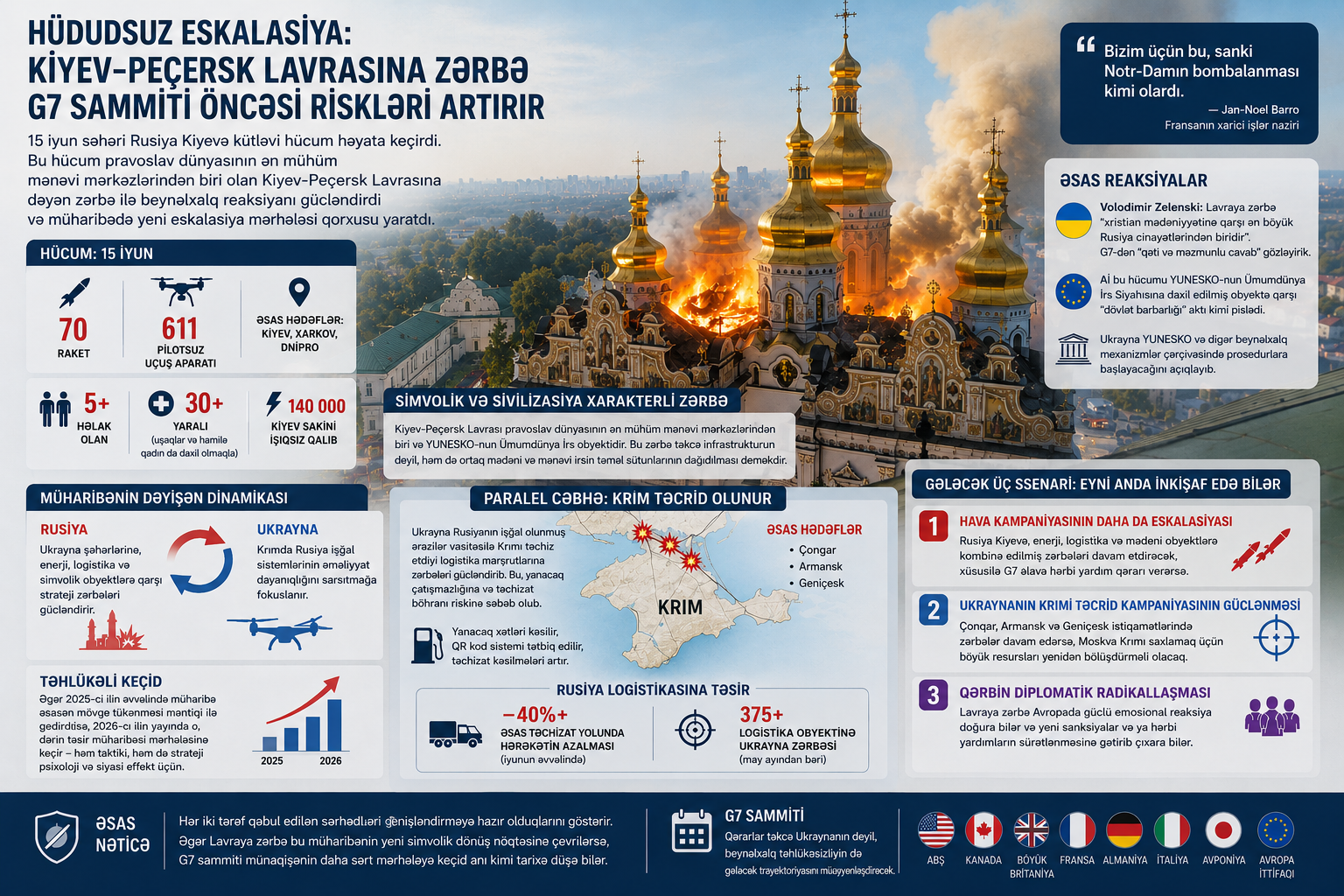
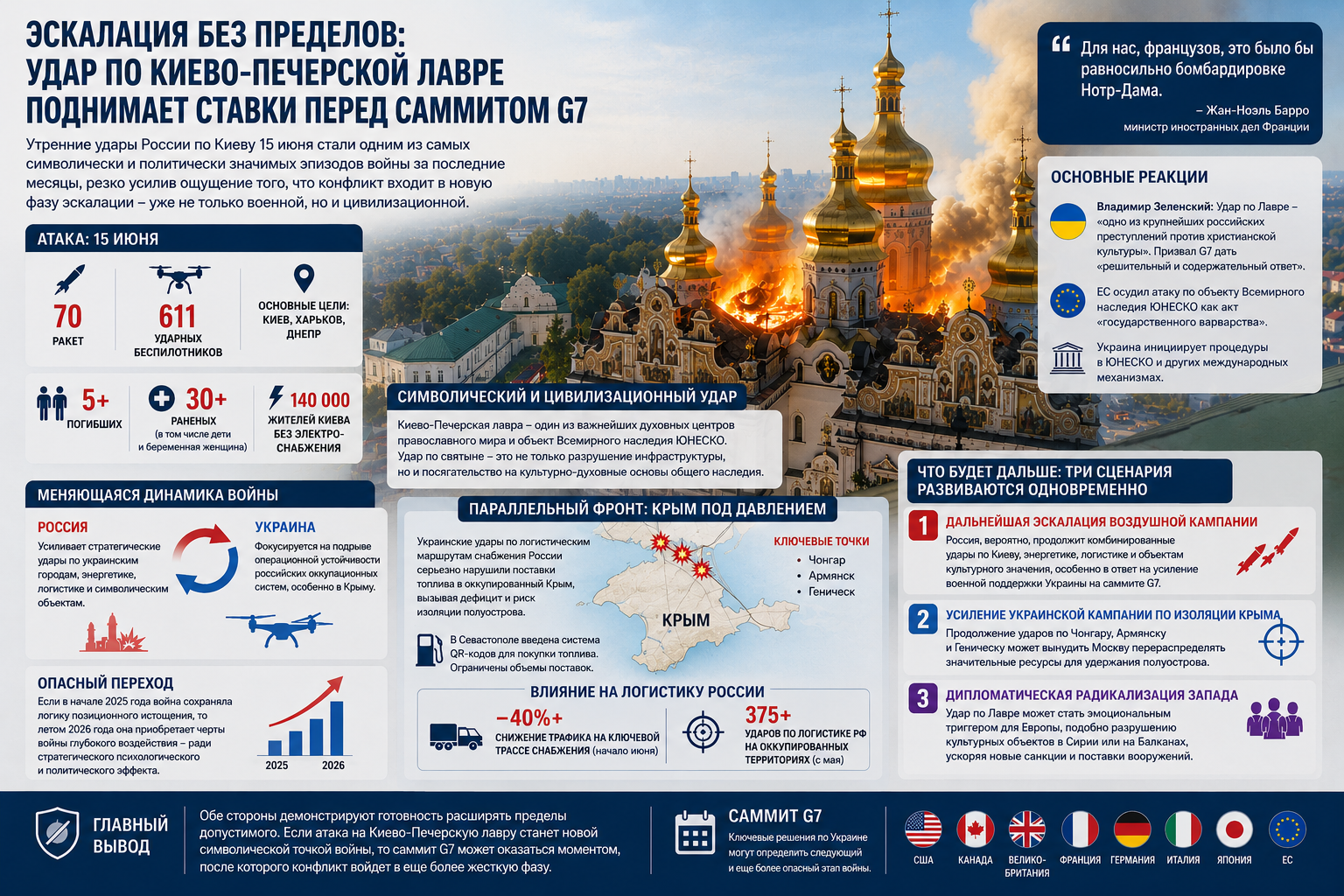
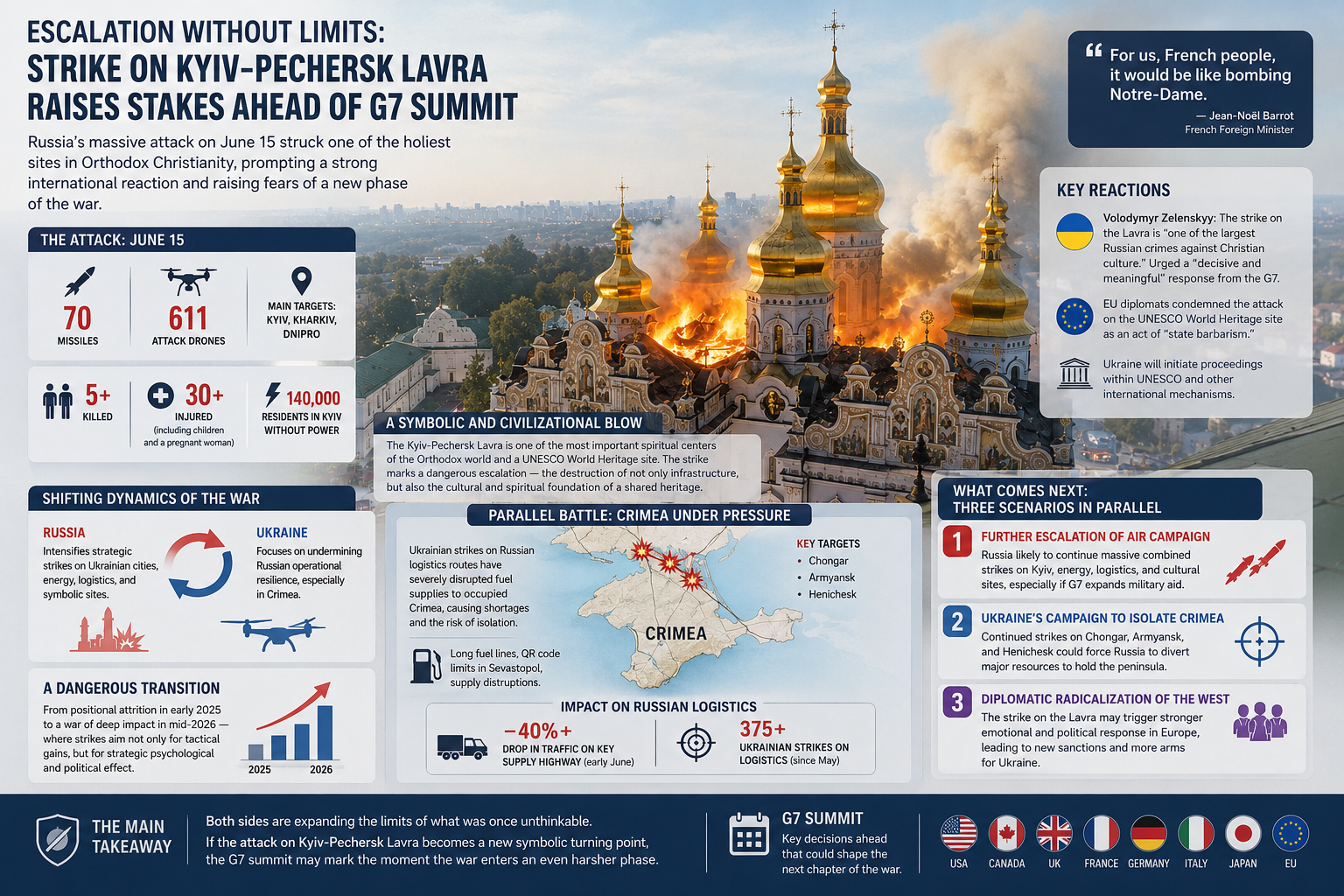
Russia’s morning strikes on Kyiv on June 15 have become one of the most symbolically and politically significant episodes of the war in recent months, sharply reinforcing the sense that the conflict is entering a new phase of escalation — no longer only military, but civilizational.
According to Ukrainian authorities, Russia launched 70 missiles and 611 attack drones across Ukraine, making Kyiv the primary target. At least five people were killed and dozens injured. Kharkiv and Dnipro also came under attack. Russia’s Defense Ministry said the targets were military-industrial facilities and military infrastructure, describing the strikes as retaliation for what it called “terrorist acts by the Kyiv regime.”
But the main political consequence of the attack was not the number of missiles or even the scale of destruction, but the strike in the area of Kyiv Pechersk Lavra — one of the most important spiritual centers of the Orthodox world and a UNESCO World Heritage site.
The fire that broke out on the roof of the Assumption Cathedral quickly became one of the most powerful symbolic episodes of the war. For Ukraine, it was a strike against national and religious identity. For Russia, it was a strike against a shrine that for centuries had remained part of the shared spiritual space of the Russian Orthodox tradition. That is what makes the incident unprecedented: the war is increasingly destroying not only infrastructure, but also the cultural foundation of a shared historical legacy.
French Foreign Minister Jean-Noël Barrot compared the strike on the Lavra to the hypothetical bombing of Notre-Dame Cathedral for France. The comparison quickly became central to Europe’s diplomatic reaction.
From a political standpoint, the timing is highly sensitive. The attack took place literally on the eve of the Group of Seven summit, where Ukraine and the question of further military support for Kyiv remain among the key agenda items. Ukrainian President Volodymyr Zelenskyy has already directly linked the strike to the need for a “decisive response” from Western leaders.
For Moscow, the timing appears far from accidental. Russia’s strategy, judging by the intensity of the strikes and the widening list of targets, increasingly revolves around demonstrating its ability to raise the cost of war ahead of every major international diplomatic event. At the same time, Ukraine is intensifying pressure on Russian logistics in Crimea, where strikes on overland supply routes have already begun creating fuel shortages and operational constraints.
This parallel process is creating a new dynamic in the conflict. Russia is increasing strategic strikes on Ukrainian cities and symbolically significant sites. Ukraine, in turn, is focusing on undermining the operational resilience of Russian occupation systems, particularly in Crimea.
As a result, the conflict is gradually shifting from front-line attrition toward mutual destruction of critical infrastructure, logistics and political symbols. This is a dangerous transition.
If at the beginning of 2025 the war largely retained the logic of positional attrition, by the summer of 2026 it is increasingly taking on the characteristics of a war of deep impact — where strikes are carried out not only for tactical advantage, but for strategic psychological and political effect.
What Comes Next
In the coming weeks, three scenarios are likely to unfold simultaneously. The first is a further escalation of the air campaign. Russia will likely continue combined strikes on Kyiv, energy infrastructure, logistics hubs and cultural sites, especially if the G7 summit decides to expand military aid to Ukraine.
The second is the intensification of Ukraine’s campaign to isolate Crimea. If strikes on Chonhar, Armyansk and Henichesk continue, Moscow may face the need to redirect substantial resources to maintain control over the peninsula.
The third is the diplomatic radicalization of the West. The strike on the Lavra could become an emotional trigger for Europe, similar to the destruction of cultural heritage sites in Syria or the Balkans, accelerating new sanctions and expanded military deliveries.
The main conclusion at this stage is that both sides are demonstrating a readiness to expand the limits of what had previously been considered unacceptable.
And if the attack on Kyiv Pechersk Lavra becomes a new symbolic turning point in the war, then the Group of Seven summit may prove to be not merely a diplomatic meeting, but a moment after which the conflict enters an even harsher phase.


Express analysis
-
Deputy Minister of Digital Development and Transport Samaddin Asadov met a delegation from CITIC Group, one of China’s leading state-owned companies. The delegation was headed by CITIC Group Vice-President Benjamin Bao. The meeting focused on new...
-
Azerbaijani President Ilham Aliyev has signed a decree establishing a State Audit Information System that will combine budget, tax, customs, banking and procurement data required by the Chamber of Accounts to monitor the use of public funds. Under...
-
Azerbaijani President Ilham Aliyev has signed a decree adding the Agriculture Ministry to the list of state bodies that receive customs statistics on the country’s import and export operations. The decree published on August 14 amends two...
-
Azerbaijani President Ilham Aliyev has signed a decree implementing legislative amendments that establish an electronic registry of breeding achievements and seed-market operators and introduce state fees for documents issued in the sector. Under...


Leave a review