


Generated by AI

The “Baku Channel”: Why Former German Politicians Are Maintaining Closed Contacts with Moscow in Azerbaijan
Azerbaijani President Ilham Aliyev has publicly confirmed for the first time that Baku is being used as a venue for closed Russian-German contacts whose participants are discussing possible ways to end the war in Ukraine.
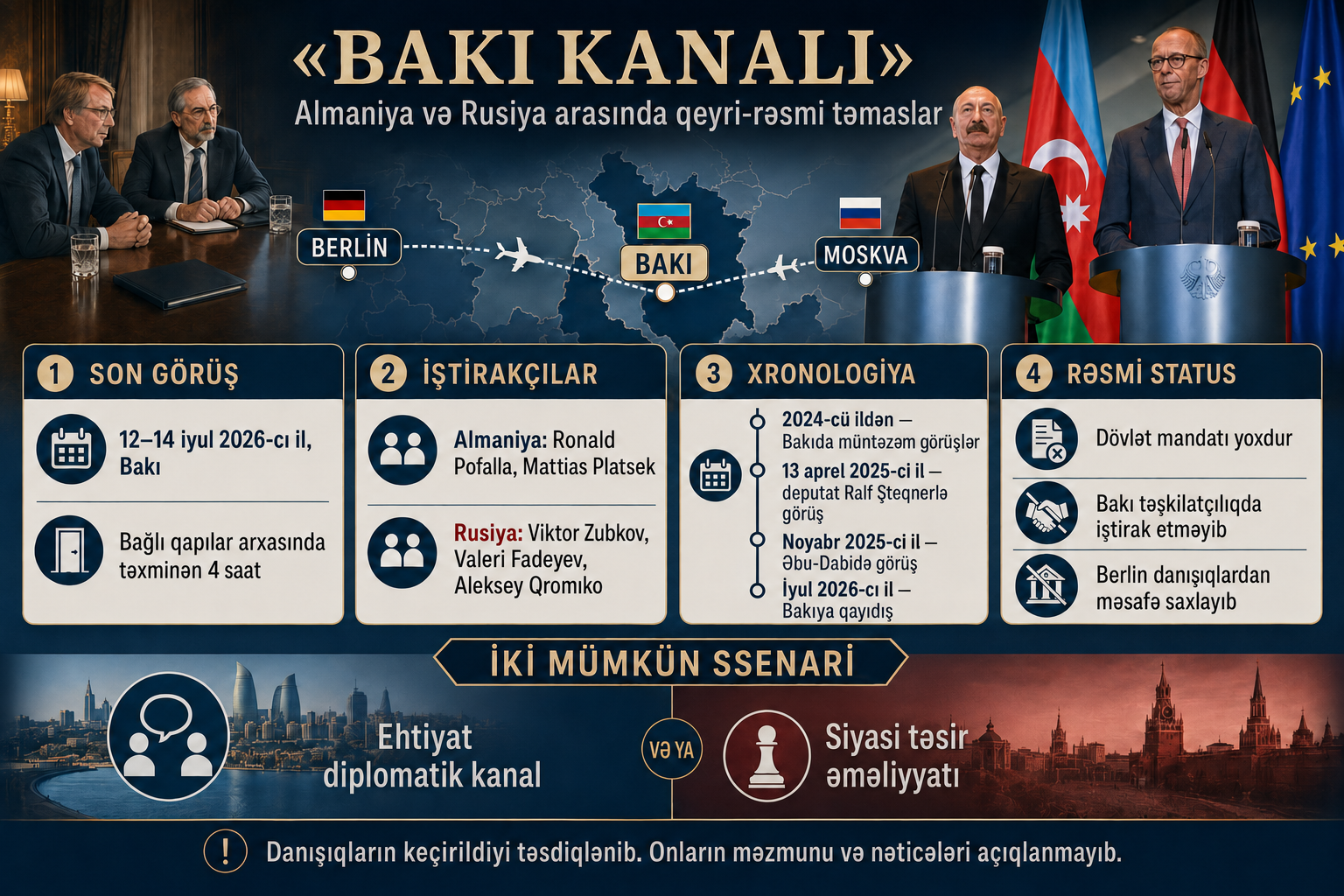
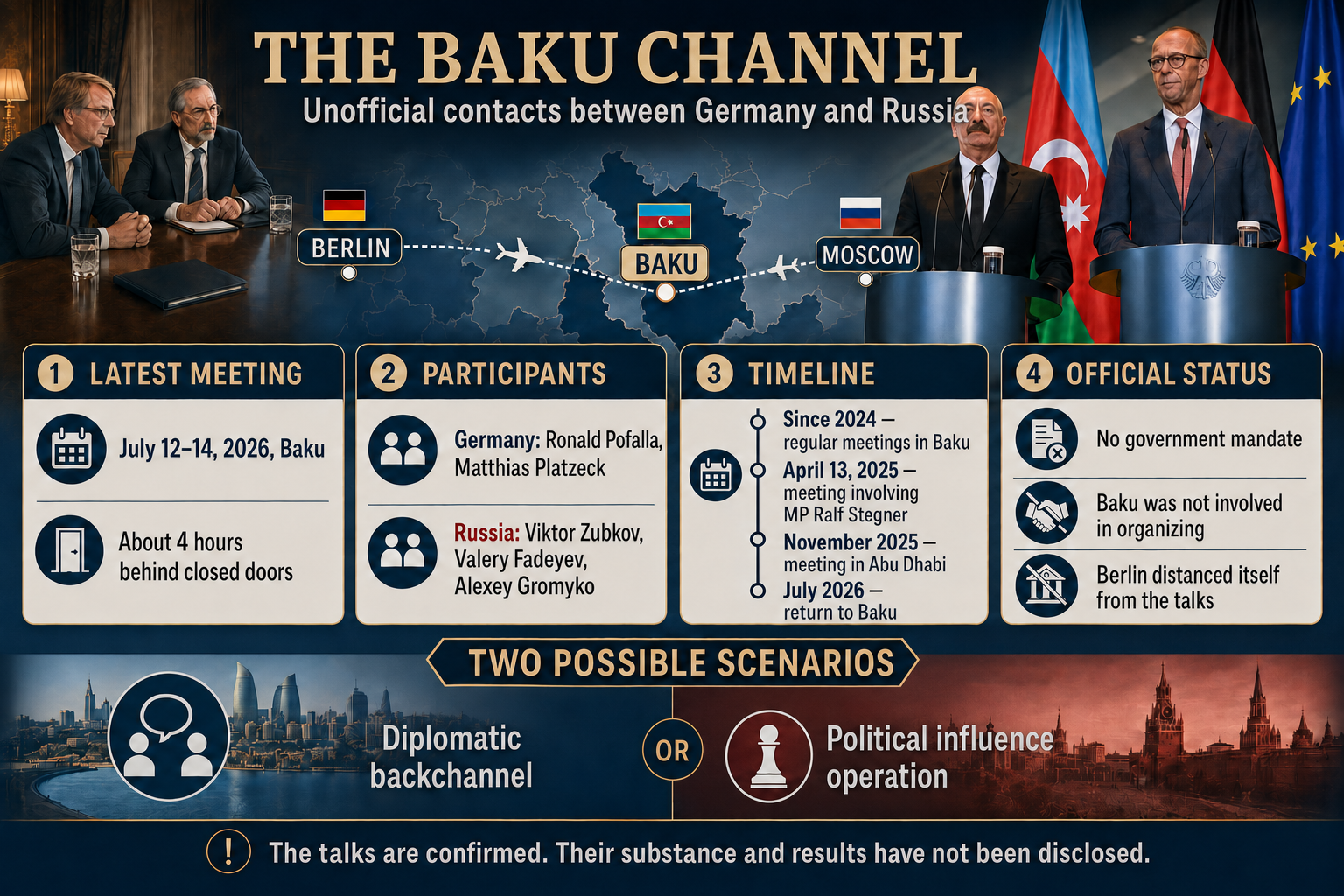
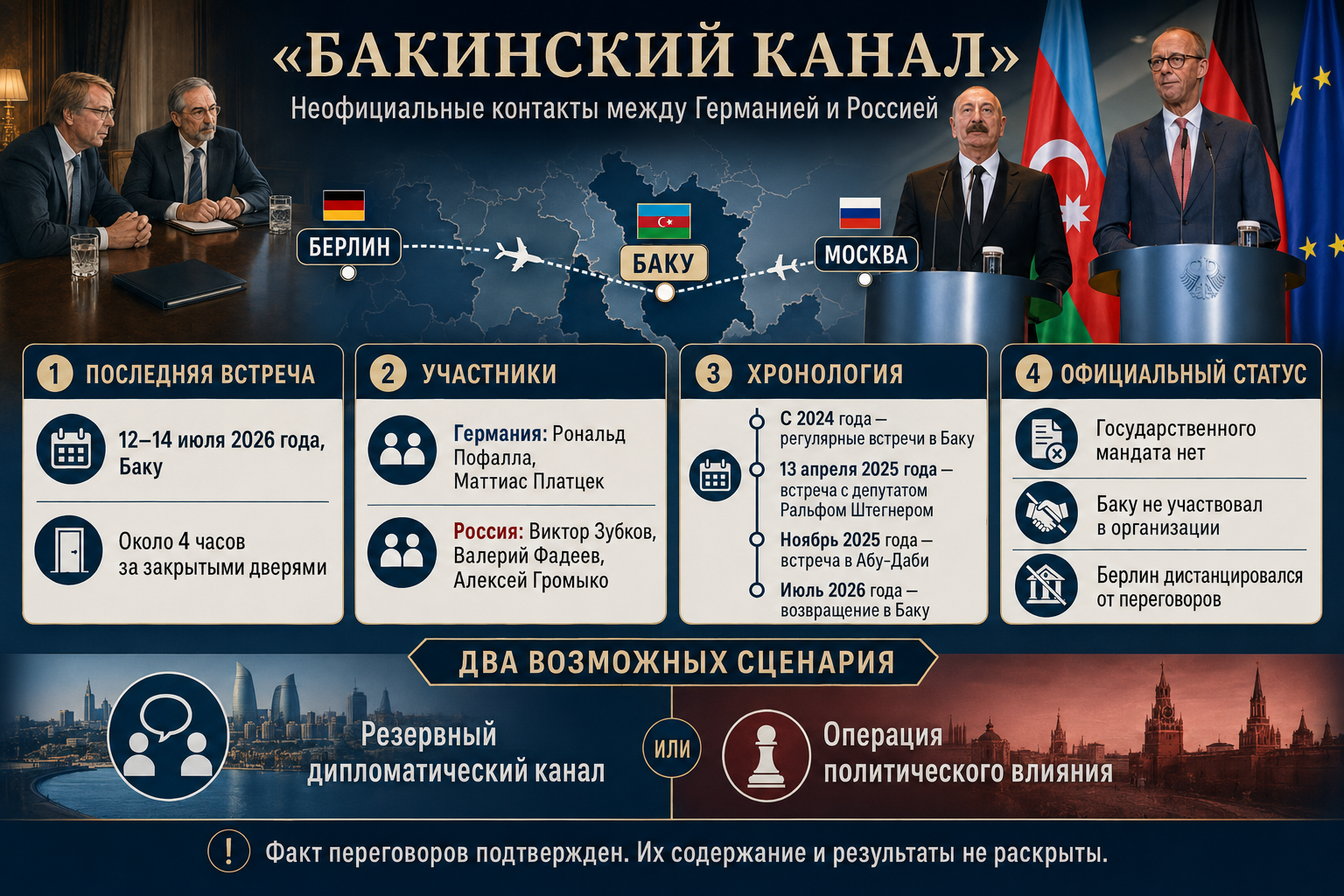
Speaking at a joint press conference with German Chancellor Friedrich Merz in Berlin, Aliyev said that a meeting between former senior officials from Russia and Germany had taken place in the Azerbaijani capital from July 12 to July 14.
“Our territory was used for such a meeting without our knowledge. I cannot comment on the details because we were not present at the meeting. However, flight data allow me to state that a secret meeting did indeed take place in Baku,” the Azerbaijani president said.
According to Aliyev, if the participants sought to contribute to ending the Russian-Ukrainian war, Azerbaijan could only welcome such an initiative. Merz, standing beside him, said that he knew nothing about the meeting. The leaders of both countries thus distanced themselves from the talks while simultaneously confirming the existence of an unofficial channel of communication.
Four hours behind closed doors
An investigation by the German public broadcaster ARD and the weekly newspaper Die Zeit makes it possible to reconstruct the main circumstances of the meeting.
On the evening of July 12, former head of the German Federal Chancellery Ronald Pofalla, former Brandenburg state premier and former chairman of Germany’s Social Democratic Party Matthias Platzeck, and former Swiss ambassador to Berlin Tim Guldimann flew directly from the German capital to Baku.
The following morning, the German group arrived at the Four Seasons Hotel. The talks began at around 11 a.m. in a conference room on the second floor, which had been closed to outsiders, and continued for approximately four hours.
The Russian delegation was led by former Russian Prime Minister and current Gazprom board chairman Viktor Zubkov. It also included Valery Fadeyev, chairman of the Russian Presidential Council for Civil Society and Human Rights, and Alexey Gromyko, director of the Institute of Europe at the Russian Academy of Sciences.
The previous evening, journalists had seen members of the Russian delegation dining at Baku’s Mugam Club restaurant. The following day, they observed the arrival of the German participants at the Four Seasons and attempted to obtain comments after the talks ended.
The participants refused to disclose the substance of the conversation. Platzeck said only that the participants had paid for the trip themselves and that the German group had stayed not at the expensive Four Seasons but at a more affordable hotel. Neither the Russian nor the German participants responded to subsequent written questions.
The “Petersburg Dialogue” without an official label
The participants formally associate their meetings with the tradition of the Petersburg Dialogue, a Russian-German public forum established in 2001 at the initiative of Russian President Vladimir Putin and then German Chancellor Gerhard Schröder.
The forum was intended to maintain contacts among politicians, businesspeople, academics and civil society representatives from the two countries. At different times, Pofalla and Zubkov headed its coordinating committees on the German and Russian sides, while Platzeck served in the leadership of its German structure.
The forum’s work was suspended after repression against independent organizations intensified in Russia. In 2023, the German organization behind the Petersburg Dialogue was formally dissolved in the wake of Russia’s full-scale invasion of Ukraine.
The dissolution of the official structure did not, however, end contacts among its former leaders. Since 2024, they have repeatedly met Russian representatives in Baku. Only once, in November 2025, were the talks moved to Abu Dhabi, after which the participants returned to the Azerbaijani capital.
The meetings are therefore no longer isolated private conversations but appear to constitute a sustained unofficial format. It could provisionally be described as the “Baku Channel” — a continuation of the Petersburg Dialogue without a legal structure, a public agenda or a state mandate.
The scandal involving a Bundestag member
The most serious political scandal surrounding these contacts erupted after a meeting held in Baku on April 13, 2025.
Ralf Stegner, a serving Bundestag member from Germany’s Social Democratic Party, participated in the meeting. Particular concern arose because Stegner was a member of the parliamentary body responsible for overseeing Germany’s intelligence agencies. Members of that body have access to confidential information, including material related to Russia and the war in Ukraine.
Pofalla, former North Rhine-Westphalia state minister Stephan Holthoff-Pförtner, and former Petersburg Dialogue executive director Martin Hoffmann travelled to Baku with Stegner. Zubkov and Fadeyev again represented the Russian side.
The participants described the event as a private and confidential meeting. They said that they had received neither a government assignment nor payment and argued that maintaining dialogue, even during periods of severe confrontation, remained a fundamental principle of sound foreign policy.
That explanation did not eliminate the concerns. German politicians called for an investigation into whether confidential information could have been placed at risk and whether Moscow could have exploited the presence of a member of the Bundestag oversight body to influence German policy.
Negotiators without authority
The central problem with the “Baku Channel” is not the mere fact that talks are taking place. Backchannels are widely used in international diplomacy. Governments employ them to test an adversary’s intentions, transmit preliminary proposals, discuss prisoner exchanges or create conditions for formal negotiations.
The participants in the Baku meetings, however, do not formally represent their governments.
Platzeck and Pofalla are former politicians. Zubkov retains influence through his connections with the Russian leadership and his position at Gazprom, but he does not hold an official diplomatic post. Fadeyev chairs a presidential council but is under European Union sanctions for supporting Russian policies and spreading narratives that justify the war. Gromyko heads an academic institute but has no authority to negotiate on behalf of the Kremlin.
The participants may therefore be able to transmit political signals, but they cannot make binding commitments on behalf of their states. This places the meetings in an intermediate zone between diplomacy, civil society contact and political influence operations.
According to ARD and Die Zeit, German security agencies view the talks as a possible Russian influence operation. The concern is that Moscow may be using former German politicians to promote calls within Germany for restoring relations, easing sanctions and ending further support for Ukraine without changing its own policies.
The German government’s position
The German government has officially distanced itself from the meetings.
The Foreign Office said that Berlin did not plan to revive or make use of the Petersburg Dialogue format. The Federal Chancellery also stated that the Baku talks were not its initiative.
Merz’s comment during the press conference with Aliyev — that he knew nothing about such a meeting — confirmed, at least publicly, the absence of an official mandate.
These statements, however, do not answer several fundamental questions. It is unknown whether the former politicians brief German state institutions about the substance of their talks, whether they convey unofficial signals to the Russian side, or whether German officials receive information about Moscow’s position after the meetings.
Even if the talks take place without the government’s knowledge, they can still influence political debate within Germany. The regularity of the contacts creates the impression that part of the German political establishment is seeking a separate path towards restoring relations with Russia.
Representatives of the Baltic and Nordic countries, as well as other supporters of a hard line towards Moscow, fear that uncoordinated contacts could undermine unity among Ukraine’s allies. The contacts also allow the Kremlin to suggest that its diplomatic isolation is gradually eroding.
Why Baku?
The choice of Baku can be explained by Azerbaijan’s distinctive foreign policy position.
The country maintains working relations with Russia while simultaneously developing energy, economic and political cooperation with Germany and the European Union. Azerbaijan has not joined European Union sanctions against Moscow, has preserved transport and commercial links with Russia, and remains an important supplier of oil and gas to the European market.
Baku has direct air connections with both Moscow and Berlin. A trip to Azerbaijan attracts less political attention than talks in the Russian capital and is easier to arrange than a meeting inside the European Union, particularly given the sanctions imposed on some Russian participants.
Finally, Azerbaijan pursues a multidirectional foreign policy and has experience engaging with parties in conflict. Following the agreements reached with Armenia, Baku is seeking to strengthen its image as a state capable of shaping a regional agenda independently while maintaining pragmatic relations with competing centres of power.
Aliyev’s statement, however, draws an important line. According to the Azerbaijani president, the country’s authorities did not organize the talks, did not participate in them and did not know they were taking place. Azerbaijan therefore cannot, at this stage, be described as a mediator between Germany and Russia. It acted as a host location chosen by the participants themselves.
Nevertheless, the repeated nature of the meetings inevitably gives Baku a degree of political significance. Even without formal mediation, the Azerbaijani capital is becoming a European-Eurasian hub of unofficial diplomacy where representatives of opposing sides can speak outside established institutions.
Europe prepares for an eventual conversation
The activity of former German politicians coincides with a broader European debate about whether a direct channel to the Kremlin will be required to bring the war in Ukraine to an end.
Moscow publicly says that it is open to dialogue while accusing European governments of failing to take practical steps. Vladimir Putin has described former Chancellor Gerhard Schröder as someone he trusts. Schröder travelled to Moscow in June and met the Russian president in person. The substance of their conversation was not disclosed.
Promoting figures who retain longstanding ties with Moscow serves the Kremlin’s interests. Russia gains interlocutors who better understand its arguments, are critical of the policy of isolation and may advocate a gradual restoration of economic relations.
This creates a dilemma for Germany. A complete absence of contacts restricts its ability to assess Moscow’s intentions and prepare for future negotiations. Uncontrolled dialogue conducted through former politicians, however, allows Russia to select interlocutors favourable to its position and influence German public opinion through them.
From a geographical venue to a diplomatic role
Aliyev’s statement has changed the political perception of the closed meetings. Before the press conference, they could be portrayed as a private initiative by former participants in the Petersburg Dialogue. The existence of the contacts has now been confirmed by the head of the country on whose territory they took place.
Aliyev nevertheless adopted a cautious position. He distanced Azerbaijan from the organization of the meetings while welcoming their possible peace-making objective. This formula allows Baku to avoid responsibility for the talks’ lack of transparency while demonstrating its readiness to support any effort aimed at ending the war.
There is still no evidence that the “Baku Channel” has produced concrete diplomatic results. It is unknown whether the participants discussed realistic conditions for a ceasefire, the restoration of relations between Russia and Europe, sanctions or a future security architecture.
It is also unclear whether the Russian participants were communicating the Kremlin’s actual position or primarily using the talks as a means of influencing Germany’s political environment.
The “Baku Channel” therefore retains its ambiguous character. It could become a preliminary venue for an official conversation between Russia and Europe that may eventually prove unavoidable. But it could equally provide Moscow with a tool to bypass European institutions, weaken the West’s common position and promote Kremlin-friendly ideas through former German politicians.
Three conditions distinguish secret diplomacy from an influence operation: the existence of a political mandate, a transparent mechanism for reporting results to state authorities, and the participants’ ability to obtain concessions from both sides. There is currently no evidence that the meetings in Baku meet even one of these conditions.
That is why the talks behind the closed doors of Baku’s hotels are becoming not only a question of future diplomacy but also a test of German security, European unity and Azerbaijan’s emerging international role.


Europe
-
Türkiye’s efforts to retain Russian gas supplies while expanding fuel exports to Europe are increasing Azerbaijan’s importance as a supplier of gas with verifiable origins. However, turning Turkish territory into a major energy hub will require new...
-
The Swiss foreign minister’s itinerary brings together several objectives: an attempt to restore the OSCE’s political relevance, a search for new business opportunities and Europe’s growing interest in energy and transport routes crossing the...
-
The Covenant of Mayors event scheduled to be held in Brussels in 2026 is today Europe’s largest platform for local climate diplomacy. Unlike the commitments of national governments, the initiative shifts the centre of gravity of climate and energy...
-
Beginning in 2027, thousands of companies exporting goods to the European Union will have to work with a new document. This document is neither a customs declaration nor a quality certificate. It is a Digital Product Passport containing the complete...


Leave a review