


Generated by AI

Azerbaijan’s Prosecutor General’s Office has placed three Russian citizens on an international wanted list after an online programme in which the participants discussed the possible overthrow of Azerbaijan’s leadership, the country’s partition and a military operation in Baku.
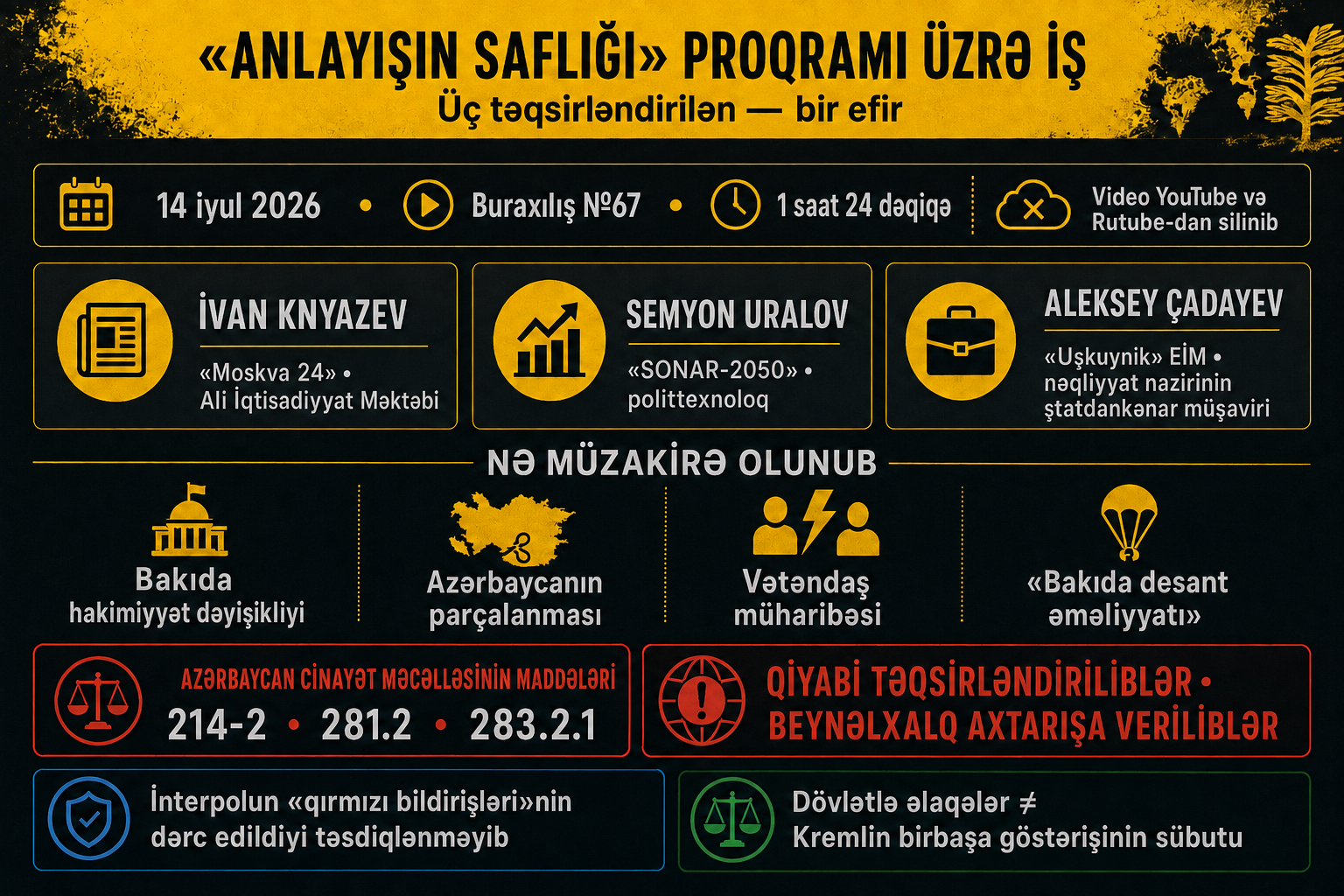
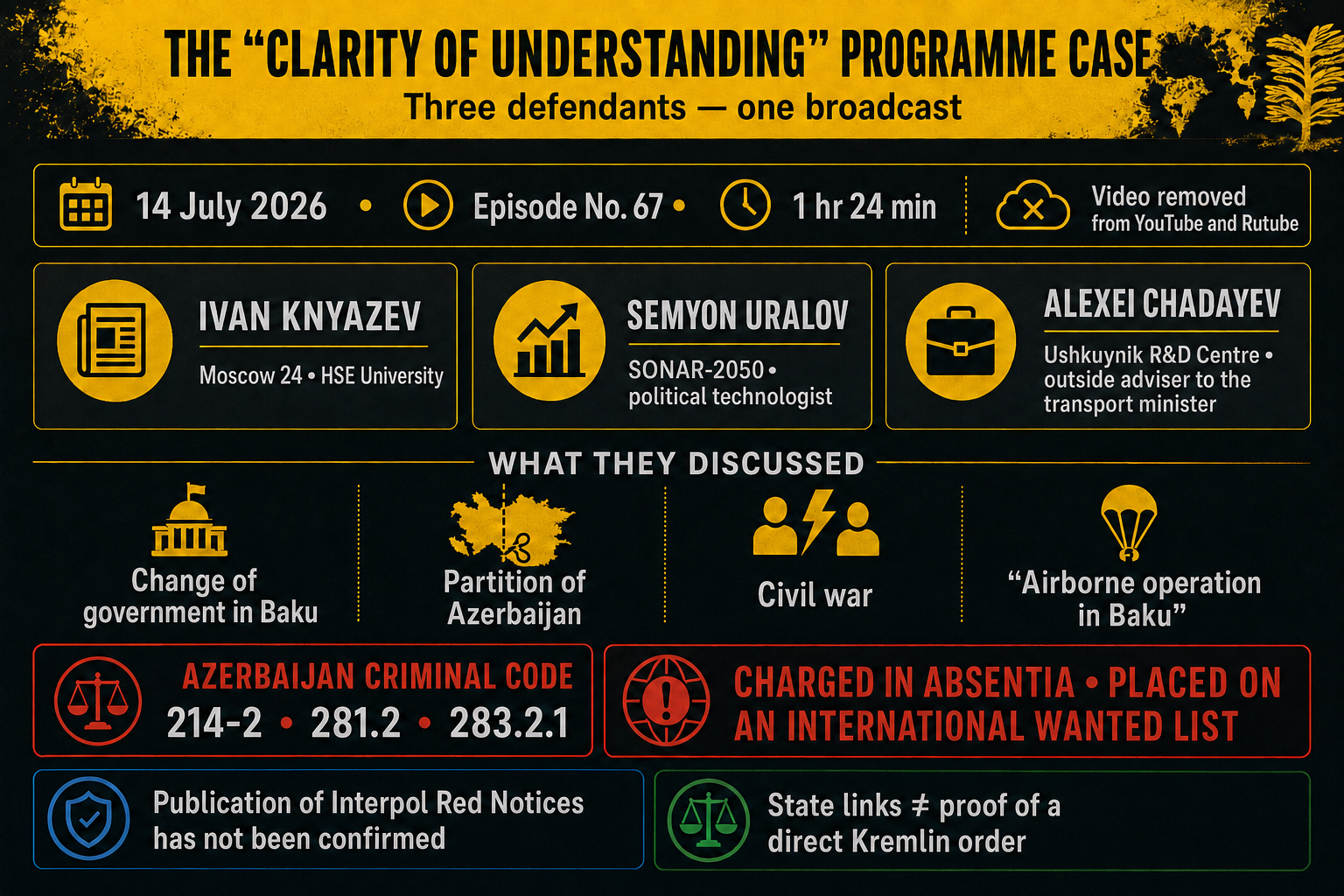
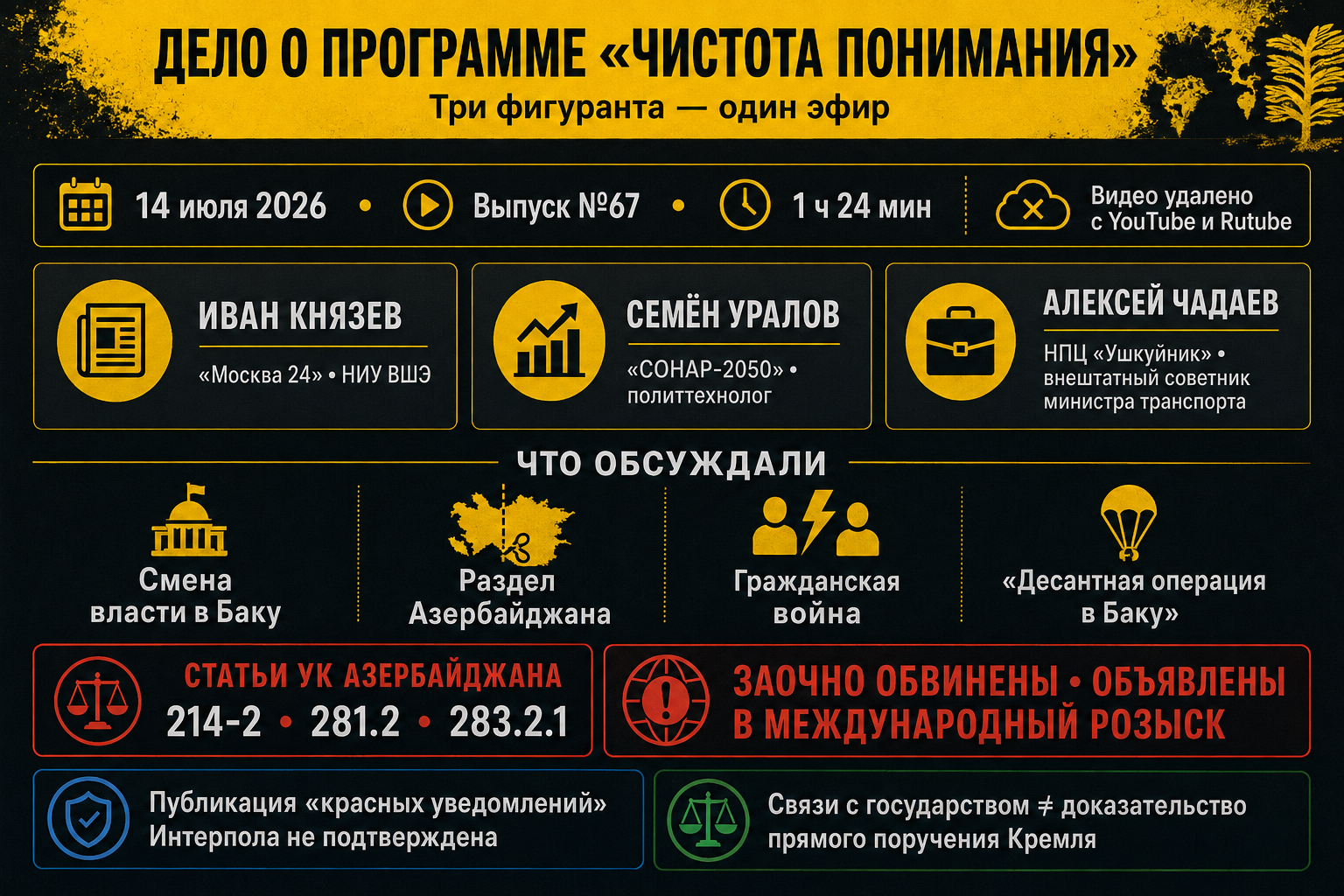
The defendants are journalist Ivan Knyazev, political consultant and media expert Semyon Uralov, and Alexei Chadayev, whom Azerbaijani prosecutors describe as a television journalist and an adviser to Russia’s transport minister.
The Prosecutor General’s Office said the criminal case concerned public calls for terrorism, the forcible alteration of Azerbaijan’s constitutional order, violation of its territorial integrity and incitement of ethnic hatred and hostility.
One of the principal grounds for the investigation was the programme “Чистота понимания LIVE // Сколько в России агентов Алиева?” — “Clarity of Understanding LIVE // How Many Aliyev Agents Are There in Russia?”, broadcast on the “Semyon Uralov” YouTube channel on July 14, 2026. It was the programme’s 67th episode and featured Knyazev, Uralov and Chadayev.
The episode, which runs for about one hour and 24 minutes, has been removed from YouTube and Rutube . A full written transcript has also been published online, making it possible to verify the participants’ wording and the context of their statements.
A review of the transcript confirms that a substantial part of the programme was devoted to possible Russian actions against President Ilham Aliyev’s government and Azerbaijan’s territorial structure.
The participants discussed several potential Russian strategies: replacing the government in Baku with a more pro-Russian regime, incorporating Azerbaijan into Russia, transferring part of its territory to Armenia, or including the country in a federation with Armenia and Georgia. Other scenarios included handing Azerbaijan over to Iran, exploiting ethnic factors to pressure Baku, and plunging the country into civil war.
Chadayev initially framed some of these propositions as rhetorical questions about what Moscow wanted to achieve in relation to Aliyev. The discussion later became more specific, covering the strengthening of Russia’s Caspian Flotilla, an increased military presence on the border of southern Dagestan, the development of maritime and aerial unmanned systems in the Caspian region, and planning an “airborne operation in Baku”.
Uralov, in turn, proposed returning Azerbaijan, Armenia and Georgia to a unified Transcaucasian federation, arguing that such a model should curb the development of nationalism in the individual republics.
The programme also contained accusations against Azerbaijani diaspora organisations and individual Russian journalists and experts whom the participants described as conduits of Baku’s influence. They discussed the possibility of requiring Azerbaijani organisations and public figures in Russia to declare their political loyalty openly.
The Prosecutor General’s Office said it regarded these statements as calls for the use of violent methods against Azerbaijan, the alteration of its constitutional order, violation of its territorial integrity and incitement of ethnic hatred.
The programme’s context is nevertheless relevant to its legal assessment: some of the most radical scenarios were listed as possible policy options rather than direct instructions for immediate action. However, the discussion of a military build-up in the Caspian Sea, the internal destabilisation of Azerbaijan and a possible operation in Baku led investigators to classify the statements as going beyond political analysis.
Prosecutors have also referred to a programme published on the same channel on August 13. According to investigators, its participants spoke about using violent methods against Azerbaijan, keeping certain individuals under an immediate threat of physical destruction and eliminating them in a targeted manner.
It has not yet been possible to establish precisely which material from August 13 the authorities are referring to. An episode entitled “Братушки и небратья” — “Brothers and Non-Brothers”, listed under that date in one archive, is available on YouTube and other platforms. However, neither Azerbaijan nor Aliyev is mentioned in its published full transcript. Prosecutors may be referring to another video, a separate excerpt from the programme, an edited publication, or material that was subsequently deleted.
The case was opened under Article 214-2 of Azerbaijan’s Criminal Code, covering public calls for terrorism; Article 281.2, covering public appeals directed against the state; and Article 283.2.1, covering the incitement of ethnic hatred and hostility, according to a statement from the Prosecutor General’s Office published by AZƏRTAC.
Knyazev, Uralov and Chadayev have been charged in absentia. Azerbaijani courts ordered their pretrial detention because all three are outside the country.
The Prosecutor General’s Office said it had asked the competent authorities of other countries to locate and detain the defendants and transfer them to Azerbaijan. It is also taking steps to arrange their search through Interpol channels. The statement does not, however, indicate that Interpol has already issued Red Notices against them.
The defendants had not publicly commented on the substance of Azerbaijan’s allegations at the time of publication. Russian authorities had also not said officially whether they intended to respond to Baku’s requests.
Who stands behind the programme’s participants?
The participants’ positions raise questions about whether they could have made such statements independently within Russia’s information system, where public criticism of the authorities, the war and the security services is tightly restricted.
Alexei Chadayev has the closest links to the state. He heads the Ushkuynik Scientific and Production Centre, which manufactures drones used by the Russian military, and in January 2026 he was appointed an outside adviser to Russian Transport Minister Andrei Nikitin. Chadayev continued to lead the centre and said he performed his advisory duties on a voluntary basis. He is therefore not merely a political commentator but also a participant in the state-linked military-industrial sector. TASS confirmed both his appointment and his leadership of Ushkuynik.
Ivan Knyazev has worked as a news presenter for the Moscow 24 television channel since 2022. The channel is part of the Moscow city media system controlled by the municipal authorities. He is also a professor and academic director of the Journalism programme at the Institute of Media of the National Research University Higher School of Economics. The Russian Federation is the university’s founder and owns its property. These details appear in Knyazev’s official biography and in Higher School of Economics documents.
Semyon Uralov is not known to hold an official government position, but he has long operated within the pro-government expert and media environment. He describes himself as a political technologist, media technologist and researcher of “cognitive warfare”. He is editor-in-chief of SONAR-2050, a project promoting the integration of Russia and Belarus, and regularly appears on state-owned or Kremlin-aligned media platforms. His public activity is centred on support for Russian foreign policy and the war against Ukraine.
The participants are therefore not independent opposition journalists but representatives of a media and political environment loyal to the state. One is simultaneously linked to a federal ministry and weapons production; another works for a municipal television channel and a state-owned university; and the third participates in projects serving Russia’s integration and foreign-policy agenda.
This is particularly significant against the background of the state of free expression in Russia. Russia ranks 172nd out of 180 countries in the 2026 World Press Freedom Index. Reporters Without Borders says almost all independent Russian media have been banned, blocked, or declared “foreign agents” or “undesirable organisations”, while the remaining major outlets are owned by the state or structures linked to the Kremlin. RSF also points to military censorship and systematic self-censorship within newsrooms.
Under such conditions, the idea that prominent journalists and an expert linked to the Russian state apparatus could have discussed overthrowing the leadership of a neighbouring country, partitioning that country and conducting a military operation in its capital entirely by chance and without a sense that such rhetoric was politically permissible raises legitimate questions.
Their institutional links do not, however, prove that the programme was commissioned or approved in advance by the Kremlin. Russia’s system of information management does not require every statement to receive prior authorisation. Loyal commentators are generally given considerably more latitude when their remarks target a foreign state and do not contradict Moscow’s current political line.
Several explanations are therefore possible. The participants may have radicalised their rhetoric independently, knowing that attacks against Azerbaijan would not expose them in Russia to the kind of prosecution used against critics of the Russian authorities or the war. Their statements may also have served as a trial balloon intended to test public and diplomatic reactions to a tougher policy towards Baku. Finally, the programme could have reflected the position of one of the competing groups within Russia’s state or security apparatus without representing the Kremlin’s official line.
Unless documents emerge showing an editorial assignment, financing, or direct instructions from state agencies, it would be impossible to claim that the Russian leadership stood behind the programme. The participants’ official positions, access to state platforms and the absence of visible sanctions against them in Russia nevertheless indicate at least political tolerance of such rhetoric. In a controlled information system, the authorities’ silence after such statements may not prove that the programme was commissioned, but it may indicate that the red line they established was not crossed.


Express analysis
-
Azerbaijani President Ilham Aliyev’s visit to the country’s Naval Forces and the testing of new maritime drones demonstrated Baku’s intention to extend its experience with unmanned technology to the Caspian Sea and gradually shift from purchasing...
-
Court proceedings involving politicians, civil society representatives and journalists 1) On September 4, the Salyan District Court reviewed an administrative report drawn up against Zamin Salayev, a member of the Azerbaijan Popular Front Party....
-
We are accustomed to thinking of a map as an objective image of the planet. Yet the familiar rectangle seen in classrooms quietly enlarges some countries and diminishes others. The United Nations General Assembly is now proposing a new way of...
-
Ukraine has intensified drone attacks on Moscow’s aviation hub in an effort to disrupt airport operations and persuade foreign airlines to stop flying through Russian airspace, according to Ukrainian officials and Western media reports. Ukrainian...


Leave a review