


Generated by AI

Fines and Us: In Which Direction Is Azerbaijan's Administrative Liability System Developing?
A Legal, Economic, and Institutional Analysis of Administrative Fine Policy
Sometimes just a few seconds can alter a person's financial plans for an entire month.
It is 8:20 in the morning.
Elvin, a resident of Baku, is rushing to take his child to school. At the moment when traffic in the city center briefly becomes lighter, he exceeds the speed limit by only a few hundred meters.
By the end of the day, the SMS message he receives on his phone is not an ordinary notification—it is an administrative fine of 100 manats.
His first thought is not about legal theory.
Instead, he begins wondering which family expense he will now have to postpone.
The utility bills?
His child's preparatory courses?
Or the small vacation he had been planning?
This story is familiar to thousands of Azerbaijani citizens.
Every year, hundreds of thousands of administrative fines are imposed across the country, with the overwhelming majority related to traffic violations.
Yet behind every fine lies not only a legal violation, but also a far more fundamental question.
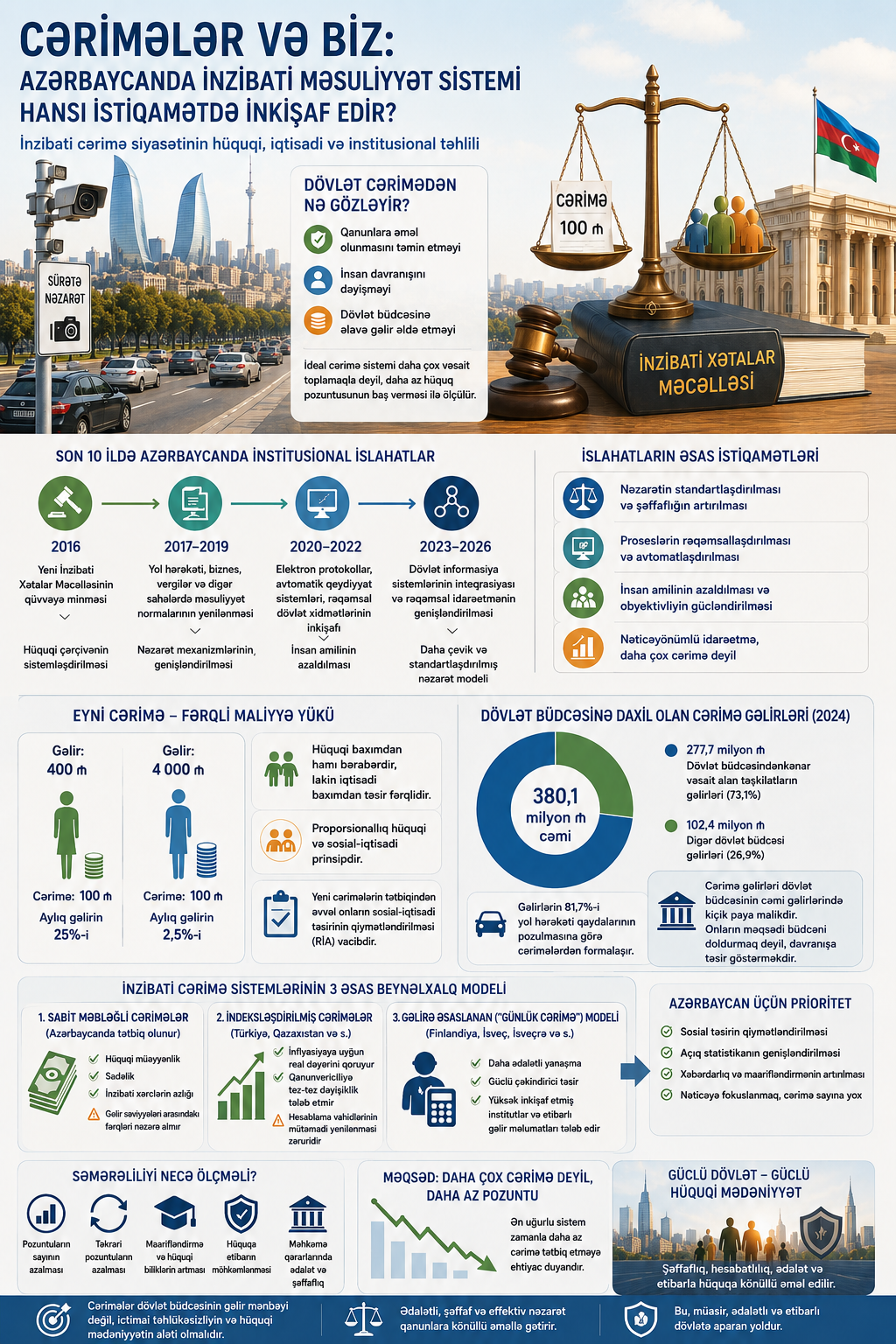
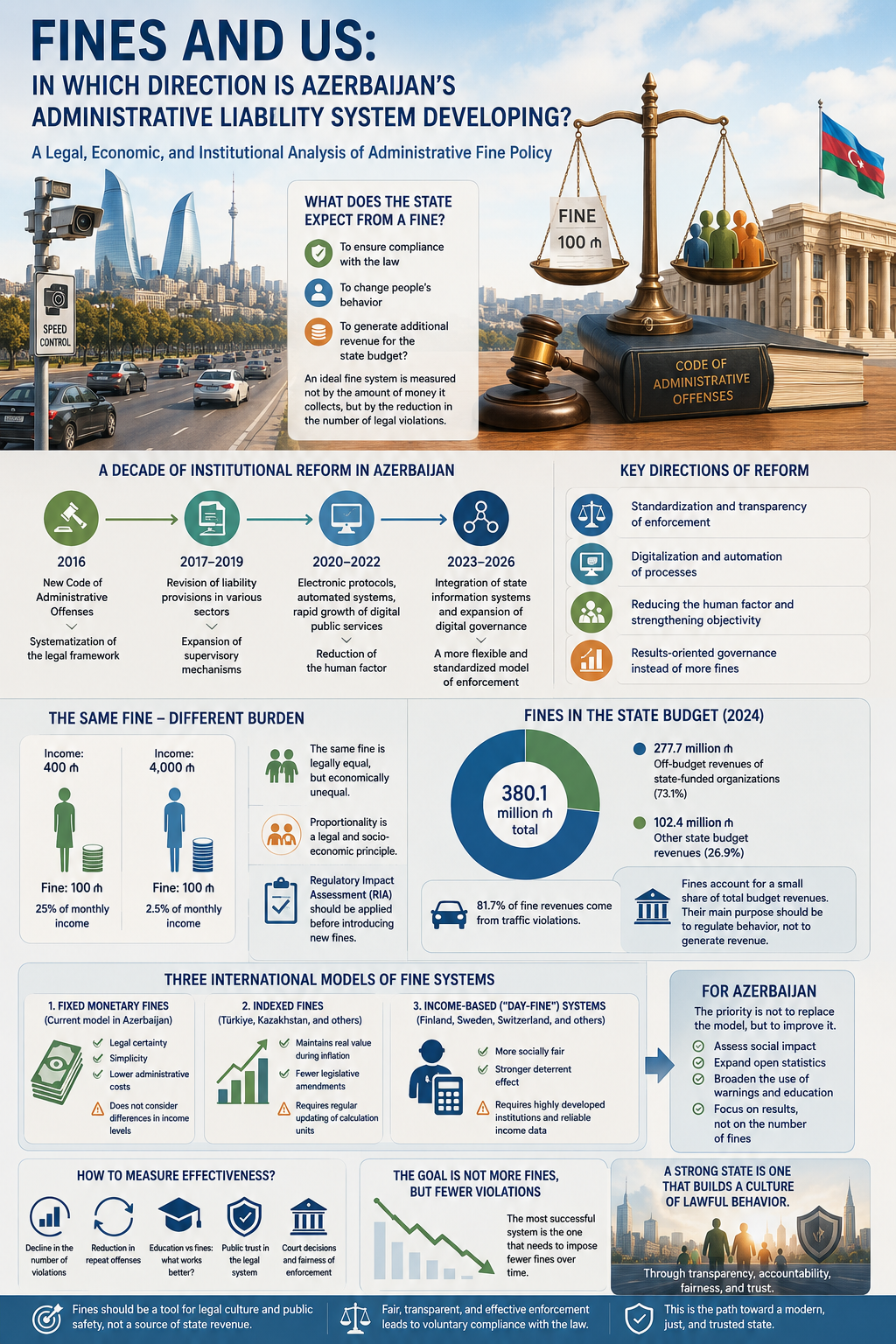
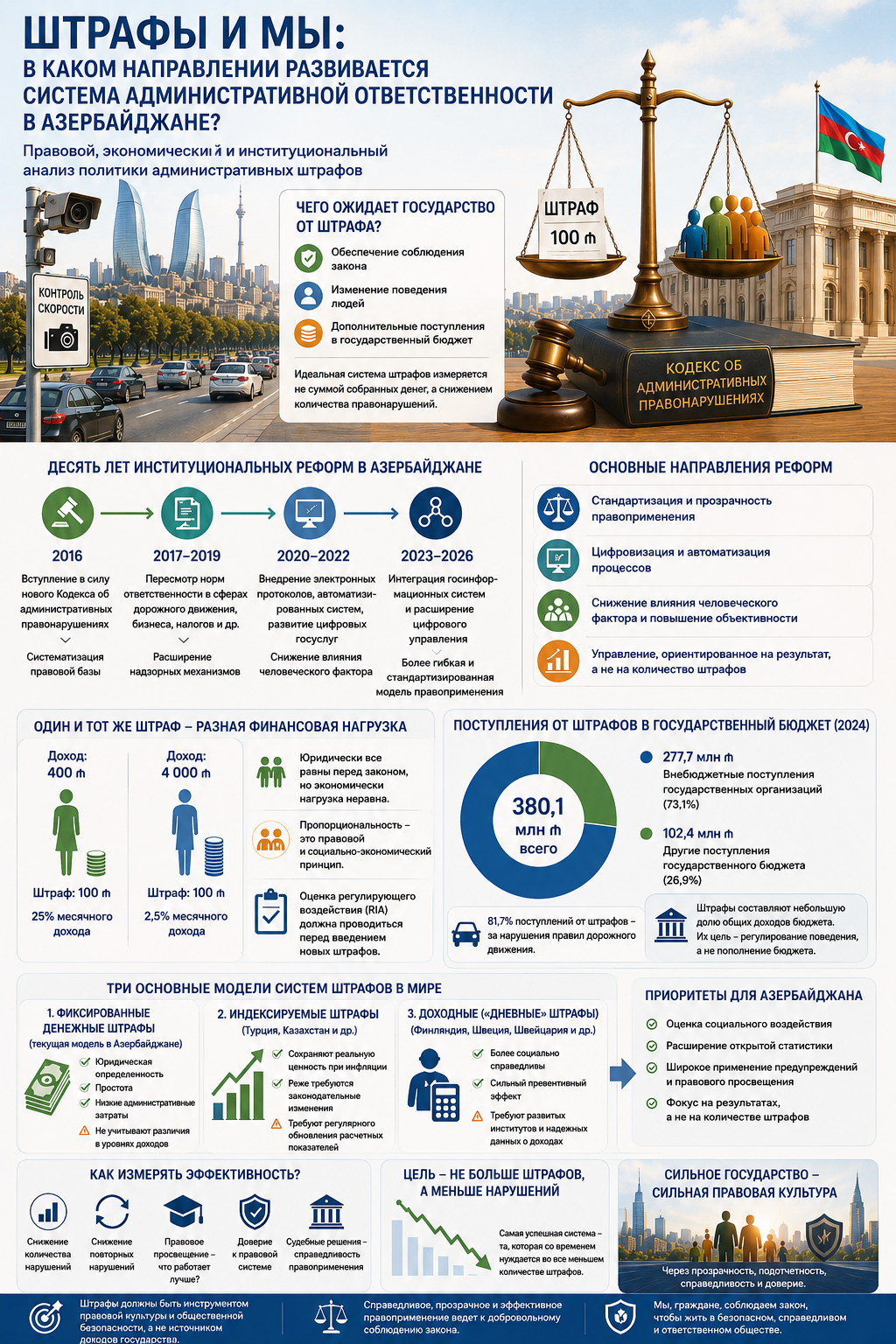
What Does the State Expect from a Fine?
To ensure compliance with the law?
To change people's behavior?
Or to generate additional revenue for the state budget?
This question is relevant not only for Azerbaijan but for virtually every legal system in the world.
Modern legal theory views an administrative fine not as a source of government revenue, but as a legal instrument for regulating social relations.
Its primary mission is not merely to punish a legal violation but, more importantly, to prevent that violation from being repeated.
In other words, an ideal system of administrative fines is measured not by the amount of money it collects, but by the reduction in the number of legal violations.
Over the past decade, Azerbaijan has also implemented significant institutional reforms in this direction.
The entry into force of the new Code of Administrative Offenses in 2016, followed by the introduction of electronic protocols, the expansion of automatic photo and video enforcement systems, the development of digital public services, and the integration of state information systems have moved administrative supervision mechanisms to an entirely new stage compared with the previous period.
These reforms have changed not only the way fines are imposed but also the philosophy of public administration itself.
Whereas the state's response to legal violations previously depended largely on the human factor, digital technologies now play an increasingly important role in decision-making across many sectors.
As a result, subjectivity has been reduced, while new opportunities have emerged for establishing uniform standards in law enforcement.
However, every legal mechanism also has social and economic consequences.
Since 2025, Azerbaijan's minimum monthly wage has increased to 400 manats, while the average nominal monthly salary has reached 1,102.9 manats.
Against this backdrop, administrative fines of identical amounts create very different financial burdens for different income groups.
From a legal perspective, everyone is equal before the law.
From an economic perspective, however, the impact of the same fine is far from equal.
This is precisely why, in developed countries, fine policy is no longer viewed solely as a legal issue.
It is regarded as an integral component of economic policy, social justice, public administration, and institutional trust.
In recent years, both the Organisation for Economic Co-operation and Development (OECD), the World Bank, and other international organizations have identified the prior assessment of the socio-economic impact of administrative sanctions, the expansion of open statistics, and the development of digital governance as key policy priorities.
The development path chosen by Azerbaijan in recent years largely corresponds to these international trends.
Rather than building a system that simply imposes more fines, the state seeks to develop a model of digital governance that objectively detects legal violations, standardizes administrative procedures, and strengthens trust between citizens and the state.
Nevertheless, one fundamental question remains unanswered.
To what extent is Azerbaijan's current system of administrative fines capable of changing citizens' behavior?
How do the economic burden, legal foundations, and institutional consequences of administrative fines compare with international practice?
What are the strengths of the current model, and in which direction should future reforms proceed?
To answer these questions, it is essential to examine administrative fine policy not only through the lens of law but also from the perspectives of economics, public administration, and public trust.
From the Legal Framework to Digital Governance: How Azerbaijan's Fine Policy Has Changed Over the Past Decade
When administrative fines become the subject of public discussion, attention is usually focused on the amount of the penalties.
In reality, however, the most significant change in public administration is not the monetary value of a fine, but the principles according to which it is imposed.
It is precisely in this area that Azerbaijan has undergone a profound institutional transformation over the past ten years.
The starting point of this transformation was the entry into force of the new Code of Administrative Offenses in 2016.
The new Code not only aligned the administrative liability system with modern economic realities but also established a new legal framework for implementing law enforcement based on uniform principles.
In the years that followed, dozens of amendments were introduced into the Code.
Administrative liability provisions were refined to address new economic relations, digital services, e-commerce, the labor market, the financial sector, food safety, and numerous other areas.
However, the essence of these reforms was not limited to updating legislation.
The real transformation occurred in the model of governance itself.
Previously, administrative supervision largely depended on the decisions of public officials, protocols drawn up on the spot, and paper-based document circulation.
Although this model functioned from a legal standpoint, its heavy reliance on the human factor often created opportunities for subjective decision-making, inconsistent enforcement practices, and lengthy administrative procedures.
In recent years, however, an entirely different approach to public administration has begun to emerge.
Photo and video enforcement systems, electronic protocols, digital payment platforms, the integration of government information systems, and the expansion of electronic public services have made administrative procedures more standardized and transparent.
These changes are not intended to increase the number of fines.
Rather, they are designed to make the detection of legal violations more objective and to ensure that the law is applied equally to everyone.
From this perspective, Azerbaijan's chosen direction appears consistent with the modern concept of public administration.
According to the Organisation for Economic Co-operation and Development (OECD) and the World Bank, the effectiveness of administrative sanctions depends primarily on whether they are applied inevitably, transparently, proportionately, and consistently.
In other words, the certainty of accountability for a legal violation often has a stronger preventive effect than the severity of the financial penalty itself.
The Main Directions of Reform in Azerbaijan
The reforms implemented over the past decade can be conditionally divided into four stages.
| Period | Key Reform | Result |
| 2016 | Introduction of the new Code of Administrative Offenses | Systematization of the legal framework |
| 2017–2019 | Revision of liability provisions in road traffic, business regulation, taxation, and other sectors | Expansion of supervisory mechanisms |
| 2020–2022 | Introduction of electronic protocols, automated enforcement systems, and rapid development of digital public services | Reduction of the human factor |
| 2023–2026 | Integration of government information systems and expansion of digital governance | A more flexible and standardized law enforcement model |
These stages demonstrate that Azerbaijan has focused primarily on improving the quality of governance rather than simply increasing the severity of penalties.
Why Does Digitalization Matter?
In modern governance theory, digitalization is not viewed merely as a technological innovation.
It is regarded as an institutional mechanism for strengthening the rule of law.
For example, there is a fundamental difference between recording a speeding violation through an automatic camera system and identifying the same violation solely on the basis of a traffic police officer's personal observation.
In the former case:
- decisions are made according to standardized criteria;
- direct contact between citizens and public officials is minimized;
- corruption risks are reduced;
- evidence is generated in electronic form;
- appeal procedures become more transparent.
This does not automatically mean that citizens will agree with the imposed fine.
However, it significantly increases confidence in the objectivity of the decision.
A New Stage for Azerbaijan: Risk-Based Supervision Rather Than More Fines
In recent years, developed countries have increasingly adopted a new concept in administrative supervision known as Risk-Based Regulation.
Under this model, the objective is not to inspect everyone with the same intensity.
Instead, public resources are concentrated on areas that pose the greatest risks.
For example:
- traffic violations that result in serious road accidents;
- serious breaches of occupational safety regulations;
- food safety;
- environmental risks;
- systematic tax evasion.
This approach allows public resources to be used more efficiently and makes administrative enforcement more outcome-oriented.
Azerbaijan's recent expansion of digital supervisory mechanisms creates an important institutional foundation for a future transition toward this model.
A Legal System Cannot Function Through Fines Alone
There is another critically important point.
According to modern legal theory, the state cannot achieve sustainable long-term results merely by imposing fines.
If citizens obey the law only because they fear financial penalties, this does not create a lasting culture of legal compliance.
Sustainable results emerge only when:
- laws are clear and understandable;
- administrative procedures are simple;
- fines are perceived as fair;
- decisions are made transparently;
- citizens' rights are effectively protected.
Under these conditions, a fine ceases to function merely as a punitive instrument and becomes an institutional mechanism that encourages lawful behavior.
For this reason, Azerbaijan's progress over the past decade has involved far more than defining new administrative offenses.
The most significant transformation has been the transition from a traditional model of administrative supervision to a digital, data-driven, and results-oriented system of governance.
The next stage will not be about increasing the number of fines but about creating a new evaluation framework capable of measuring how effectively fines reduce legal violations.
Such a framework could transform administrative fine policy from a purely legal mechanism into one of the key indicators of the quality of public governance.
Fines Are Not Merely Punishment—They Are Also a Social Burden: Is the Current System Equally Fair to All Citizens?
Although administrative fines are legally identical for everyone, their economic impact is not.
This issue has become one of the most widely debated and sensitive aspects of modern fine policy.
Imagine two drivers committing exactly the same traffic violation.
Each receives an administrative fine of 100 manats.
One earns the minimum monthly wage of 400 manats, while the other has a monthly income of 4,000 manats.
From a legal perspective, both individuals bear identical responsibility.
From an economic perspective, however, the impact of the fine is entirely different.
For the first driver, a fine of 100 manats represents one quarter of his monthly income.
For the second, it amounts to only 2.5 percent of his monthly earnings.
Thus, while the same fine is legally equal, it does not produce equal social consequences.
For this reason, recent international legal and economic research increasingly treats the principle of proportionality not only as a legal concept but also as a socio-economic one.
How Balanced Is Azerbaijan's Current Model?
Azerbaijan applies a system of fixed monetary fines.
This model offers several important advantages.
First and foremost, it provides legal certainty.
Citizens know in advance exactly what fine will be imposed for a particular violation.
This simplifies law enforcement, reduces the number of court disputes, and lowers administrative costs.
Nevertheless, the model also has significant weaknesses.
The most serious is that it does not take into account the different economic circumstances of various income groups.
As a result, the same fine can impose a much heavier social burden on lower-income households.
This is not merely a theoretical issue.
With the minimum monthly wage set at 400 manats, an administrative fine of 200 manats represents half of a person's monthly income.
Such a burden may force some families to reduce spending on utility bills, food, or their children's education.
The Weakest Link in Fine Policy: The Absence of Social Impact Assessment
Another important issue is that when new administrative fines are introduced in Azerbaijan, there is still no broadly applied mechanism for assessing their social and economic impact.
In many developed countries, before new administrative sanctions are adopted, policymakers analyze their likely effects on:
- citizens;
- businesses;
- the state budget;
- market competition;
- social equality.
This approach is known as Regulatory Impact Assessment (RIA) and constitutes an integral part of public policymaking across most OECD countries.
Although analytical approaches to lawmaking have become stronger in Azerbaijan in recent years, the systematic application of RIA to administrative fines remains an area with considerable potential for further development.
This does not mean that the current policy is flawed.
On the contrary, such an approach would help ensure that future decisions are better substantiated and more socially balanced.
Open Statistics Remain Limited
Compared with previous years, Azerbaijani public institutions now publish considerably more statistical information.
Nevertheless, from an analytical standpoint, several important indicators are still not disclosed on a regular basis.
For example, a much more objective assessment of fine policy would be possible if the following information were published in a unified format:
- the total number of administrative fines imposed annually;
- a breakdown by sector;
- the rate of repeat violations;
- the proportion of administrative decisions overturned by courts;
- the number of administrative penalties replaced by warnings;
- voluntary payment rates for administrative fines.
These data are valuable not only for journalists and researchers but also for the government itself.
After all, outcomes that are not measured cannot be effectively managed.
A Larger Number of Fines Is Not Necessarily a Sign of Success
Public discussions often include the following argument:
"More fines were issued this year, which means enforcement has become stronger."
In reality, this conclusion is not always correct.
If the number of fines increases every year, it may indicate one of two very different developments:
- the enforcement system has become more effective at detecting violations; or
- the number of legal violations themselves is increasing instead of declining.
For precisely this reason, developed countries increasingly rely on different performance indicators.
The primary measure is no longer the number of fines imposed but the results they produce.
If, over a five-year period, violations of traffic regulations, consumer protection laws, or labor legislation decline, this indicates that the fine policy is working successfully.
Conversely, a persistently high number of fines may signal not the effectiveness of administrative enforcement but the continued existence of underlying problems.
The Next Stage for Azerbaijan
Over the past decade, Azerbaijan has made substantial progress in the digitalization of administrative supervision.
This represents an important achievement.
However, the next stage should shift attention away from the simple question:
"How many fines were imposed?"
Instead, policymakers should focus on more important questions:
- Have fines actually reduced the number of legal violations?
- How has the rate of repeat offenses changed?
- In which sectors are fines more effective than warnings?
- In which situations does public education produce better results than financial penalties?
- How has public trust in the legal system evolved?
These questions will become the principal indicators of future administrative fine policy.
If the administrative liability system functions not merely as a mechanism for collecting fines but as a governance tool that changes behavior and encourages voluntary compliance with the law, both the state and society will benefit.
Such an approach is fully consistent with Azerbaijan's objectives of strengthening the rule of law and building a modern system of public administration.
Do Fines Fill the State Budget or Foster a Culture of Lawfulness?
One of the most frequently debated issues surrounding administrative fines in Azerbaijan concerns their role in the state budget.
Public opinion often suggests that fines have evolved from being a legal instrument of accountability into a source of government revenue.
Although this perception is emotionally compelling, its validity can only be assessed through official statistics and the structure of public finances.
According to official data, 380.1 million manats were transferred to the state budget from fines and financial sanctions in 2024.
Of this amount, 277.7 million manats were recorded as off-budget revenues of state-funded organizations, while the remainder was classified as other state budget revenues.
Notably, 81.7 percent of these revenues originated from administrative fines imposed for violations of traffic regulations.
At first glance, these figures appear substantial.
However, they tell a different story when viewed against the scale of Azerbaijan's overall public finances.
State budget revenues are measured in tens of billions of manats, meaning that fines account for only a small fraction of total government income.
From a macroeconomic perspective, therefore, the sustainability of the state budget does not depend on fines.
This leads to an important conclusion:
For Azerbaijan, the primary purpose of administrative fines should not be fiscal revenue generation but the regulation of public behavior.
The Issue Is Not the Amount of Revenue but Public Perception
The key issue is not how much money enters the budget but how society perceives the process.
If citizens begin to believe that the principal purpose of fines is to increase government revenues, confidence in the legal system may weaken.
The legitimacy of the law depends not only on its text but also on how it is perceived by the public.
This is why, in developed countries, government institutions not only publish information on revenues generated through fines but also explain how these funds are allocated.
Such transparency strengthens both accountability and public trust.
Although Azerbaijan has already taken certain steps in this direction, broader and more systematic public reporting on the use of revenue generated by fines could make an additional contribution to strengthening institutional confidence.
What Does the High Share of Traffic Fines Indicate?
According to official statistics, the overwhelming majority of administrative fine revenues originate from traffic violations.
This is hardly surprising.
On the one hand, automated camera systems, electronic protocols, and digital enforcement mechanisms are significantly more advanced in road traffic regulation than in many other areas.
On the other hand, this raises another important question.
If substantial revenues continue to be generated every year from traffic fines, does this not indicate that road discipline has yet to reach the desired level?
If the objective is not merely to collect fines but to reduce traffic accidents and violations, then over the long term, declining revenue from traffic fines should actually be regarded as a success of public policy.
In other words, effective fine policy contains a certain paradox:
The most successful system is the one that gradually needs to impose fewer fines.
Why Does Public Education Remain Secondary?
Although Azerbaijan's administrative enforcement system has undergone significant technological modernization in recent years, considerable untapped potential remains in preventive measures and legal education.
For example, in several European countries, drivers or business owners who commit a minor administrative offense for the first time may, under certain circumstances, receive a warning instead of an immediate financial penalty.
They may also be required to attend educational programs or complete online legal awareness courses, after which sanctions may be reduced.
Azerbaijan's legislation also provides for warnings in certain categories of administrative offenses.
However, in practice, opportunities to combine fines with preventive educational measures could be expanded further.
Such an approach does not weaken the principle of inevitable punishment.
On the contrary, it contributes to the development of a stronger legal culture.
How Should the Effectiveness of Fines Be Measured?
In Azerbaijan, assessments of administrative policy typically focus on two indicators:
- how many administrative protocols have been issued;
- how much revenue has been collected for the state budget.
These, however, are merely indicators of administrative activity.
They do not fully reflect actual outcomes.
Far more important questions include:
- Has the number of repeat violations declined over the past five years?
- How has the number of serious traffic accidents caused by violations changed?
- Which administrative sanctions have actually influenced behavior, and which have not?
- In which areas has public education proved more effective than financial penalties?
- What percentage of administrative decisions have been overturned by the courts, and for what reasons?
Unfortunately, systematic and comparable public statistics on these indicators remain insufficiently developed.
Yet such information is far more valuable for evaluating the quality of public policy than the total amount of revenue generated through fines.
The Next Stage: Results-Oriented Fine Policy
Azerbaijan has achieved significant progress in the digitalization of administrative supervision in recent years.
The next priority should be the transition toward results-oriented governance.
This means that every new administrative sanction should be evaluated not only by asking:
"How many fines were imposed?"
but also:
"To what extent did this decision reduce legal violations?"
Such an approach has the potential to transform administrative fines from a fiscal instrument into a mechanism for legal and social development.
After all, a strong state is not one that issues a large number of fines.
A strong state is one that cultivates a culture of voluntary compliance with the law.
This can only be achieved through transparency, accountability, public education, and citizens' trust—not through severe sanctions alone.
Progress in these areas will define the next stage of Azerbaijan's development as a modern state governed by the rule of law.
Do Fines Fill the State Budget or Foster a Culture of Lawfulness?
One of the most frequently debated issues surrounding administrative fines in Azerbaijan concerns their role in the state budget.
Public opinion often suggests that fines have evolved from being a legal instrument of accountability into a source of government revenue.
Although this perception is emotionally compelling, its validity can only be assessed through official statistics and the structure of public finances.
According to official data, 380.1 million manats were transferred to the state budget from fines and financial sanctions in 2024.
Of this amount, 277.7 million manats were recorded as off-budget revenues of state-funded organizations, while the remainder was classified as other state budget revenues.
Notably, 81.7 percent of these revenues originated from administrative fines imposed for violations of traffic regulations.
At first glance, these figures appear substantial.
However, they tell a different story when viewed against the scale of Azerbaijan's overall public finances.
State budget revenues are measured in tens of billions of manats, meaning that fines account for only a small fraction of total government income.
From a macroeconomic perspective, therefore, the sustainability of the state budget does not depend on fines.
This leads to an important conclusion:
For Azerbaijan, the primary purpose of administrative fines should not be fiscal revenue generation but the regulation of public behavior.
The Issue Is Not the Amount of Revenue but Public Perception
The key issue is not how much money enters the budget but how society perceives the process.
If citizens begin to believe that the principal purpose of fines is to increase government revenues, confidence in the legal system may weaken.
The legitimacy of the law depends not only on its text but also on how it is perceived by the public.
This is why, in developed countries, government institutions not only publish information on revenues generated through fines but also explain how these funds are allocated.
Such transparency strengthens both accountability and public trust.
Although Azerbaijan has already taken certain steps in this direction, broader and more systematic public reporting on the use of revenue generated by fines could make an additional contribution to strengthening institutional confidence.
What Does the High Share of Traffic Fines Indicate?
According to official statistics, the overwhelming majority of administrative fine revenues originate from traffic violations.
This is hardly surprising.
On the one hand, automated camera systems, electronic protocols, and digital enforcement mechanisms are significantly more advanced in road traffic regulation than in many other areas.
On the other hand, this raises another important question.
If substantial revenues continue to be generated every year from traffic fines, does this not indicate that road discipline has yet to reach the desired level?
If the objective is not merely to collect fines but to reduce traffic accidents and violations, then over the long term, declining revenue from traffic fines should actually be regarded as a success of public policy.
In other words, effective fine policy contains a certain paradox:
The most successful system is the one that gradually needs to impose fewer fines.
Why Does Public Education Remain Secondary?
Although Azerbaijan's administrative enforcement system has undergone significant technological modernization in recent years, considerable untapped potential remains in preventive measures and legal education.
For example, in several European countries, drivers or business owners who commit a minor administrative offense for the first time may, under certain circumstances, receive a warning instead of an immediate financial penalty.
They may also be required to attend educational programs or complete online legal awareness courses, after which sanctions may be reduced.
Azerbaijan's legislation also provides for warnings in certain categories of administrative offenses.
However, in practice, opportunities to combine fines with preventive educational measures could be expanded further.
Such an approach does not weaken the principle of inevitable punishment.
On the contrary, it contributes to the development of a stronger legal culture.
How Should the Effectiveness of Fines Be Measured?
In Azerbaijan, assessments of administrative policy typically focus on two indicators:
- how many administrative protocols have been issued;
- how much revenue has been collected for the state budget.
These, however, are merely indicators of administrative activity.
They do not fully reflect actual outcomes.
Far more important questions include:
- Has the number of repeat violations declined over the past five years?
- How has the number of serious traffic accidents caused by violations changed?
- Which administrative sanctions have actually influenced behavior, and which have not?
- In which areas has public education proved more effective than financial penalties?
- What percentage of administrative decisions have been overturned by the courts, and for what reasons?
Unfortunately, systematic and comparable public statistics on these indicators remain insufficiently developed.
Yet such information is far more valuable for evaluating the quality of public policy than the total amount of revenue generated through fines.
The Next Stage: Results-Oriented Fine Policy
Azerbaijan has achieved significant progress in the digitalization of administrative supervision in recent years.
The next priority should be the transition toward results-oriented governance.
This means that every new administrative sanction should be evaluated not only by asking:
"How many fines were imposed?"
but also:
"To what extent did this decision reduce legal violations?"
Such an approach has the potential to transform administrative fines from a fiscal instrument into a mechanism for legal and social development.
After all, a strong state is not one that issues a large number of fines.
A strong state is one that cultivates a culture of voluntary compliance with the law.
This can only be achieved through transparency, accountability, public education, and citizens' trust—not through severe sanctions alone.
Progress in these areas will define the next stage of Azerbaijan's development as a modern state governed by the rule of law.
What Does International Experience Tell Us? Which Path Should Azerbaijan Choose in Its Administrative Fine Policy?
There is no single universal model for the application of administrative fines around the world.
Each country employs mechanisms that reflect its own legal system, economic conditions, and traditions of public administration.
Nevertheless, all successful systems share one fundamental principle:
The purpose of a fine is not to generate government revenue but to ensure voluntary compliance with the law.
It is within this general framework that Azerbaijan continues to develop its system of administrative liability.
International experience, however, demonstrates that the amount of a fine is less important than the principles according to which it is determined and enforced.
Three Models, Three Different Approaches
Comparative legal analysis shows that three principal models of calculating administrative fines have emerged worldwide.
Model One: Fixed Monetary Fines
This is the model currently used in Azerbaijan.
Under this approach, legislation establishes a specific monetary penalty for each administrative offense.
The principal advantages of this system are clear:
- it provides legal certainty;
- citizens know in advance what liability they face;
- administrative procedures are simplified;
- the number of court disputes is reduced.
However, the model also has a significant disadvantage.
The same monetary amount creates vastly different economic burdens for people with different income levels.
Model Two: Indexed Fines
In countries such as Türkiye, Kazakhstan, and several others, administrative fines are not expressed directly in the national currency.
Instead, they are linked to annually updated calculation units established by law.
This system preserves the real deterrent effect of fines during periods of inflation while reducing the need for frequent legislative amendments.
Considering recent inflationary developments and price changes in Azerbaijan's economy, the possibility of indexing certain administrative fines may eventually become a subject of academic and public debate.
Nevertheless, any such reform should be preceded by comprehensive economic analysis.
Model Three: Income-Based ("Day-Fine") Systems
Perhaps the most widely discussed model is the income-based system used in countries such as Finland, Sweden, and Switzerland.
Under this approach, the amount of a fine depends not only on the nature of the administrative offense but also on the offender's officially declared income.
At first glance, this model appears to be socially fairer.
However, it requires a highly developed institutional framework.
Among its essential prerequisites are:
- comprehensive digital recording of all personal income;
- a high level of tax compliance;
- fully integrated government databases;
- a very limited shadow economy.
Without these conditions, such a system could make administration significantly more complicated while simultaneously generating new legal disputes.
Which Model Is Most Appropriate for Azerbaijan?
In recent years, public debate in Azerbaijan has occasionally cited the Finnish model as an example, leading to proposals that income-based fines should also be introduced domestically.
Such an approach, however, would oversimplify the issue.
Legal institutions are not merely collections of legislative texts.
They are products of an entire system of governance.
The Finnish system functions successfully not simply because of legislation.
Its effectiveness rests upon:
- comprehensive digital registration of personal income;
- exceptionally high tax discipline;
- strong institutional trust.
Azerbaijan operates under different economic and institutional conditions.
Consequently, a complete abandonment of the current fixed-fine model does not appear advisable in the foreseeable future from either a legal or an administrative standpoint.
The Priority Is Not to Replace the Model but to Improve It
This is perhaps the most important lesson offered by international experience.
The world's most successful countries do not constantly replace their systems.
Instead, they improve existing models by complementing them with more effective institutional mechanisms.
For Azerbaijan, this may likewise represent the most appropriate strategy.
First Direction: Assessing Social Impact
Whenever new administrative fines are introduced, their effects on different income groups should be assessed in advance.
This approach constitutes one of the key components of the Regulatory Impact Assessment (RIA) framework widely applied throughout OECD member states.
Second Direction: Expanding Open Data
Although various Azerbaijani government agencies publish statistical information, the country still lacks a unified analytical platform covering all areas of administrative supervision.
Such a platform could regularly publish information on:
- the number of fines imposed;
- repeat violation rates;
- complaint outcomes;
- court decisions overturning administrative sanctions;
- voluntary payment rates;
- trends in legal violations across different sectors.
Publishing these data would strengthen public oversight while allowing a far more objective evaluation of government policy.
Third Direction: Expanding the Warning Mechanism
Although Azerbaijan's administrative liability system already includes warnings as a legal measure, their practical application remains limited.
Expanding the use of warnings and mandatory educational programs for first-time offenders who commit low-risk administrative violations could both:
- increase public satisfaction; and
- improve the efficiency of government resource allocation.
This does not imply impunity.
On the contrary, it reflects a more modern approach in which the principal objective of sanctions is behavioral change.
A Critical Perspective: Azerbaijan's Main Challenge Is Not the Size of Fines
Let us return to the central question posed at the beginning of this article.
Is Azerbaijan's principal problem really that administrative fines are too high?
A comparative analysis conducted by the Turan Analytical Service suggests otherwise.
The primary problem is not the amount of the fines but the absence of a systematic framework for evaluating their effectiveness.
Today, public debate largely revolves around the question:
"How many manats was the fine?"
From the standpoint of public administration, however, far more important questions are:
- Have these fines actually reduced legal violations?
- By what percentage have repeat offenses declined?
- Which administrative sanctions have produced measurable results, and which have not?
- Has the application of fines strengthened or weakened public trust in the legal system?
These are the indicators that should determine the success of administrative policy.
In recent years, Azerbaijan has made considerable progress in modernizing digital governance and administrative supervision.
The next stage should focus on creating a fine policy that is data-driven, results-oriented, and socially balanced.
If consistent progress is made in this direction, Azerbaijan's administrative liability system can evolve from a mechanism that merely punishes legal violations into an effective instrument of public governance that strengthens legal culture and civic responsibility.
Key Findings and Recommendations
The principal conclusion reached by the Turan Analytical Service is that the main challenge facing Azerbaijan's administrative fine policy is not the existence of fines themselves but the absence of a systematic evaluation of their outcomes.
If the primary indicators of government performance remain limited to the number of administrative protocols issued or the amount of revenue collected for the state budget, administrative fines risk drifting away from their true legal purpose.
If, however, the principal indicators become:
- a reduction in the number of legal violations;
- voluntary compliance with the law by citizens;
- stronger public trust in state institutions,
then the administrative liability system can truly be regarded as having fulfilled its intended purpose.
The experience of modern states demonstrates that the rule of law is strengthened not through harsher penalties but through rules that are fair, transparent, and applied consistently.
The legitimacy of the law depends not only on its adoption.
It also depends on whether citizens believe that the law is fair.
In this respect, Azerbaijan's recent course toward digitalization and the modernization of administrative governance provides important advantages.
At the next stage, however, the country's principal priority should not be to impose more fines but to achieve:
- fewer legal violations;
- a stronger culture of legal compliance;
- higher levels of legal awareness;
- greater mutual trust between the state and its citizens.
Because a strong state is not one that issues a large number of fines.
A strong state is one in which citizens obey the law not because they fear being fined, but because they believe the law itself is fair.
This principle ultimately defines the distinction between a system based primarily on punishment and one founded on the rule of law and public trust.
Only a legal system that combines transparency, accountability, fairness, and effective public administration can create a lasting culture of voluntary compliance.
From this perspective, Azerbaijan's continuing modernization of its administrative liability system should be assessed not by the number of fines imposed or the amount of revenue collected, but by its ability to improve public safety, strengthen legal culture, and reinforce citizens' confidence in public institutions.
If future reforms continue to follow this direction, Azerbaijan will be able to transform its administrative liability system from a mechanism of enforcement into a modern instrument of governance that promotes responsible civic behavior and sustainable institutional development.
Key Findings and Recommendations
The principal conclusion reached by the Turan Analytical Service is that the main challenge facing Azerbaijan's administrative fine policy is not the existence of fines themselves but the absence of a systematic evaluation of their outcomes.
If the primary indicators of government performance remain limited to the number of administrative protocols issued or the amount of revenue collected for the state budget, administrative fines risk drifting away from their true legal purpose.
If, however, the principal indicators become:
- a reduction in the number of legal violations;
- voluntary compliance with the law by citizens;
- stronger public trust in state institutions,
then the administrative liability system can truly be regarded as having fulfilled its intended purpose.
The experience of modern states demonstrates that the rule of law is strengthened not through harsher penalties but through rules that are fair, transparent, and applied consistently.
The legitimacy of the law depends not only on its adoption.
It also depends on whether citizens believe that the law is fair.
In this respect, Azerbaijan's recent course toward digitalization and the modernization of administrative governance provides important advantages.
At the next stage, however, the country's principal priority should not be to impose more fines but to achieve:
- fewer legal violations;
- a stronger culture of legal compliance;
- higher levels of legal awareness;
- greater mutual trust between the state and its citizens.
Because a strong state is not one that issues a large number of fines.
A strong state is one in which citizens obey the law not because they fear being fined, but because they believe the law itself is fair.
This principle ultimately defines the distinction between a system based primarily on punishment and one founded on the rule of law and public trust.
Only a legal system that combines transparency, accountability, fairness, and effective public administration can create a lasting culture of voluntary compliance.
From this perspective, Azerbaijan's continuing modernization of its administrative liability system should be assessed not by the number of fines imposed or the amount of revenue collected, but by its ability to improve public safety, strengthen legal culture, and reinforce citizens' confidence in public institutions.
If future reforms continue to follow this direction, Azerbaijan will be able to transform its administrative liability system from a mechanism of enforcement into a modern instrument of governance that promotes responsible civic behavior and sustainable institutional development.


Legislation
-
Azerbaijan's Ministry of Internal Affairs has completed another stage of the country's criminal justice reform by aligning its internal regulations with legislative amendments adopted in 2025. The Ministry's Collegium has introduced dozens of...
-
The formation of one of the key elements of legislation on public-private partnership (PPP) has been completed. The Economy Ministry has been granted the authority to transfer state land plots to private investors for the implementation of...
-
In the global trade of precious metals and diamonds, several large mining countries, trading centers and financial hubs dominate the industry. However, the geography of the sector is gradually expanding. New transport routes and regulatory reforms are creating opportunities for smaller economies to integrate into global value chains.
-
Azerbaijani President Ilham Aliyev signed a decree on March 10 ordering the implementation within three months of a constitutional law approving amendments to the Constitution of the Nakhchivan Autonomous Republic, the presidential press service said, formalizing changes to the governance of the strategically important exclave.


Leave a review