


Generated by AI

Buzovna Is Still Waiting for Answers: Ombudsman Takes Complaint Under Review, but Environmental and Road Problems Remain Unresolved
Road traffic in central Buzovna is still being shaped by the consequences of an accident that has formally been addressed. The groundwater leak has been stopped, but the damaged road has not been restored. For nearly a month, buses and cars have been forced to bypass the closed section, taking a lengthy detour through the settlement’s streets.
The installation of a pipeline to drain groundwater showed signs of non-compliance with Azerbaijan’s urban planning and construction legislation.
Article 7.0.6 of Azerbaijan’s Urban Planning and Construction Code establishes public disclosure as one of the fundamental principles of urban planning and construction activity. Articles 25–27 of the Code require transparency in territorial-planning procedures, opportunities for citizens to submit objections and proposals, and advance public notification of the objectives and anticipated effects of planning. These articles, however, apply directly when a project requires the preparation or amendment of territorial-planning documents.
A more specific breach concerns Clause 6.1.9 of the state construction standard AzDTN 1.6-2, “Organisation of Construction”. Under this requirement, the client must place an information board in a visible location before construction begins. The board must identify the authority that issued the construction permit, the purpose of the project, the client, designer and contractor, and the expected starting and completion dates.
No such information board was installed in Buzovna. Residents were not informed about the nature and purpose of the project, its timetable, the client, designer or contractor, or the authority that authorised the work. This violated both the Code’s principle of public disclosure and the specific requirement of the construction standard.
The experience of other projects implemented by the Azerbaijan State Water Resources Agency, or ADSEA, heightens concerns that this section may also remain problematic. A lack of transparency, public oversight and timely restoration of damaged infrastructure increases the risk of new accidents and prolonged deterioration of the road.
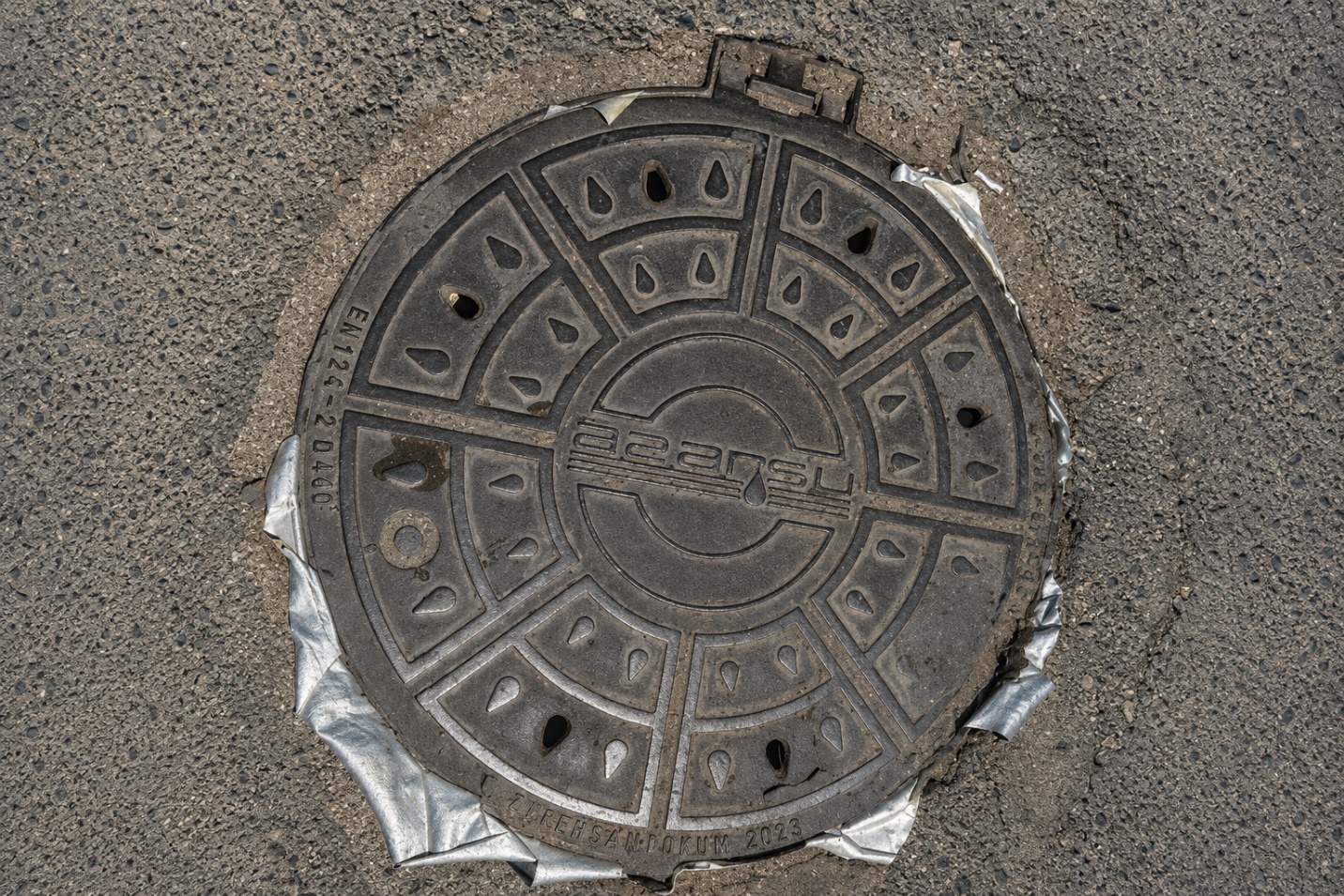
A similarly problematic sewer line, allegedly laid illegally in 2024, has become part of everyday life. The asphalt along the line constructed for the Azerbaijan Trade Unions Confederation is subsiding and collapsing. It remains unrepaired for months. A heavy smell spreads from the manholes. Residents cover gaps with whatever materials they can find in an attempt to protect their yards and homes from the stench.
Meanwhile, water of unknown origin reaches the coast every day and floods part of the area. No one has publicly explained whether it is groundwater, technical water or sewage. Nor have the results of any laboratory tests been published to show whether the water poses a threat to people or the marine environment.
Behind what appear to be local problems — a broken road, the smell of sewage and a flooded beach — a more serious question is gradually emerging: what happens when several state institutions are connected to the same problem, but none assumes responsibility for resolving it?
Nearly three months of official appeals have produced no answers. The complaint about the agencies’ silence is now under the supervision of Azerbaijan’s Ombudsman’s Office. For Buzovna residents, however, the central facts remain unchanged: the road is still damaged, the source of the water flowing onto the beach has not been established, and questions about the legality and safety of the sewer line remain unanswered.
Five Institutions and Not One Substantive Answer
On May 25, acting under the Law on Access to Information, I submitted an information request simultaneously to five institutions: the Ministry of Ecology and Natural Resources, the Azerbaijan State Water Resources Agency, the State Committee for Urban Planning and Architecture, the Azerbaijan Trade Unions Confederation and the Khazar District Executive Authority.
The first official appeals were submitted on April 4 and concerned the construction of a sewer line in Buzovna, damage to road infrastructure, possible environmental pollution and the suspected discharge of wastewater into the Caspian Sea.
At the centre of the dispute is a sewer line installed by ADSEA for a facility belonging to the Trade Unions Confederation. The legality of the construction, the quality of the work and the line’s possible environmental impact have yet to receive a public, documented assessment.
The May 25 request contained specific questions. On what legal basis was the sewer line built? Who prepared and approved the project? Were technical and environmental assessments conducted? Who supervised the quality of the work? Who is responsible for restoring the damaged road? Was the water reaching the coast tested?
The institutions were also expected to provide information about internal investigations, assessments of the actions of responsible officials, and the possibility of arranging independent technical and environmental examinations.
None of the five recipients replied.
As a result, the public still does not know who authorised the line’s construction, whether the work complied with the approved design, who conducted technical supervision or whether there is a risk to residents’ health and the Caspian coast.
This is not a private conflict between the owners of neighbouring properties or an isolated utility accident. The questions concern a public road, sewer infrastructure, the sanitary safety of a residential area, the condition of a beach and the possible pollution of the sea.
That is why the silence of government institutions has become a separate part of the problem.
Complaint to the Ombudsman
After the statutory response periods expired, a complaint was submitted on June 23 to Azerbaijan’s Commissioner for Human Rights, Sabina Aliyeva, concerning state bodies’ refusal to provide information and the violation of the right of access to it.
The complaint said that the absence of responses, as well as the delivery of formal or incomplete letters, obstructed the exercise of rights guaranteed by Azerbaijan’s Constitution.
Article 50 of the Constitution establishes everyone’s right to lawfully seek, obtain, transmit, prepare and disseminate information. Article 57 guarantees citizens the right to appeal to state bodies and receive a reasoned response.
The appeal also alleged possible violations of the Law on Access to Information. In particular, it referred to provisions establishing the principle of openness, an information holder’s obligation to provide information in full, deadlines for answering requests, and liability for an unjustified refusal or evasion of a response.
In Buzovna, however, the question of information is directly connected to the question of safety.
Article 39 of the Constitution guarantees the right to live in a healthy environment. The Aarhus Convention, to which Azerbaijan is a party, provides for the public’s right to obtain environmental information and participate in decisions that may affect the environment.
If water of unknown origin flows daily onto the beach and then into the sea, information about its composition cannot be treated as secondary administrative data. It directly concerns public health, the sanitary condition of the coast and the environmental security of the Caspian Sea.
I asked the Ombudsman to accept the complaint for consideration, conduct an investigation, request explanations and documents from the five institutions, facilitate the receipt of complete answers and provide a legal assessment of the actions of the officials concerned.
If violations were confirmed, it was proposed that formal submissions be sent to the appropriate authorities to remedy them and hold those responsible to account.
The Ombudsman’s Office said the appeal had been placed under review. To date, however, the government institutions have still not provided complete, substantive answers to the questions raised.
One Leak Has Been Stopped, but Its Consequences Remain
The elimination of the groundwater leak in central Buzovna shows that state and municipal bodies are capable of acting when a specific decision is taken.
Yet even this work has not been completed.
The road damaged by the leak and the subsequent work has remained partly destroyed for nearly a month. Buses and cars continue to use detour routes. Residents lose time every day, traffic is diverted onto neighbouring streets and restoration work remains unfinished.
The situation surrounding the sewer line is more complicated. It requires establishing not only the reasons for the asphalt’s collapse but also the entire chain of administrative and technical responsibility.
Who commissioned the construction? Who designed and approved the project? Who issued the permits? Who performed technical supervision? Who accepted the facility for operation? Where is the wastewater being directed? Does the line comply with construction, sanitary and environmental standards?
Until these questions are answered, any patching of individual sections of asphalt risks being only a temporary measure.
If the road surface is subsiding because of incorrectly installed pipes, leakage, insufficient soil compaction or violations of backfilling procedures, the damage will continue. If the problem lies in the design itself, repairing isolated sections of the road will not eliminate its source.
Water of Unknown Origin
Water whose origin has not been officially established appears every day on Buzovna beach.
For residents, this is not an abstract environmental risk. The water passes through an area used for recreation and reaches places close to where adults and children swim.
Samples must be collected, laboratory tests conducted and the results published to determine the degree of danger. At a minimum, the water should be tested for microbiological and chemical contamination. Its precise point of origin and route to the coast must also be established.
If tests have been conducted, the public has a right to see the results. If they have not, the authorities must explain why.
Until the water’s origin is established, a risk to swimmers, residents of nearby homes and the Caspian Sea ecosystem cannot be ruled out. At the same time, it cannot be asserted that the water is sewage unless this is confirmed by laboratory analysis.
State environmental monitoring, sanitary supervision and the public’s right to information exist precisely to eliminate such uncertainty.
Responsibility Divided Among Agencies
The Buzovna case shows how an administrative system can create a situation in which powers are distributed among several institutions while responsibility for the final outcome effectively belongs to no one.
The Azerbaijan State Water Resources Agency is responsible for water and sewer infrastructure. The Ministry of Ecology and Natural Resources should monitor possible environmental impacts. The State Committee for Urban Planning and Architecture has authority over construction regulation. The Khazar District Executive Authority is responsible for the condition of the territory and the coordination of local services.
The Trade Unions Confederation, for whose facility the sewer line was constructed, cannot remain a passive observer either.
Each institution has its own area of authority. Residents, however, are not dealing with separate bureaucratic functions. They face a single outcome: a damaged road, a sewage smell and water of unknown origin on the beach.
In this case, the division of powers increasingly resembles the division of irresponsibility. One institution may refer to another’s jurisdiction, the second may cite a lack of technical authority, and the third may point to the need for additional approval. While this administrative circle continues, the problem remains in place.
What Must Be Published
Buzovna does not need more formal letters or notices that an appeal has been forwarded from one institution to another.
It needs a single public, inter-agency response containing:
- documents identifying the client and detailing the design and approval of the sewer line and groundwater-drainage system;
- information about permits issued for the work;
- the results of technical and environmental assessments;
- information identifying who supervised and accepted the facility;
- test results for the water reaching the beach;
- a plan to eliminate the sewage smell;
- a timetable for restoring the damaged road surface;
- an assessment of the responsibility of the organisations and officials involved.
Publication of this information would make it possible to distinguish confirmed violations from assumptions, determine the scale of the environmental risk and understand precisely what work is required.
Until the documents are disclosed, their place will continue to be occupied by the smell, the subsiding asphalt and the flow of unidentified water.
Complaint Under Review, Problem Unresolved
A previous Turan article asked why government agencies and the trade unions continued to “play hide-and-seek”.
More than a month later, the question remains relevant. The only change is that the agencies’ silence is now officially under the supervision of the Ombudsman’s Office.
Placing a complaint under review, however, is not the same as restoring a violated right. That requires complete answers, publication of documents, proper testing, restoration of the road and the elimination of possible sources of pollution.
The individuals and organisations whose decisions or inaction led to the present situation must also be identified.
Until that happens, Buzovna will continue to live in the strange gap between a formal state response and the absence of visible results. The leak has been stopped, but the road has not been restored. The complaint has been registered, but no answers have been received. The sewer line is operating, but its legality and safety have not been explained. Water continues to reach the beach, but its origin remains unknown.
Buzovna is still waiting — for the road to be repaired, the sewage stench to end, the water-test results to be disclosed, and an answer to the central question: who is responsible for what is happening in the settlement?
Previous articles:
Buzovna Awaits Answers: State Authorities and Trade Unions Continue Playing Hide-and-Seek
Sewerage, water supply and Illegal pipes
Monument to Corruption: A Rusted Bin in Buzovna Exposes Azerbaijan’s Systemic Failures
The problem is that the government is Executive, not Proactive
Coastal Crisis in Azerbaijan: Hidden Sewage Discharges at Zagulba-Buzovna Beaches
Azerbaijan Marks National Press Day with Sewage Fountain
Is it possible to raise the standards of beach recreation amidst environmental issues?
Environmental crisis in Azerbaijan: sewage scandals and inactivity of state structures
Silence speaks volumes: Azerbaijan's struggle with transparency and accountability
Will Azerbaijani beaches raise "Blue flags"?
Construction of Immoral Water Supply System in Buzovna Accelerated
Construction of "immoral" water pipeline is suspended
Third Lawsuit against Azersu on Turan News Agency's Information Request


Social
-
Behind the high stone wall of an ordinary private home in Buzovna stand several ancient gravestones. They are not part of a decorative garden, nor were they moved there by archaeologists. The house simply happened to be built on the site of an old...
-
The participation of Armenian wrestlers in the U17 World Championships will test whether the cautious political dialogue between the two countries can move beyond negotiating rooms. If one of Armenia’s young wrestlers climbs to the top of the podium...
-
“Ali Ayaghi” in Buzovna: A Shrine, a Legend, and the Forgotten History of Absheron History on the Absheron Peninsula rarely lies on the surface. It hides beneath later buildings and survives in the names of neighbourhoods, ancient cemeteries, wells,...
-
A journey through the history of Azerbaijan usually begins with its best-known symbols—Gobustan, the Maiden Tower, and Ateshgah. These landmarks have long become part of the national historical canon and essential destinations on every itinerary....


Leave a review