


Generated by AI

A journey through the history of Azerbaijan usually begins with its best-known symbols—Gobustan, the Maiden Tower, and Ateshgah. These landmarks have long become part of the national historical canon and essential destinations on every itinerary. Yet only a few dozen kilometers northeast of Baku lies another place, one that has remained almost unnoticed by both mass tourism and broader historical discourse.
It is the coastal strip stretching between Buzovna, Zagulba, Bilgah, and Nardaran.
On the map, it appears to be a succession of seaside settlements with beaches, rocky coves, and summer-house districts. A closer look, however, reveals that this is one of the most remarkable historical landscapes in Azerbaijan. Within a distance of less than ten kilometers stand Bronze Age petroglyphs, ancient burial mounds, sacred rocks, medieval necropolises, shrines that continue to attract pilgrims, monuments of early Christianity and Islam, and, at the end of this millennia-long sequence, the presidential residence of the modern Azerbaijani state.
Such a concentration of historical periods seems almost unbelievable. Yet it is precisely this phenomenon that invites us to view northern Absheron not as a collection of isolated monuments, but as a single historical landscape.
Most existing studies examine these sites separately. Archaeologists study the burial mounds. Historians of religion focus on the shrines. Ethnographers record local traditions. Such an approach is entirely natural for academic research, but it leaves unanswered the question that immediately arises when one looks at the map.
Why are all these monuments located so close to one another?
Why did the people of the Bronze Age choose precisely this stretch of coastline? Why did ancient places of worship emerge here? Why were necropolises, mausoleums, and pirs constructed here continuously over thousands of years? Why, after the Second World War, did the Soviet leadership establish its government residences here, and why did Zagulba later become the site of the presidential residence of independent Azerbaijan?
Sometimes the history of a place is more important than the history of individual structures.
Archaeologists describe such territories as cultural landscapes—places that successive civilizations choose again and again. States, languages, and religions change, yet the landscape itself continues to attract people. The reasons may be entirely practical: a favorable coastline, freshwater sources, distinctive terrain, or sheltered bays. Sometimes, however, the decisive factor is something less tangible—the special significance that a place gradually acquires in the collective memory.
Northern Absheron is remarkably similar to precisely such a cultural landscape.
Modern scholarship increasingly demonstrates that geography influences history far more profoundly than was long believed. Coastlines determine trade routes, elevations become natural settlement centers, unusual rock formations turn into sacred sites, and convenient bays survive the rise and fall of historical eras. A landscape is capable of preserving its attractiveness even when its population changes completely.
This is precisely why the same stretch of coastline successively attracted Bronze Age hunters, the agricultural communities of Caucasian Albania, Muslim pilgrims, the Soviet political elite, and the leadership of modern Azerbaijan. Political systems came and went. The place itself remained.
This series of publications is devoted to an attempt to examine northern Absheron as a single historical landscape.
The first article explores the mysterious Nazranly quarter (məhəllə) of Buzovna, whose name may preserve the memory of the region's early Christian or Judeo-Christian traditions.
The second article will focus on the shrine known as Ali Ayagy, where Islamic tradition may conceal much older ideas about a sacred place.
The third article examines the so-called Hun Cemetery of Buzovna, where local historical memory intersects with archaeological evidence, and where the principal question concerns not so much the origin of the surviving gravestones as what may lie beneath them.
The fourth article takes the reader to the Umid Gaya rocks between Bilgah and Nardaran—a site where Bronze Age petroglyphs, cup-shaped depressions, stone cart tracks, and burial mounds have survived.
The concluding article is devoted to Zagulba. At first glance, it appears to stand apart from this historical sequence. Yet it is here that the connection between the ancient landscape and modern political geography becomes especially clear. Why was this particular stretch of coastline chosen first for government residences and later for the presidential residence? The answer may lie not only in politics but also in the landscape itself.
These studies do not seek to confirm legends. Neither do they attempt to dismiss them simply because they belong to the realm of oral tradition. Folk memory sometimes preserves genuine historical events, although it inevitably reshapes them. Archaeology demands evidence and cannot always provide definitive answers. The most fascinating discoveries often emerge precisely where scientific analysis meets human memory.
There is another reason to turn to these places today.
Many monuments of northern Absheron are gradually disappearing. Ancient burial mounds are being destroyed by modern construction. Historic necropolises are shrinking. Individual gravestones now stand in the courtyards of contemporary houses. Petroglyphs are slowly eroding under the combined effects of time and human activity.
History disappears not only when famous palaces collapse. It also disappears when the last burial mound vanishes unnoticed, when an ancient inscription on limestone is worn away, or when yet another section of an old cemetery gives way to a newly built street.
Historians usually ask very specific questions: Who built this mausoleum? Who carved these images into the rocks? Who was buried in this necropolis?
But northern Absheron may require a different question.
Not who came here.
But why people from different historical eras chose this place again and again.
There is still no answer. Yet the search for that answer has the potential to unite the Bronze Age and the present day, legend and archaeology, ancient shrines and state residences into one continuous historical narrative.
Because sometimes the principal monument is neither a temple, nor a burial mound, nor a cemetery.
The principal monument is the landscape itself—a stretch of land that has continued to attract people for several millennia, outliving religions, empires, wars, and states.
And it is precisely for this reason that the history of northern Absheron may still be far from over.
Early Jewish and Christian Preachers on Absheron: Buzovna, Nazranly, and the Mystery of Tarsa-pir
The history of early Christianity on the Absheron Peninsula remains one of the least explored subjects in the religious history of Azerbaijan. Unlike Gabala, Sheki, Kish, Lekit, and other regions of ancient Caucasian Albania, where more prominent Christian monuments have survived, Absheron is generally regarded as a territory shaped primarily by the Islamic culture of the late medieval period. Yet local toponymy, oral traditions, and several individual shrines point to a much older layer of religious history—Jewish, Judeo-Christian, and early Christian.
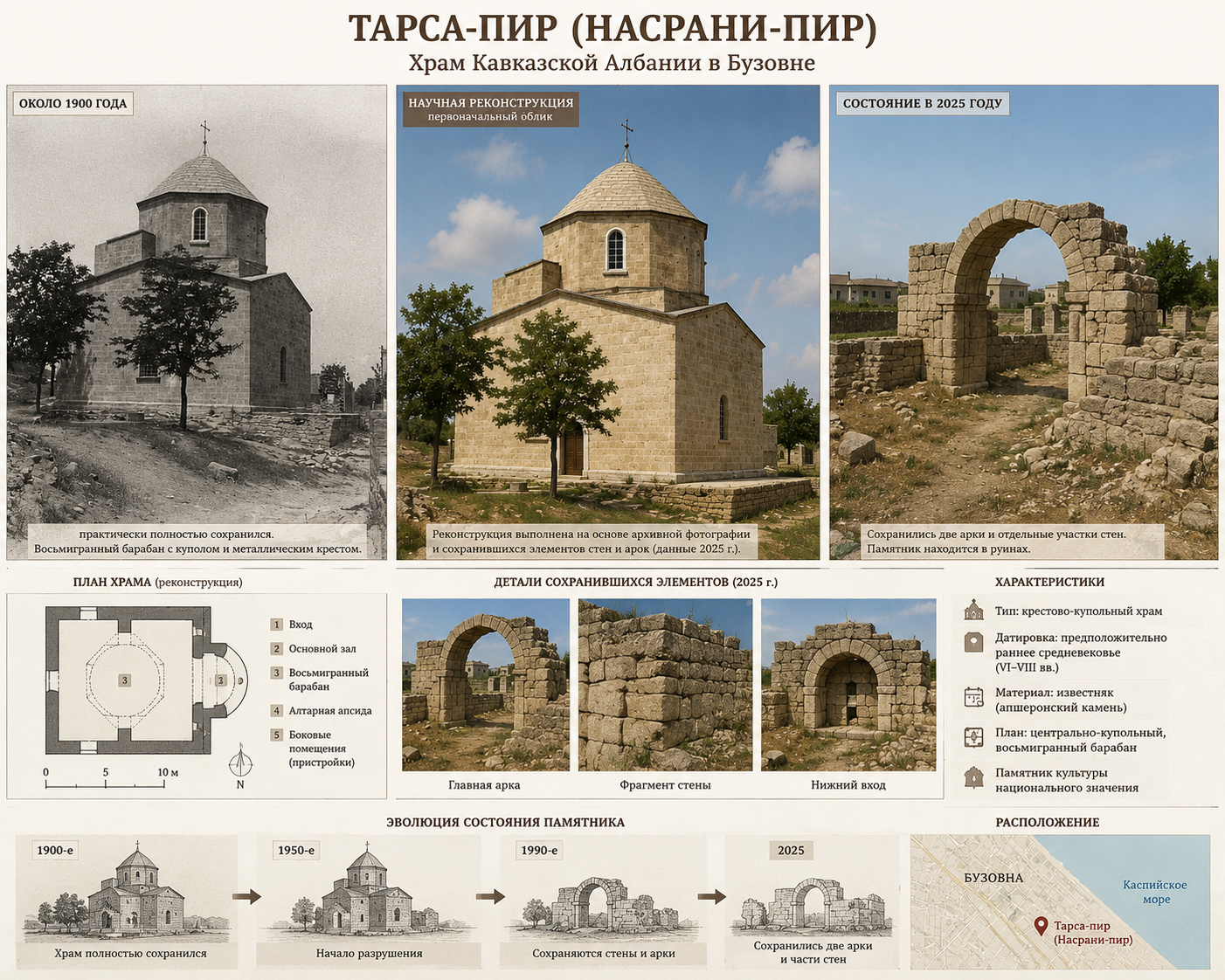
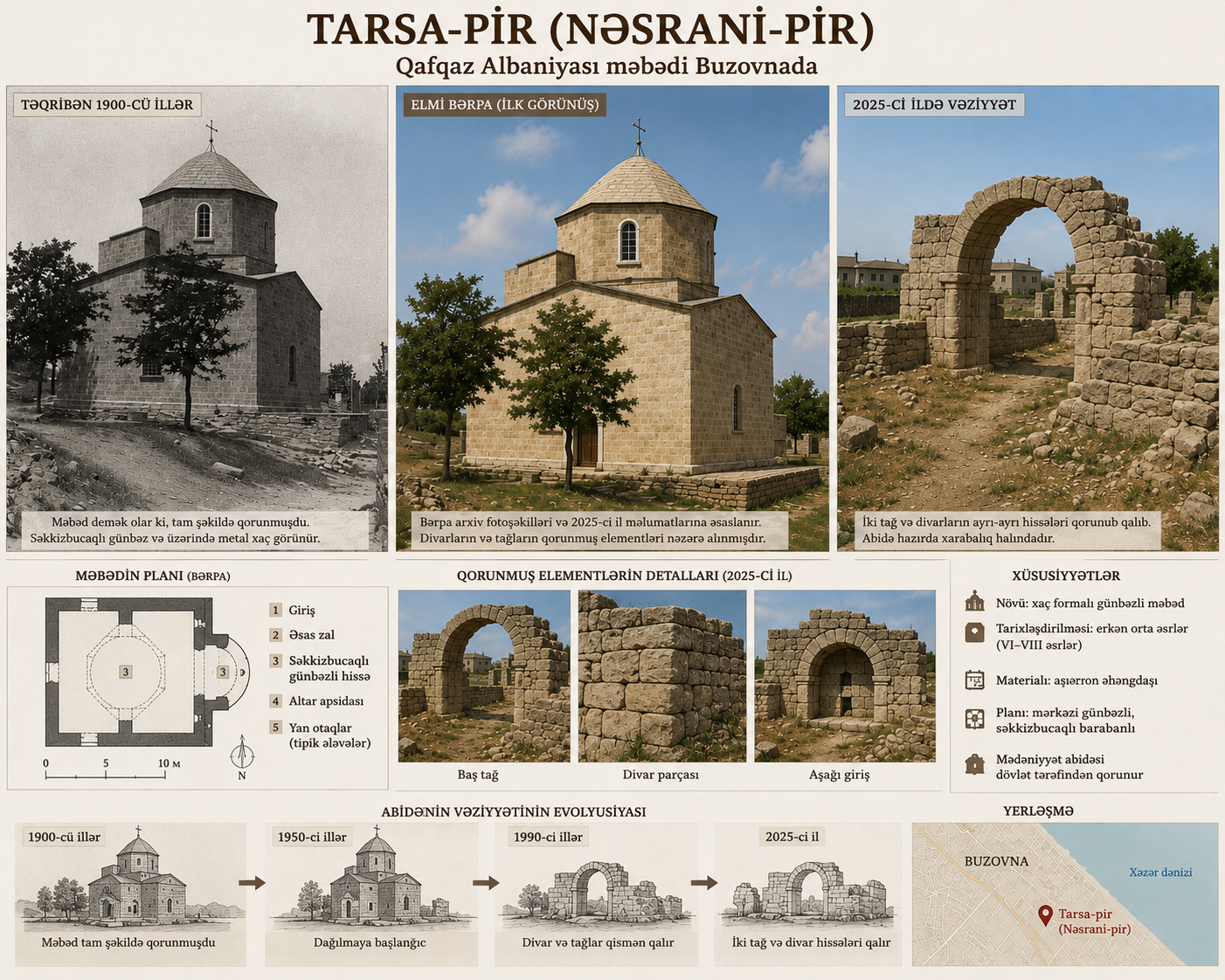
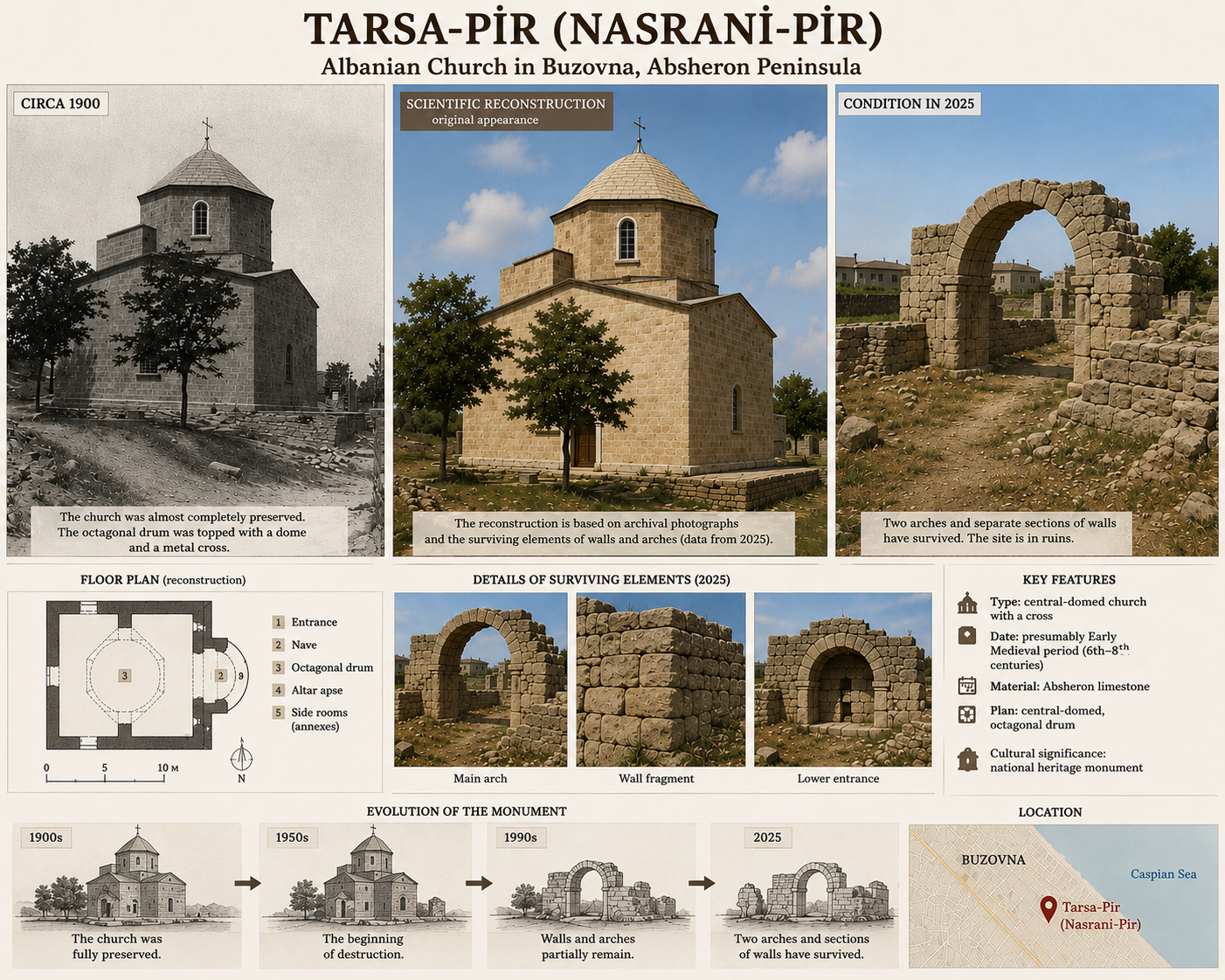
A special place in this context belongs to Buzovna, one of the oldest settlements on the Absheron Peninsula. Local historical memory preserves the name of a quarter known as Nazranly or Nazrani ("Nestorian"), which some local historians associate with the Nazarenes—the early followers of Jesus of Nazareth. Close to this toponymic layer lies another important site, Tarsa-pir (pir meaning a sacred place or shrine), whose name may literally be translated as "the Christian shrine" or "the shrine of a Christian."
The purpose of this study is not to prove a preconceived theory but rather to examine cautiously the following question: could early Jewish and Christian preachers have reached the Absheron Peninsula, and might Buzovna preserve traces of this ancient religious memory?
1. Absheron as a Crossroads of Ancient Routes
Since antiquity, the Absheron Peninsula has stood at the intersection of overland and maritime routes linking the Caucasus, Iran, Mesopotamia, the Caspian region, and the Eastern Mediterranean. The Caspian Sea was not an isolated periphery. It connected merchants, missionaries, warriors, migrants, and pilgrims.
During the Classical and Early Medieval periods, the territory of present-day Azerbaijan belonged successively to the spheres of influence of Caucasian Albania, Parthia, and later Sasanian Iran. These lands were open to diverse religious traditions, including Zoroastrianism, Judaism, early Christianity, Syriac Christianity, and, later, Islam.
The Jewish presence in the Caucasus was likewise not a late phenomenon. Jewish communities existed throughout various parts of the Eastern Caucasus, particularly in areas associated with trade routes and urban centers. The existence of such Jewish communities may have facilitated the spread of early Christianity, since the first Christian missionaries generally addressed Jewish communities of the Diaspora before turning to the wider local population.
2. The Judeo-Christian Legacy: Who Were the Nazarenes?
The term Nazarenes is associated with the earliest followers of Jesus of Nazareth. In the Aramaic tradition and later in Arabic, related forms such as Notzri, Nasrani, and Nasara referred to the followers of Jesus the Nazarene. In early Islamic usage, Nasara became the standard designation for Christians.
Historically, however, the Nazarenes were not simply "Christians" in the general sense. The term is commonly used to describe Judeo-Christian communities of the first centuries who recognized Jesus as the Messiah while maintaining their connection to Jewish religious tradition. They continued to observe the Mosaic Law, used the Aramaic language, read the Hebrew Scriptures, and at the same time revered Jesus as the Christ.
Following the establishment of official Church orthodoxy during the fourth and fifth centuries, such communities gradually became marginalized within the Christian world. Historical sources mention them primarily in Palestine, Syria, and Transjordan. There is no direct evidence that they migrated to the Caucasus. Nevertheless, the possibility that individual Judeo-Christian groups reached the Caucasus through Syria, Mesopotamia, and Iran is entirely consistent with the broader historical context.
3. Caucasian Albania and Early Christianity
The Christian tradition of Caucasian Albania traces the beginning of Christian preaching in the region to the apostolic circle. According to ecclesiastical tradition, Saint Elishe, a disciple of the Apostle Thaddeus, preached in the region as early as the first century AD. Christianity later became firmly established under the Albanian kings, particularly after the conversion of King Urnayr in the fourth century.
From a historical perspective, however, it is more accurate to speak not of the mass Christianization of the region in the first century, but of the gradual penetration of Christian ideas through Jewish, Syriac, and Mesopotamian channels. By the fourth and fifth centuries, Christianity had already become a significant political and cultural force within Caucasian Albania.
It is important to note that the early Christianity of Caucasian Albania was not identical to the Byzantine, Armenian, or Georgian traditions. It developed within a zone where multiple influences intersected—Syriac, Iranian, Armenian, indigenous Albanian, and, possibly, Judeo-Christian.
4. The Apostle Bartholomew and the Baku Tradition
Of particular importance to the Absheron Peninsula is the tradition concerning the Apostle Bartholomew. According to Christian tradition, Bartholomew—often identified with Nathanael of Cana in Galilee—preached throughout various regions of the East, including Mesopotamia, Persia, Armenia, and Caucasian Albania.
The Baku tradition associates his martyrdom with the area of present-day Baku. For this reason, the Chapel of Saint Bartholomew once stood near the Maiden Tower. Even though this tradition cannot be verified through first-century documentary evidence, it demonstrates that, within Christian historical memory, Absheron was regarded as part of the early apostolic world.
For the subject of Buzovna, this tradition is important for two reasons. First, it directly connects the Absheron Peninsula with the earliest Christian missionary activity. Second, Bartholomew came from Galilee—the same religious and cultural environment that produced the first disciples of Jesus. Consequently, the Baku tradition did not regard Christianity as a later import but associated it with the earliest apostolic period itself.
5. Buzovna and the Nazranly Quarter
Perhaps the most intriguing element of Buzovna's historical tradition is the quarter known as Nazranly or Nazrani. The very name evokes associations with the terms Nazrani, Nasrani, Nazarenes, and Nazarethians. In local interpretation, it is sometimes understood as "the quarter of the Nazarenes" or "the quarter of the followers of Nazareth."
Strict methodological caution is essential here. A place name alone cannot serve as proof of the ethnic or religious identity of its inhabitants. The name may have originated during different historical periods and may admit several explanations. It may be connected with:
- the memory of a Christian population;
- the nickname of a particular community;
- settlers arriving from another locality with a similar name;
- a later popular reinterpretation of an ancient word;
- the Arabic-Persian designation of Christians as Nasara or Tarsa.
Nevertheless, the coincidence of the name Nazranly with the nearby Tarsa-pir makes this connection particularly compelling. If one toponym may point to the Nazarenes, while another literally translates as "the Christian shrine," then what we are observing is no longer an isolated coincidence but potentially a surviving fragment of a much older religious landscape.
6. Tarsa-pir: A Christian Shrine Within an Islamic Landscape
The name Tarsa-pir consists of two semantic elements. In Persian and Turkic tradition, the word tarsa frequently meant "Christian." In Azerbaijani culture, the word pir denotes a sacred place, a site of pilgrimage, a mausoleum, or another object of religious veneration.
Accordingly, Tarsa-pir may be translated as "the shrine of a Christian," "the Christian pir," or "the Christian sanctuary." The name is particularly significant because it may have survived the Islamization of the region. In many parts of the Caucasus and the Middle East, ancient Christian or pre-Islamic sacred sites did not disappear entirely but were reinterpreted within the framework of popular Islamic religious practice. People continued to visit these sacred places, while their original meaning gradually evolved.
If Tarsa-pir indeed originated as an early Christian site, it may represent an example of such religious continuity: an ancient Christian sanctuary preserved in the collective memory of the local Muslim population as a pir.
7. Could Early Jewish Preachers Have Reached the Absheron Peninsula?
There are no direct historical sources documenting the activities of Jewish preachers specifically in Buzovna. The question, however, should be considered within a broader historical context. The earliest Christian missionaries themselves emerged from a Jewish environment. The Apostles and the first disciples of Jesus were Jews, spoke Aramaic, and thought within the framework of Jewish religious tradition.
If Jewish communities existed in the Eastern Caucasus, the first Christian missionaries would naturally have addressed them before turning to the broader local population. This pattern of Christian expansion was characteristic of many regions of both the Roman and Parthian worlds: first the synagogue and the Jewish Diaspora, then the wider indigenous population.
For this reason, it is more accurate to speak not of a purely Christian mission but of a possible Judeo-Christian phase in the spread of Christianity. During that period, the boundary between Judaism and Christianity had not yet become fully defined. To the local population, such preachers may have appeared as representatives of a distinctive eastern faith associated with Jerusalem, Galilee, and the Syriac-Mesopotamian world.
8. Saints Elijah and Andrew in the Traditions of Buzovna
Particularly noteworthy are the traditions concerning Saint Elijah and Saint Andrew associated with Buzovna. During the nineteenth century, several travelers and scholars of the Caucasus recorded accounts of ancient shrines and burial sites on the Absheron Peninsula that local inhabitants associated with these biblical figures.
These accounts are found above all in the writings of the distinguished Russian orientalist and traveler Ilya Berezin, who, during his journeys across Absheron, recorded local traditions concerning the existence of the graves of Saints Elijah and Andrew in the vicinity of Buzovna.
From a historical standpoint, these accounts cannot be interpreted literally. The Prophet Elijah lived in the ninth century BC in the ancient land of Gilead, while the Apostle Andrew originated from Galilee and, according to Christian tradition, preached in Asia Minor, the Black Sea region, and the Caucasus. No reliable historical evidence confirms that either of them ever visited Buzovna.
The traditions themselves, however, possess considerable historical value. Throughout the history of the Middle East and the Caucasus, numerous sacred sites became associated with well-known biblical figures regardless of their actual burial places. Such locations evolved into centers of pilgrimage and preserved the memory of the region's earliest religious traditions.
The figure of the Apostle Andrew is especially significant. According to ancient ecclesiastical tradition, he preached in parts of the Caucasus and along the Black Sea coast. Consequently, the appearance of his name in the legends of Absheron may reflect a very ancient layer of Christian memory dating back to the earliest centuries of Christianity's spread throughout the Caucasus.
The presence of the Prophet Elijah in local traditions is equally revealing. The cult of Elijah was widespread among the Christians of the Middle East, the Caucasus, and Transcaucasia. Many ancient sanctuaries associated with springs, hills, and places of pilgrimage were dedicated to him.
For this reason, the traditions concerning Saints Elijah and Andrew in Buzovna should not be regarded as evidence that they personally visited the Absheron Peninsula. Rather, they should be understood as testimony to the existence of a durable early Christian tradition in this locality. Considered together with the toponyms Nazranly and Tarsa-pir, as well as the traditions concerning apostolic preaching, these accounts suggest that Buzovna may have been one of the local centers where the memory of the ancient Christian heritage of Absheron was preserved.
9. What Can Be Considered Established, and What Remains a Hypothesis
The following may be regarded as established:
- The Absheron Peninsula lay within a zone of ancient trade and cultural contacts.
- Caucasian Albania was one of the earliest centers of Christianity in the Caucasus.
- Christian tradition associates the region with apostolic preaching, including the missions of Saint Elishe and the Apostle Bartholomew.
- The cult of Saint Bartholomew existed in Baku.
- Buzovna preserves toponyms and sacred sites that may point to an underlying layer of Christian historical memory.
- The name Tarsa-pir can legitimately be translated as "the Christian shrine."
The following, however, remain hypotheses:
- that the Nazranly quarter was founded specifically by Palestinian Nazarenes;
- that a distinct Judeo-Christian community existed in Buzovna;
- that Tarsa-pir was originally a Nazarene sanctuary;
- that the earliest apostolic missionaries personally visited Buzovna.
Confirming these hypotheses would require archaeological excavations, epigraphic discoveries, the study of old cemeteries, analysis of historical maps, investigation of local oral traditions, examination of pre-revolutionary descriptions of the Absheron Peninsula, and comparative linguistic research on local toponyms.
Folk Memory as the Guardian of History
Buzovna may prove to be one of the most important locations for the study of the early Christian history of the Absheron Peninsula. The Nazranly quarter and the shrine of Tarsa-pir do not constitute direct evidence for the presence of the ancient Nazarenes. They do, however, provide a substantial foundation for further scholarly investigation.
The most cautious conclusion is therefore the following: traces of early Eastern Christian and, possibly, Judeo-Christian traditions may well have survived on the Absheron Peninsula, including the area around Buzovna. These traces have reached us not in the form of monumental churches or written chronicles, but rather as place names, traditional local names, sacred sites, and oral traditions.
For this reason, Buzovna deserves dedicated historical and archaeological research. If Nazranly and Tarsa-pir are indeed connected with an ancient Christian population, then they may represent a forgotten chapter in the history of the Absheron Peninsula—a period when the peninsula's religious landscape was considerably more complex than is generally assumed today.
When the evidence relating to Nazranly, Tarsa-pir, the traditions concerning the Apostle Bartholomew in Baku, and the accounts of Saints Elijah and Andrew in Buzovna are considered together, they form a distinctive map of the Christian memory of the Absheron Peninsula. Individually, none of these elements provides direct proof for the existence of early Judeo-Christian communities. Taken together, however, they suggest that the collective memory of the peninsula has preserved traces of a remarkably ancient religious layer whose origins may reach back to the earliest centuries of Christianity in Caucasian Albania.
This subject deserves further archaeological, linguistic, and historical investigation.
(To Be Continued)


Social
-
The Bronze Age burial-mound field is officially protected by the state. On the ground, however, the ancient mounds are being damaged, encroached upon by construction and gradually erased from the landscape. On the northeastern edge of the...
-
BAKU, July 31 — Azerbaijan faces a difficult choice between the two main power centres in world football after the Union of European Football Associations (UEFA) threatened to boycott all competitions organised by the International Federation of...
-
Traffic in central Buzovna continues to be shaped by the consequences of an accident that has formally been resolved. The groundwater leak has been stopped, but the damaged road has not been restored. For nearly a month, buses and cars have been forced to bypass the closed section by using other streets in the settlement.
-
Behind the high stone wall of an ordinary private home in Buzovna stand several ancient gravestones. They are not part of a decorative garden, nor were they moved there by archaeologists. The house simply happened to be built on the site of an old...


Leave a review