


Generated by AI

Azerbaijan faces a difficult choice between the two main power centres in world football after the Union of European Football Associations (UEFA) threatened to boycott all competitions organised by the International Federation of Association Football (FIFA) over a plan to bring private investors into the management of commercial rights to World Cups and other tournaments.
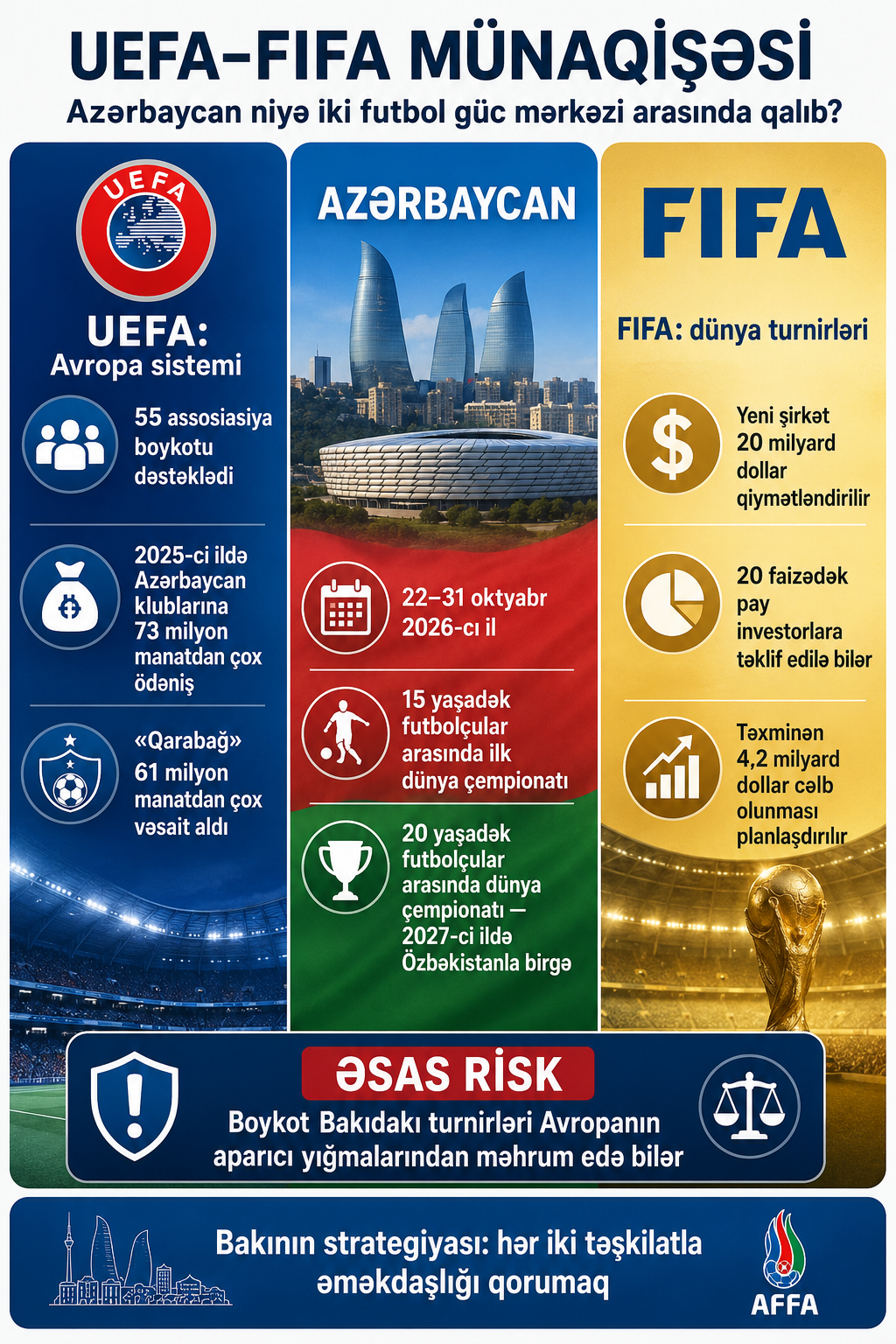
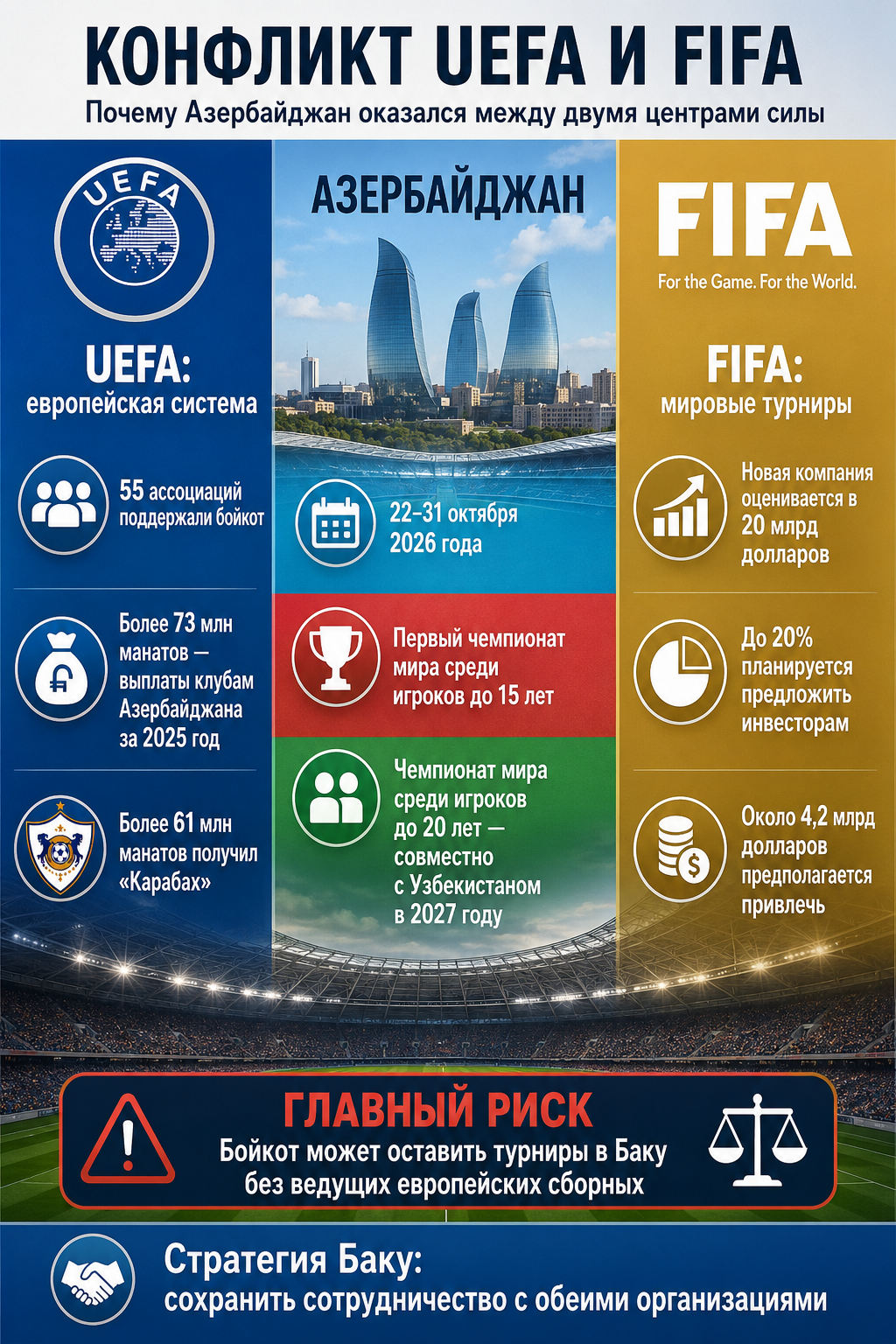
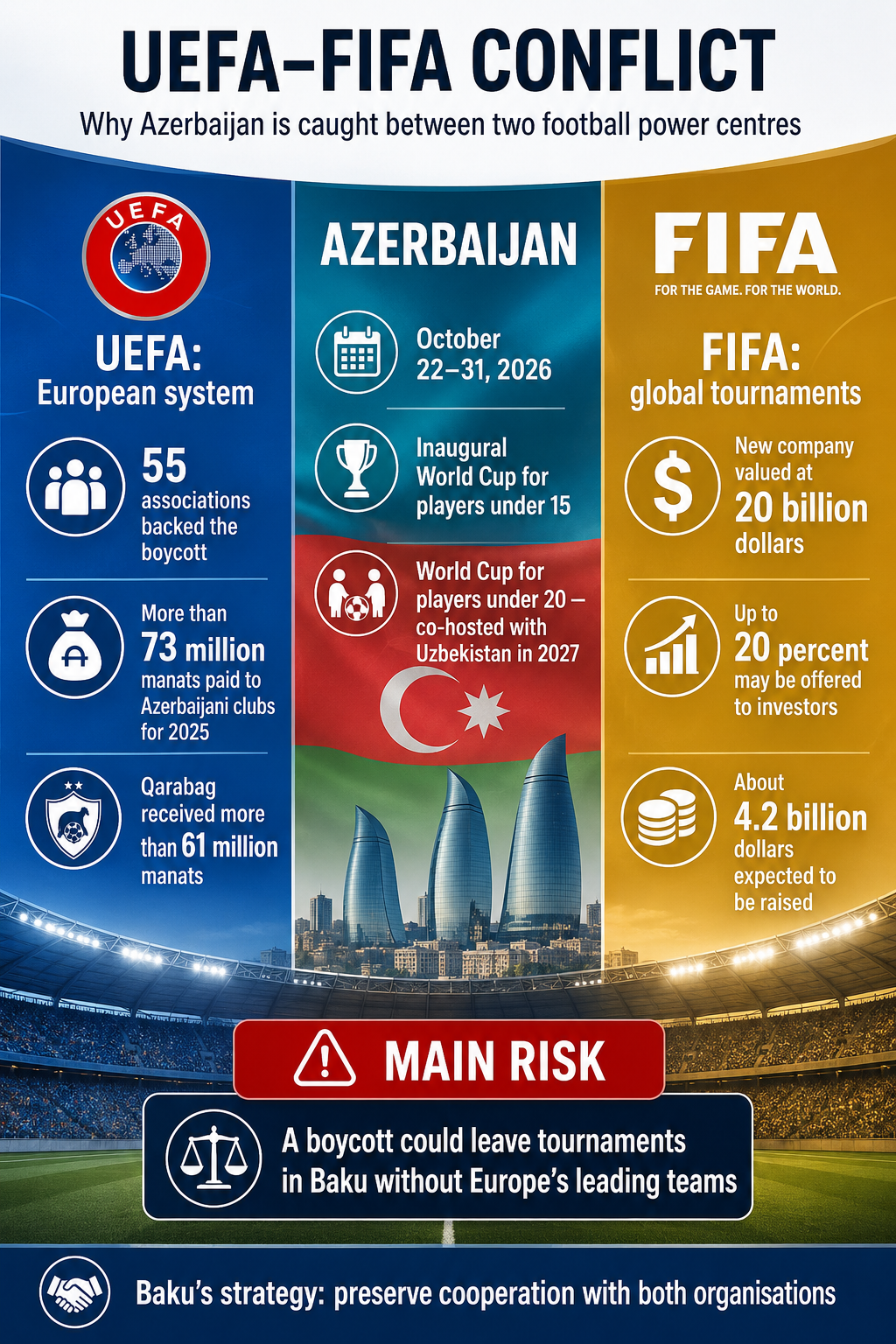
For Baku, the dispute has more than political and financial significance. Azerbaijan is due to host the inaugural World Cup and Football Festival for players under the age of 15 from October 22 to 31, 2026, and to stage the World Cup for players under the age of 20 jointly with Uzbekistan in 2027.
If the European boycott takes effect and extends to youth competitions, the two projects intended to raise Azerbaijan’s international profile could be deprived of Europe’s leading national teams.
The World Cup as an investment asset
The confrontation was triggered by a proposal from the leadership of the International Federation of Association Football to establish a separate commercial company called FIFA Forward Enterprise. The plan envisages transferring to the new entity the management of commercial operations linked to World Cups and other competitions organised by the world governing body.
The new company is valued at about 20 billion dollars. The International Federation of Association Football is considering selling a stake of up to 20 percent to external investors in an effort to raise about 4.2 billion dollars.
The assets involved include revenue from television broadcasting rights, sponsorship agreements, ticket sales, product licensing and other commercial activities. The American bank JPMorgan Chase is involved in preparing the project, while the potential investors are reported to include Thrive Eternal, an investment vehicle linked to entrepreneur Joshua Kushner.
Gianni Infantino, president of the International Federation of Association Football, has presented the project as a means of significantly increasing funding for national associations and accelerating the development of football in countries without large domestic revenues.
Each of the organisation’s 211 national federations has been promised up to 40 million dollars over a four-year cycle if the project is approved by September 19. In that case, the total funding package could reach 10 billion dollars. If the proposal is rejected, the programme would revert to the previously planned 2.7 billion dollars, equivalent to about 10 million dollars for each national association.
Opponents of the initiative argue, however, that an immediate increase in payments could be accompanied by a long-term loss of control over the main commercial asset in world football.
That argument gained additional weight after the resignation of Infantino’s senior adviser Carlos Cordeiro. The former investment banker described the proposal as a bad deal for football and questioned why an organisation with billions of dollars in reserves and no debt needed to sell a permanent stake in its most valuable asset.
Europe responds with a threat of a complete boycott
At an emergency meeting on July 30, all 55 national associations belonging to the Union of European Football Associations voted to boycott competitions organised by the International Federation of Association Football unless the investment project was withdrawn in full.
The European body said the World Cup was part of football’s shared heritage, not an investment product that could be placed partly in the hands of external investors.
Under the position adopted at the meeting, European national teams will not participate in any competition organised by the International Federation of Association Football for as long as the proposal remains alive. Europe said it would abandon the boycott only if the project were withdrawn completely and legally binding assurances were provided that the management of competitions would not be transferred to private capital.
The decision therefore does not concern only senior men’s and women’s World Cups. Its wording covers youth, junior and other competitions organised by the world governing body.
The Confederation of North, Central America and Caribbean Association Football and the Asian Football Confederation have also opposed the project. They expressed dissatisfaction over the lack of prior consultation and insufficient information about the financial and governance implications of the proposed deal. The Asian confederation, however, did not join the threat of a boycott.
At the centre of the dispute are not the commercial rights themselves, which are already sold to broadcasters and sponsors, but the possibility that private investors could obtain a permanent stake in the structure responsible for managing the world’s largest international tournaments.
Azerbaijan’s cautious position
The Association of Football Federations of Azerbaijan is one of the 55 members of the European football body and is therefore formally part of the unified position that has been announced.
However, as of July 31, the Association of Football Federations of Azerbaijan had not issued a separate detailed statement explaining how it would act if the investment project remained in place and the boycott took effect.
There is also no independent confirmation in open sources of reports that the Azerbaijani association did not participate in the preliminary discussion of the European statement or saw its final wording only after publication. Such claims therefore cannot yet be treated as established fact.
Baku’s caution is understandable. Azerbaijan is simultaneously dependent on the European football system and expanding cooperation with the world governing body, which has entrusted the country with hosting two new international tournaments.
Openly opposing the Union of European Football Associations would mean entering into a dispute with the organisation that shapes the day-to-day life of Azerbaijani club football. Support from the International Federation of Association Football, meanwhile, is important for hosting World Cups and receiving development funding.
The most likely position of the Association of Football Federations of Azerbaijan is therefore to wait for the next stage of negotiations and avoid taking an independent political role in the dispute.
Inaugural World Cup for players under 15 at risk
The first test for Baku may be the World Cup and Football Festival for players under the age of 15.
The Bureau of the Council of the International Federation of Association Football appointed Azerbaijan on June 24 to host the inaugural edition of the competition. The tournament will take place from October 22 to 31, 2026, and, under the approved concept, will be open to boys’ teams from all national associations.
A similar competition for girls is planned for 2027. From 2028, national associations are expected to be invited to send both boys’ and girls’ teams to two separate competitions.
Azerbaijani President Ilham Aliyev has already signed an order establishing an organising committee and providing financial and logistical support for the tournament.
The staging of the competition has not yet been called into question. Azerbaijan has the necessary stadiums, training grounds, hotels and transport infrastructure, and preparations are likely to continue regardless of the negotiations between the football organisations.
The main risk concerns the composition of the field.
If the European associations carry out their decision to impose a complete boycott, the youth teams of Spain, France, England, Germany, Italy and other leading football nations will not travel to Azerbaijan. Their absence would significantly reduce the sporting standard of the competition, spectator interest and the commercial attractiveness of television coverage.
The current European statement does not provide for limiting the boycott to senior competitions. On the contrary, the announced formula covers all tournaments organised by the world governing body. Preserving the participation of European youth teams would therefore require either a change in Europe’s position or the withdrawal of the project by the International Federation of Association Football.
The dispute could have even more serious consequences for the World Cup for players under the age of 20, which Azerbaijan and Uzbekistan are due to stage jointly in 2027. That tournament is expected to include European teams emerging from qualification and has considerably greater sporting and commercial value.
European funding carries greater weight
The financial structure of Azerbaijani football explains why it would be extremely difficult for Baku to distance itself from the European organisation.
The International Federation of Association Football supports Azerbaijan through its Forward programme. The money is used for the national association’s operations, the construction and modernisation of infrastructure, the development of grassroots football and the introduction of new technology.
For Azerbaijani football, however, the financial importance of the Union of European Football Associations is considerably greater.
The European body finances national federations through its HatTrick programme. The funding is used to train coaches and referees, organise youth competitions, develop women’s and grassroots football, and construct sports facilities.
In December 2025, it was reported that the Association of Football Federations of Azerbaijan would receive more than 5.5 million euros under the solidarity programme.
The European organisation’s role is even more visible at club level. According to the Association of Football Federations of Azerbaijan, payments from the European body to Azerbaijani clubs for 2025 exceeded 73 million manats.
The Aghdam-based Qarabag club received more than 61 million manats. Baku’s Sabah club was allocated about 3 million manats, Araz-Nakhchivan received approximately 2.5 million manats, and Zira was paid more than 2 million manats. The remainder was distributed among other clubs in the national championship.
The revenue comes from participation in European club tournaments, sporting results, television rights, ranking performance and solidarity payments.
The International Federation of Association Football has no comparable mechanism for providing clubs with regular financial support. Its payments to club teams are mainly linked to the participation of their players in World Cups. Since players from Azerbaijani clubs have limited representation at such tournaments, the relevant payments remain far smaller than European funding.
Two partners offering different opportunities
The Union of European Football Associations has played a central role in integrating Azerbaijan into international club football.
Baku hosted the Europa League final in 2019, four matches of the European Championship staged in 2021 under its original Euro 2020 title, as well as several youth and qualifying competitions.
Under the auspices of the International Federation of Association Football, Azerbaijan has so far hosted only the World Cup for women under the age of 17 in 2012. The forthcoming tournament for players under 15 and the World Cup for players under 20, to be staged jointly with Uzbekistan, are expected to take that cooperation to a new level.
This creates an unusual balance of interests for Baku. The European organisation provides Azerbaijani clubs with competitions, revenue and most of their international football activity. The world governing body offers the country global visibility, new tournaments and access to development programmes.
Abandoning either direction would mean either losing vital financial and sporting links with Europe or weakening Azerbaijan’s prospects of becoming a regular host of global competitions.
Room for compromise is narrowing
For now, the conflict remains conditional: the boycott is tied to the investment project remaining alive and moving forward. If the International Federation of Association Football abandons the proposal and provides the required guarantees, European teams will be able to continue participating in its tournaments.
The unanimous vote of the 55 European associations, resistance from other regional confederations and the resignation of the world governing body president’s senior adviser have significantly reduced the chances of the project being implemented in its original form.
But if Gianni Infantino continues seeking approval for the deal, Azerbaijan will face a practical rather than symbolic choice.
Baku may continue preparations and stage the tournaments under the auspices of the world governing body. Without Europe’s leading teams, however, their international standard would be significantly lower than expected. At the same time, failing to support the common European position could complicate relations with the organisation on which Azerbaijani clubs and a substantial share of the country’s football funding depend.
Azerbaijan’s most likely strategy will therefore be to maintain relations with both sides, support a negotiated settlement and avoid public steps that could be interpreted as choosing one power centre against the other.
The main threat to Azerbaijan is not the cancellation of the planned competitions but the possibility that major international tournaments could be reduced to events with limited representation.
For Azerbaijan, which hopes to use football as an instrument of international recognition, preserving a unified global football system is more valuable than the financial promises or political victory of either side.


Social
-
Traffic in central Buzovna continues to be shaped by the consequences of an accident that has formally been resolved. The groundwater leak has been stopped, but the damaged road has not been restored. For nearly a month, buses and cars have been forced to bypass the closed section by using other streets in the settlement.
-
Behind the high stone wall of an ordinary private home in Buzovna stand several ancient gravestones. They are not part of a decorative garden, nor were they moved there by archaeologists. The house simply happened to be built on the site of an old...
-
The participation of Armenian wrestlers in the U17 World Championships will test whether the cautious political dialogue between the two countries can move beyond negotiating rooms. If one of Armenia’s young wrestlers climbs to the top of the podium...
-
“Ali Ayaghi” in Buzovna: A Shrine, a Legend, and the Forgotten History of Absheron History on the Absheron Peninsula rarely lies on the surface. It hides beneath later buildings and survives in the names of neighbourhoods, ancient cemeteries, wells,...


Leave a review