


Generated by AI

Buzovna Awaits Answers: State Authorities and Trade Unions Continue Playing Hide-and-Seek
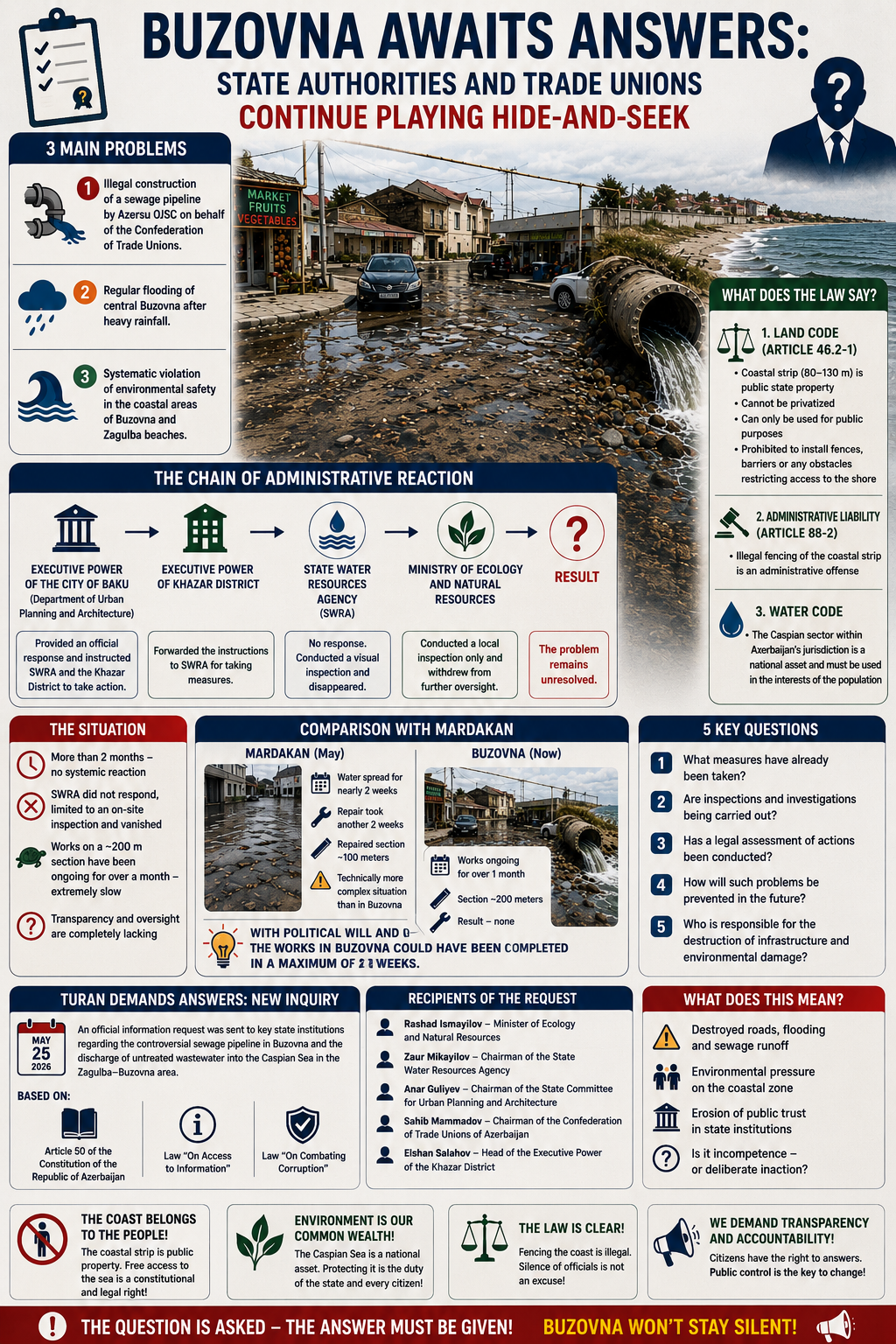
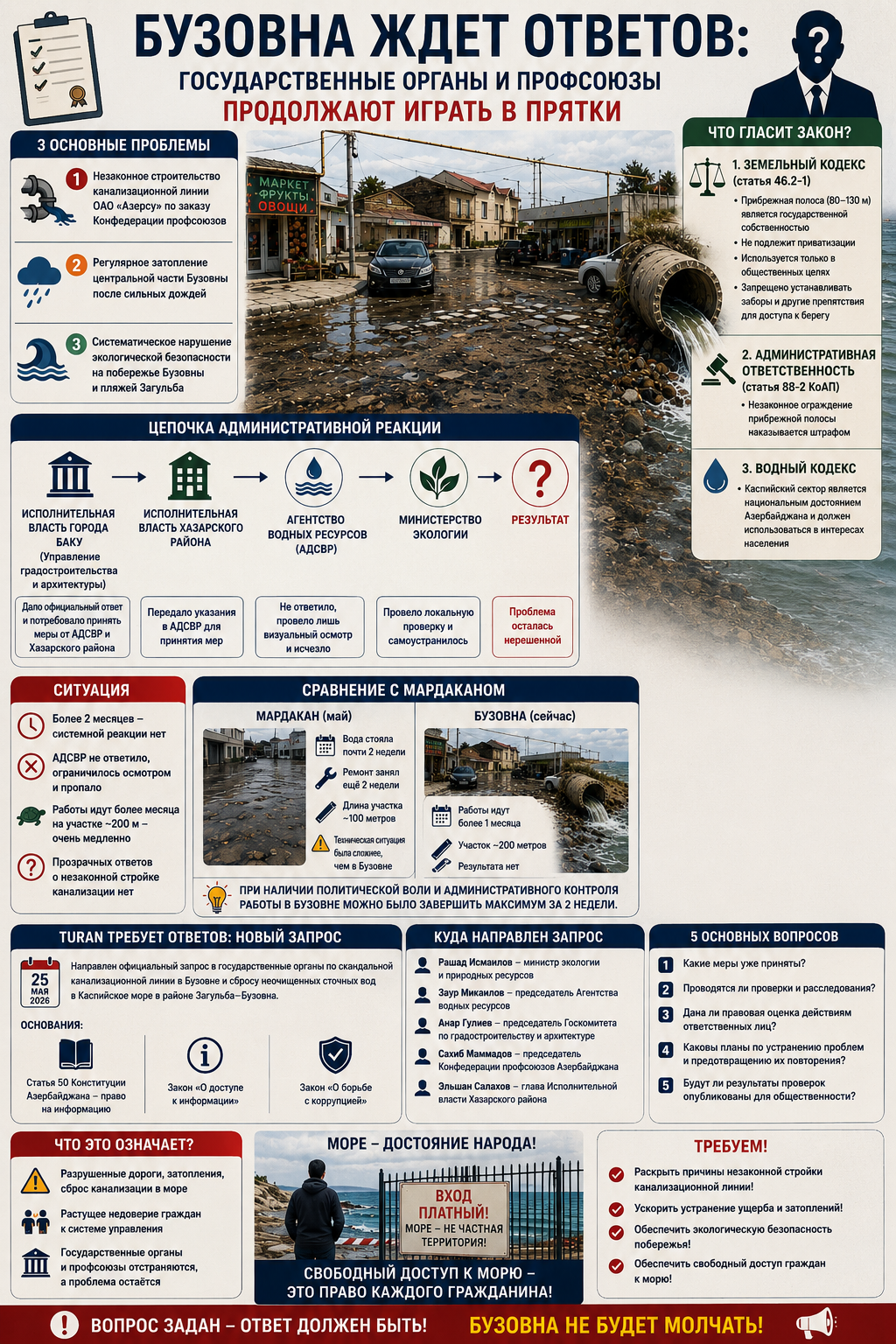
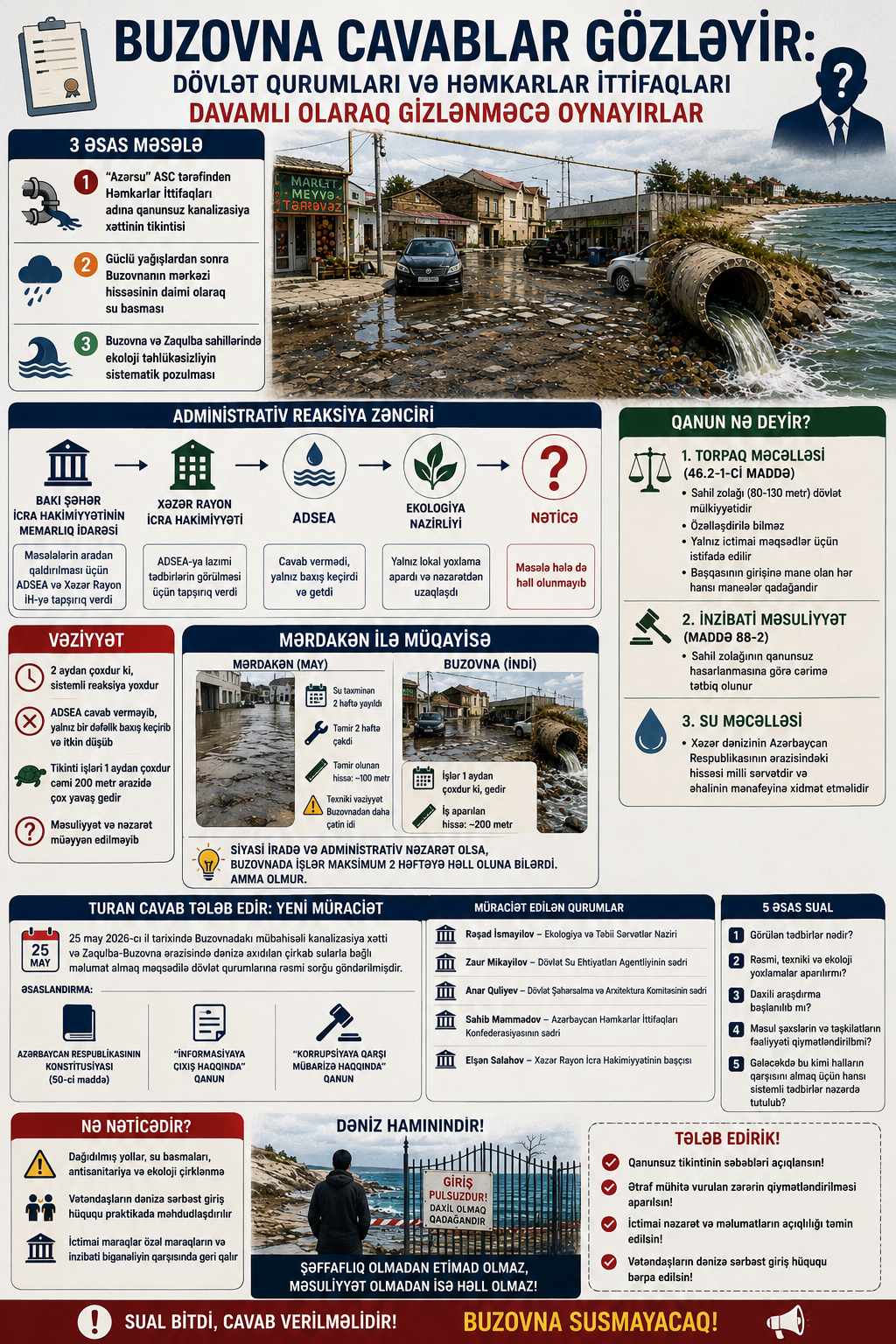
State institutions and the Confederation of Trade Unions of Azerbaijan continue to avoid giving direct answers to the questions I raised concerning the critical environmental and infrastructure situation in the settlement of Buzovna.
On April 4, an official appeal was sent to the Ministry of Ecology and Natural Resources, the State Water Resources Agency, the State Committee for Urban Planning and Architecture, the Confederation of Trade Unions, and the Executive Authority of the Khazar District regarding three key issues.
The first concerned the illegal construction of a sewage pipeline by the Open Joint Stock Company Azersu on behalf of the Confederation of Trade Unions. The second involved the regular flooding of central Buzovna after heavy rainfall. The third addressed the systematic violation of environmental safety in the coastal areas of the Buzovna and Zagulba beaches.
However, after more than two months, the situation has effectively remained without any systemic response.
The only institution that provided a clear official reply was the Department of Urban Planning and Architecture of the Executive Authority of the City of Baku. In its response, the department demanded that the State Water Resources Agency and the Executive Authority of the Khazar District take measures to resolve the issues outlined in the appeal.
Following this, the Khazar District Executive Authority, in turn, forwarded instructions to the State Water Resources Agency to take the necessary action.
At that point, the chain of administrative reaction virtually stopped.
No response was ever received from the State Water Resources Agency. Its staff merely conducted a visual inspection of the area a month ago and then disappeared.
The Ministry of Ecology limited itself to a local inspection of works aimed at eliminating the discharge of groundwater onto the surface in central Buzovna, after which it effectively withdrew from further oversight.
Meanwhile, the works themselves are progressing extremely slowly. For more than a month, operations have been ongoing on a section of approximately two hundred meters, and a final resolution remains far away.
Comparison with a similar accident in the settlement of Mardakan only intensifies questions about the effectiveness of the responsible authorities.
There, in May, a serious rupture in a sewage line occurred on the central street. Water spread across the area for nearly two weeks, after which another two weeks were spent repairing the damaged section of approximately one hundred meters.
At the same time, specialists note that the technical situation in Mardakan was significantly more complex than the current one in Buzovna.
This leads to an obvious conclusion: with political will and administrative control, the works in Buzovna could have been completed within a maximum of two weeks.
But this is not happening.
Against the backdrop of a lack of transparent answers regarding the illegal construction of the sewage line, the slow elimination of flooding consequences, and the ongoing environmental pressure on the coastal zone, the central question arises: is this inaction the result of bureaucratic inefficiency, or is it a deliberate prolonging of the resolution process?
While state authorities and trade unions continue to distance themselves, Buzovna remains trapped among destroyed roads, sewage runoff, and growing distrust in the system of governance.
In Azerbaijan, citizens’ free access to the sea is formally guaranteed by law, but in practice it is often restricted by private facilities, fences, and commercial beaches.
Key legal provisions:
1. The Land Code of Azerbaijan
According to Article 46.2-1 of the Land Code:
- the coastal strip of the Caspian Sea, ranging from eighty to one hundred thirty meters in width, is considered public state territory;
- this zone cannot be privatized;
- it may only be used for public purposes;
- it is prohibited to install fences, barriers, or any other obstacles restricting citizens’ access to the shore.
This is the main legal guarantee.
2. Administrative liability
Illegal fencing of the coastal strip is punishable under Article 88-2 of the Code of Administrative Offenses.
The law directly classifies restrictions on access to the shore as a violation.
3. The Water Code
The Water Code establishes that the Caspian sector within Azerbaijan’s jurisdiction is a national asset and must be used in the interests of the population.
While state institutions continue to avoid answering questions, Zagulba and Buzovna are gradually turning from resort areas into zones of environmental and infrastructure crisis, where public interests are increasingly уступают private interests and administrative indifference.
Turan Demands Answers: A New Inquiry into the Buzovna Sewage Case
On May 25, I sent an official information request to key state institutions demanding clarification regarding the controversial sewage pipeline in Buzovna, which, in my assessment, has already gone beyond the framework of a local коммунальный dispute and has become a matter of state governance and environmental security.
The request also asked whether an investigation had been carried out into the discharge of untreated wastewater into the Caspian Sea in the Zagulba–Buzovna area, as mentioned in the original appeal, and what the results of that investigation were.
The request was submitted on the basis of Article 50 of the Constitution of Azerbaijan, which guarantees the right to obtain information, as well as the laws “On Access to Information” and “On Combating Corruption.”
The document was addressed to:
- Rashad Ismayilov, Minister of Ecology and Natural Resources;
- Zaur Mikayilov, Chairman of the State Water Resources Agency;
- Anar Guliyev, Chairman of the State Committee for Urban Planning and Architecture;
- Sahib Mammadov, Chairman of the Confederation of Trade Unions of Azerbaijan;
- Elshan Salahov, Head of the Executive Authority of the Khazar District.
The reason for the information request was the lack of response and practical action by these institutions following my earlier appeal.
The new request asked for concrete answers across five key areas.
Among them:
- what measures have already been taken;
- whether official, technical, and environmental inspections are underway;
- whether internal investigations have been launched;
- whether the actions of responsible officials and organizations have been legally assessed.
A separate question was raised regarding the possibility of conducting an independent technical and environmental assessment, restoring damaged infrastructure, and publicly disclosing the results of all inspections.
The request also raised a strategic issue:
what systemic measures do the addressees intend to take to prevent similar situations in the future?
This concerns not only technical oversight, but also the transparency of infrastructure projects, public monitoring, access to information, and inter-agency coordination.
Special attention in the request was given to the quality of institutional communication.
The appeal concluded with a demand to provide an official response within the legally established period of seven working days.
This request became an important test for state institutions:
are they ready for an open examination of infrastructure failures, environmental risks, and possible violations, or will the Buzovna case once again remain in the zone of administrative silence?
The Khazar District Executive Authority Responds, but Takes No Responsibility
The response of the Executive Authority of the Khazar District to the information request formally appears to be an official document, but in essence it demonstrates a pattern typical of such infrastructure crises: acknowledging the existence of a problem without accepting responsibility for it.
The core of the response can be reduced to three main points.
The first: the district executive authority claims that conducting internal investigations, technical oversight, supervision, and legal assessment does not fall within its competence.
This is an important statement because it effectively means institutional distancing from a situation unfolding on the territory of the district itself.
Yet this creates an obvious contradiction.
If the district authority is not responsible for controlling construction and engineering processes on its own territory, then who is responsible for the consequences — destroyed roads, ground subsidence, and residents’ complaints?
The position of the Khazar District Executive Authority contradicts the Regulation on Local Executive Bodies, approved by a presidential decree of Azerbaijan on June 6, 2012, as well as the Rules of State Supervision over Urban Construction approved by a presidential decree on November 24, 2014.
The second point is that the Executive Authority confirmed it had forwarded the request to the State Water Resources Agency.
This indirectly confirms the absence of inter-agency coordination.
Instead of joint and accountable participation, the system continues to function by passing letters from one institution to another.
The third and most important point concerns the environmental aspect.
According to the letter, a water sample was taken from an inspection well near the drainage line, and laboratory analysis revealed no pollutants.
However, this answer raises more questions than it resolves.
First, the sample was not taken from the marine waters or the actual discharge site in the Zagulba–Buzovna area, but from a nearby well.
These are fundamentally different control points.
Second, a single laboratory test cannot rule out systematic or periodic sewage discharge, especially if the releases are unstable.
Third, the very wording about possible “future illegal connections” indirectly confirms that the risk of unlawful use of the line exists.
The conclusion is obvious:
the Khazar District Executive Authority did not deny the existence of the problem, but it also failed to answer the key questions:
- who authorized the construction;
- who supervised the project;
- who is responsible for the destruction of infrastructure;
- and whether a full environmental assessment of the marine zone was ever conducted.
In other words, the state system once again demonstrated a typical bureaucratic mechanism:
to acknowledge the existence of an object, record the absence of pollution at one single point, and at the same time avoid answering about the origin of the problem itself.
For Buzovna, this means one thing:
the issue of the sewage pipeline remains unresolved, and responsibility remains blurred across institutions.
The Others Simply Vanished into Silence
The other recipients of the information request effectively ignored the appeal altogether.
Lawyers note that in such cases, state institutions are obliged to provide socially significant information within the time limits established by law.
An incomplete response, a purely formal reaction, or no response at all may qualify as a violation of the right to access information.
The development of this case could become an important test not only for the infrastructure oversight system, but also for how effectively Azerbaijan’s mechanism of access to public information actually works.
According to legal experts, such documents fall under a special legal regime.
Under Article 24 of the Law on Access to Information, state institutions are required to provide requested information fully, accurately, and within the deadlines established by law.
Where the requested information already exists, the response period is seven working days.
Failure to respond within this period without official notice of an extension may be regarded as a violation of the law.
Lawyers emphasize that complete silence from a state institution in such a case may qualify as administrative inaction.
This may mean a violation of two constitutional norms at once:
- Article 50, guaranteeing the right to obtain information;
- and Article 57, guaranteeing the right of citizens to submit appeals.
Formal Replies and Legal Consequences
Equally problematic is the practice of formalistic replies. If an institution responds with vague formulations such as “the matter is under control,” “the information is under review,” or “an inspection is being carried out within the scope of competence,” but fails to provide direct answers to the questions raised, this may be considered an evasion of the obligation to provide information. According to experts, such practice is one of the most common forms of concealed refusal.
Refusal to disclose such data, or avoidance of answering, may affect not only the right to information but also the citizens’ right to a safe environment.
At the same time, the case reveals a potential anti-corruption dimension.
According to the Law of Azerbaijan “On Combating Corruption,” corruption-related offenses include the unjustified refusal to provide individuals or legal entities with information that must be disclosed under the law or other legal acts, delaying the provision of such information, or supplying incomplete or distorted data (Article 9.3.8).
If an infrastructure project lacks clarity regarding the заказчик, contractor, permit documents, technical acceptance certificates, and the existence of an environmental assessment, this creates risks of non-transparent use of budgetary funds and possible circumvention of public procurement procedures.
Legal experts say that such circumstances may provide grounds for an appeal to the Prosecutor General’s Office and to the Human Rights Commissioner.
In addition, the applicant has the right to file an administrative lawsuit seeking recognition of the unlawful inaction of state institutions and obliging them to provide the requested information.
Based on previous experience, this scenario may well become the next stage of the case.
Administrative Liability for Failure to Provide Information and Violating Response Deadlines
The legislation of the Republic of Azerbaijan establishes administrative liability for unjustified refusal to provide information, evasion of reply, provision of incomplete or inaccurate information, and violation of the deadlines for reviewing citizens’ appeals.
Under the Code of Administrative Offenses of Azerbaijan, officials who violate citizens’ right to information may face administrative fines ranging from three hundred to five hundred manats.
Grounds for sanctions may include:
- unjustified refusal to provide information;
- ignoring an official information request;
- violating the deadline for providing information;
- issuing a formal reply without the substance of the requested information;
- providing knowingly false or distorted information.
According to the Law of Azerbaijan “On Access to Information,” if the requested information already exists, the state institution must provide it within seven working days.
Violation of this deadline without official notification of an extension may qualify as administrative inaction.
In addition, under the Law of Azerbaijan “On Citizens’ Appeals,” state institutions are required to examine citizens’ appeals on their merits and provide a reasoned response within the established deadlines.
Formal replies, evasion of direct answers, or the unjustified transfer of an appeal between institutions without resolving the issue may also be regarded as violations of the law.
The legal consequences of such violations may include:
- the imposition of an administrative fine;
- disciplinary sanctions against an official;
- judicial recognition of the inaction as unlawful;
- a court order obliging the institution to provide the requested information.
Where the subject of the request concerns environmental issues, public safety, infrastructure, or the use of public funds, refusal to provide information may have additional legal consequences, including prosecutorial review and anti-corruption investigation.
The President Strengthens the System of Electronic Appeals
Against the backdrop of Turan’s struggle for transparency and effective communication between citizens and state institutions, President of Azerbaijan Ilham Aliyev signed a decree introducing amendments to the Law “On Citizens’ Appeals” and the rules of document management in state and municipal institutions.
The amendments strengthen the legal status of electronic appeals and expand the channels of interaction between citizens and state institutions.
The new provisions establish three official methods for submitting electronic appeals:
- through the internet resources of state institutions;
- through official electronic mail addresses;
- through the Electronic Government Information System.
This means the institutional recognition of digital mechanisms as equal in legal standing to traditional channels of communication.
The reform reflects the ongoing course toward deeper digitalization of public administration and further centralization of administrative processes within the “single window” model.
Through the Electronic Government Information System, citizens will be able not only to submit appeals, but also to monitor the process of review and receive official responses in a unified digital space.
A significant change is the expansion of the applicant’s right to choose.
Citizens may now decide how they want to receive their response:
- by electronic mail;
- by regular postal address;
- or through the Electronic Government Information System.
This changes the architecture of interaction itself, transforming the citizen from a passive applicant into an active participant in the administrative process.
Experts note that the legal equalization of digital and paper appeals is especially important for residents of remote regions and Azerbaijani citizens living abroad.
Reducing dependence on physical location may significantly improve access to state complaint mechanisms.
The new system also enhances transparency.
The registration of appeals through the Electronic Government Information System creates a digital trail for every request, reduces the risk of document loss, and increases the accountability of officials.
The next stage of reform may include the creation of an independent platform for monitoring the quality of responses, the publication of open statistics on complaint handling, the expansion of digital literacy programs, and the introduction of real administrative liability for missed deadlines.
International practice shows that the effectiveness of electronic appeals systems is determined not only by technology.
The experience of Estonia and South Korea demonstrates that digital reforms work only when accompanied by changes in governance culture, independent oversight, and clear accountability mechanisms.
For Azerbaijan, this decree is another step toward an electronic state.
However, the ultimate measure of success, as in any administrative reform, will not be the number of registered appeals, but the state’s actual ability to solve the problems that citizens bring before it.
Previous articles:
Buzovna Awaits Answers: State Authorities and Trade Unions Continue Playing Hide-and-Seek
Sewerage, water supply and Illegal pipes
Monument to Corruption: A Rusted Bin in Buzovna Exposes Azerbaijan’s Systemic Failures
The problem is that the government is Executive, not Proactive
Coastal Crisis in Azerbaijan: Hidden Sewage Discharges at Zagulba-Buzovna Beaches
Azerbaijan Marks National Press Day with Sewage Fountain
Is it possible to raise the standards of beach recreation amidst environmental issues?
Environmental crisis in Azerbaijan: sewage scandals and inactivity of state structures
Silence speaks volumes: Azerbaijan's struggle with transparency and accountability
Will Azerbaijani beaches raise "Blue flags"?
Construction of Immoral Water Supply System in Buzovna Accelerated
Construction of "immoral" water pipeline is suspended
Third Lawsuit against Azersu on Turan News Agency's Information Request


Social
-
How citizens participate in urban planning and environmental decisions in Azerbaijan The law requires projects to be disclosed in advance, residents to be heard and the rejection of their proposals to be explained. Yet an almost invisible gulf...
-
Field observation conducted on the coast near the settlement of Pirshaghi. August 2026 “It’s not as if this is your place...” This analysis begins not with figures, but with an ordinary observation. On the Caspian coast, near the settlement of...
-
Looking down on the northern Absheron coast, it is difficult not to notice a pattern. Azerbaijan's most restricted government compound — the presidential residence in Zagulba — is located neither in central Baku, nor amid the oilfields, nor even on...
-
The Road from Absolutism to Constitutional Government The Iranian Constitutional Movement (Mashruteh), which unfolded in the early twentieth century, is regarded as one of the most important turning points in the political modernization of the...


Leave a review