


Generated by AI

Sewerage, the Sea and Responsibility: How a Complaint Exposed Problems of Infrastructure Oversight in Baku
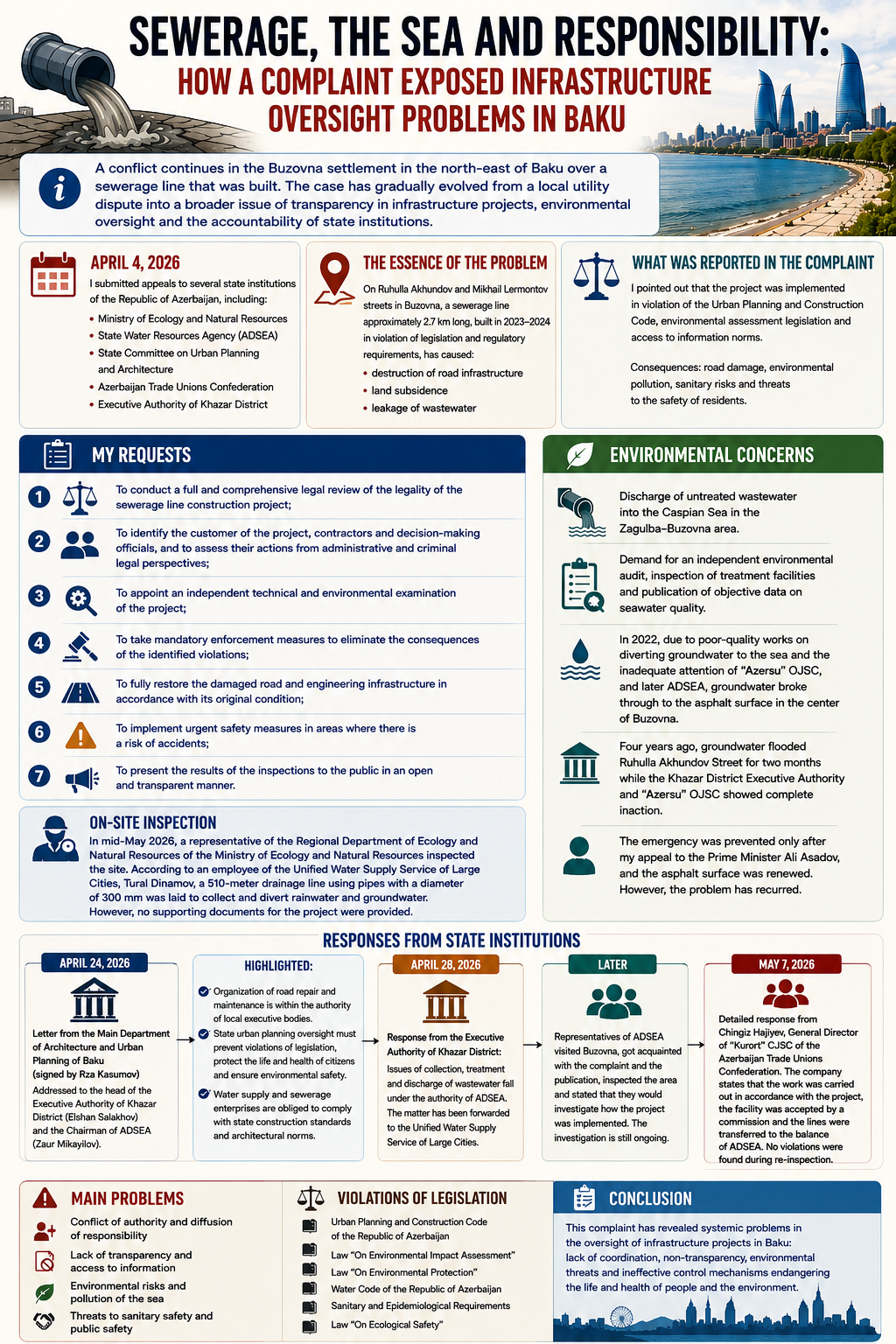
A conflict surrounding a newly constructed sewerage line in the settlement of Buzovna in northeastern Baku continues to escalate, gradually transforming from a local коммунal dispute into a broader issue concerning the transparency of infrastructure projects, environmental oversight and the accountability of state institutions.
On April 4, 2026, I submitted appeals to several state institutions of Azerbaijan, including the Ministry of Ecology and Natural Resources, the State Water Resources Agency, the State Committee for Urban Planning and Architecture, the Azerbaijan Trade Unions Confederation and the Executive Authority of the Khazar district.
The appeal stated that on Ruhulla Akhundov and Mikhail Lermontov streets in Buzovna there had been destruction of road infrastructure, ground subsidence and wastewater leaks associated with a sewerage line approximately 2.7 kilometres long that had been constructed during 2023–2024 in violation of legislative and regulatory acts.
Taking this into account and in accordance with the current legislation, I requested:
- To conduct a full and comprehensive legal review of the legality of the sewerage line construction project;
- To identify the customer of the project, contractors and officials responsible for decision-making, as well as to provide administrative and criminal legal assessment of their actions;
- To appoint an independent technical and environmental examination of the project;
- To take mandatory enforcement measures to eliminate the consequences of the identified violations;
- To fully restore the damaged road and engineering infrastructure in accordance with its original condition;
- To implement urgent safety measures in areas where there is a risk of accidents;
- To present the results of the inspections to the public in an open and transparent manner.
I raised this issue during the construction stage because the course of the work and the position of the responsible state institutions already pointed to problems that would affect not only local residents but anyone using the road. I wrote that the project was being implemented in violation of the requirements of the Urban Planning and Construction Code, environmental assessment legislation and norms governing access to information. Among the expected consequences were road damage, environmental pollution, sanitary risks and threats to residents’ safety.
Particular attention in the complaint was devoted to the environmental situation along the Zagulba–Buzovna coastline. In the appeal I referred to the discharge of untreated wastewater into the Caspian Sea and demanded an independent environmental audit, inspection of treatment facilities and publication of objective data regarding the quality of seawater. I also drew attention to the breakthrough of groundwater onto the asphalt surface in the centre of Buzovna caused by poor-quality work carried out in 2022 on diverting groundwater into the sea and by inadequate attention from Azersu Open Joint-Stock Company and later ADSEA. Four years ago groundwater flooded Ruhulla Akhundov Street for two months amid complete inaction by the Khazar District Executive Authority and Azersu Open Joint-Stock Company. The emergency was prevented and the asphalt surface restored only after my appeal to Prime Minister Ali Asadov. However, as demonstrated by the repeated breakthrough of groundwater and the failure of drainage systems, the work had been carried out, to put it mildly, poorly.
In the middle of May this year, following my appeal, a representative of the Regional Department of Ecology and Natural Resources of the Ministry of Ecology and Natural Resources inspected the site: “During the investigation, a person identifying himself as an employee of the Unified Water Supply Service of Large Cities, Tural Dinamov, stated that a drainage line 510 metres long using pipes with a diameter of 300 millimetres had been laid at one location for the collection and diversion of rainwater and groundwater. However, no supporting documents related to the specified project were presented.”
Responses of State Institutions
The first official response came in a letter dated April 24 from the Main Department of Architecture and Urban Planning of Baku, signed by department head Rza Kasumov and addressed to Khazar District Executive Authority head Elshan Salakhov and Azerbaijan Water Resources Agency ADSEA chairman Zaur Mikayilov.
The letter emphasised that the organisation of repair and maintenance of roads falls within the authority of local executive bodies and that state urban planning supervision must ensure prevention of legislative violations, protection of citizens’ lives and health, as well as environmental safety.
The document also reminded that water supply and sewerage enterprises are obliged to comply with state construction standards and architectural norms. The appeal was forwarded “according to jurisdiction” for further consideration.
On April 28 a response was also received from the Khazar District Executive Authority. The letter stated that issues related to the collection, treatment and discharge of wastewater fall under the authority of the Azerbaijan Water Resources Agency and that the district administration had already forwarded the matter to the Unified Water Supply Service of Large Cities.
Later representatives of ADSEA arrived in Buzovna. We met at the site of the emergency section. Representatives of the institution reviewed the appeal and the publication, inspected the road beneath which the sewerage line passes and stated that they intended to determine how the project had been implemented. They left. They are still determining it.
Position of the Trade Unions Confederation
The most detailed response was received on May 7 from Chingiz Hajiyev, General Director of the “Kurort” Closed Joint-Stock Company of the Azerbaijan Trade Unions Confederation.
The letter stated that the construction of external water supply and sewerage lines for the “Khazar” sanatorium and the “Buzovna” Physiotherapy Centre, formerly known as “Sheki”, had been carried out by the “Sukanal” Research and Design Institute on the basis of technical conditions issued by Azersu Open Joint-Stock Company in February 2020.
According to the document, the project was approved by the relevant institutions in October 2022, while the readiness of the facilities for operation was confirmed by a commission in May 2024. The sewerage line and water pipeline were transferred to the balance sheet of the Khazar District “Sukanal” Department of ADSEA.
At the same time, Chingiz Hajiyev noted that employees of “Kurort” Closed Joint-Stock Company had reported that a repeated inspection of the territory revealed no violations or defects and that the issues raised in the appeal were outside the authority of the Trade Unions Confederation. I should immediately note that the information regarding the satisfactory condition of the territory beneath which the sewerage line passes is false.
Conflict of Authority and the Absence of a Single Responsible Institution
One of the central problems revealed during the correspondence, both previously and now, among state institutions was the effective diffusion of responsibility among different agencies.
In 2024 the Khazar District Executive Authority informed me in writing that the project had not been coordinated with the district administration and fell under the competence of Azersu Open Joint-Stock Company.
At the same time, Azersu Open Joint-Stock Company stated that it was not the executor of the project but had merely issued technical conditions for connection. According to the company’s official response, implementation of the project was carried out on the order of the “Kurort” Closed Joint-Stock Company of the Azerbaijan Trade Unions Confederation.
The Azerbaijan Trade Unions Confederation in turn stated that it had acted on the basis of technical conditions and project documentation prepared by the “Sukanal” Institute of Azersu Open Joint-Stock Company.
Meanwhile, the Ministry of Ecology and Natural Resources reported that the project had not undergone a state environmental assessment.
In practice, each institution acknowledged only a limited part of its responsibility, creating a legal vacuum.
Violations of the Urban Planning and Construction Code
The correspondence materials indicate violations of several provisions of the Urban Planning and Construction Code of the Republic of Azerbaijan.
1. Absence of Full-Fledged State Urban Planning Oversight
The Main Department of Architecture and Urban Planning of Baku directly referred to Presidential Decree No. 375 dated November 24, 2014 “On the Rules for the Implementation of State Urban Planning Oversight”. According to this decree, local executive authorities are obliged to regularly monitor compliance with construction norms, environmental safety and the prevention of threats to the life and health of citizens.
However, the submitted documents show that:
- the district executive authority did not approve the project;
- state oversight was not effectively carried out;
- the consequences of the construction accident began to be addressed only after complaints emerged and after road subsidence, pits and trenches appeared.
This may indicate improper fulfilment of obligations related to state construction oversight.
2. Possible Violations of Construction Norms and Rules
The appeals refer to:
- subsidence of the road surface;
- damage to engineering communications;
- leakage of wastewater;
- threats to sanitary safety.
Such consequences may indicate violations of mandatory construction requirements during the laying of underground communications, including:
- soil compaction standards;
- requirements for protecting the road surface;
- rules governing the installation of gravity sewerage systems;
- waterproofing and sealing requirements.
Particularly important is the fact that ADSEA representatives arrived at the site only after public resonance had emerged and effectively began an internal investigation after the fact. This despite the fact that their employees had been and continue to be present in the area on a daily basis.
Environmental Risks and Possible Violations of Environmental Legislation
A separate block of issues concerns the environmental consequences of the project.
Of particular importance is the response of the State Environmental Expertise Agency, which officially confirmed that no application concerning the project had been submitted within the framework of environmental assessment procedures.
This may mean that the project either:
- did not undergo the mandatory environmental assessment procedure;
- or was classified in such a way as to avoid a full-fledged environmental assessment.
In both cases, questions arise regarding compliance with the law of the Republic of Azerbaijan “On Environmental Impact Assessment”.
My appeal also referred to facts involving the discharge of wastewater into the Caspian Sea in the Zagulba–Buzovna area. Notably, none of the addressees responded to this part of my appeal.
The facts are indisputable, and I have already written about them. The issue concerns violations of:
- the Water Code of the Republic of Azerbaijan;
- the law “On Environmental Protection”;
- sanitary and epidemiological requirements;
- environmental safety legislation.
Problems of Transparency and Access to Information
The situation also demonstrates a systemic problem of limited transparency in infrastructure projects.
Throughout the investigation, the following information was not publicly available:
- project documentation;
- environmental conclusions;
- data regarding contractors;
- project cost estimates;
- results of state expertise examinations;
- information concerning tender procedures.
This creates indications of possible violations of legislation governing access to information and the principles of transparency in state and quasi-state procurement.
Particularly noteworthy is the fact that the contractor “REPAIR VS CONSTRUCTION” Limited Liability Company was involved in the construction of the controversial sewerage line on the basis of a contract dated April 10, 2023. However, there is no publicly available information regarding competitive procedures or a tender.
Legal Paradox: The Facility Has Been Commissioned, but Complaints Continue
The “Kurort” Closed Joint-Stock Company claims that:
- the work was completed in accordance with the project;
- the facility was accepted by a commission;
- the lines were transferred to the balance sheet of the Khazar District “Sukanal” Department of ADSEA;
- repeated inspections revealed no violations.
However, the following continue simultaneously:
- residents’ complaints;
- destruction of the road surface;
- concerns regarding leaks;
- claims concerning the quality of construction work;
- the spread of sewerage odours throughout the area, especially during the summer season.
A fundamental question arises: how was the facility accepted by the state commission despite such a significant number of complaints regarding the consequences of its operation?
This concerns not only the construction itself but also the mechanism for state acceptance of infrastructure facilities.
A Symptom of a Broader Systemic Problem
The story of the sewerage line in Buzovna demonstrates a broader crisis in the management of infrastructure projects in the suburbs of Baku.
Against the backdrop of active urbanisation on the Absheron Peninsula, engineering networks are often constructed in a fragmented manner, without comprehensive planning and transparent public oversight, despite the requirements of the Urban Planning and Construction Code of the Republic of Azerbaijan.
As a result, the following emerge:
- conflicts of authority;
- weak coordination among institutions;
- absence of full-fledged environmental monitoring;
- lack of transparency in procedures;
- low public trust in official conclusions.
A Broader Problem
The situation in Buzovna reflects a broader problem characteristic of the rapidly urbanising suburbs of Baku. In recent years, new residential districts, hotel facilities and sanatorium infrastructure have been actively developed on the Absheron Peninsula. However, the development of engineering communications and environmental oversight has often lagged behind the pace of construction.
Experts in the field of urban governance note that Azerbaijan continues to maintain a fragmented system of responsibility among local executive authorities, municipal structures, contractors and state agencies. As a result, residents frequently encounter situations in which different institutions redirect complaints to one another, while establishing specific responsibility drags on for months.
For the coastal settlements of Absheron, the problem also has an environmental dimension. The issue of pollution of the Caspian Sea by wastewater is periodically raised by environmentalists and public activists, especially during the summer season, when the burden on sewerage systems and coastal infrastructure increases.
This story demonstrates how sensitive infrastructure projects become in conditions of growing public demand for transparency, environmental safety and accountability of state institutions. Today, even a local коммунal problem is capable of evolving into a broader discussion regarding the quality of urban governance and the effectiveness of state oversight.
P.S. Dear addressees,
In my previous appeals to you, I acted in the capacity of Director of the “Turan” Analytical Service. However, with the exception of the subdivision of the Ministry of Ecology and Natural Resources, the responses of the other institutions were addressed not to M. Aliyev, the head of an analytical service officially registered by the state, but to citizen M. Aliyev residing at a specified address.
Such an approach inevitably creates the impression of coordinated disregard both for the professional status of the applicant and for the very essence of official communication. Undoubtedly, each of us is first and foremost a citizen of our state, possessing rights and obligations that stand above any official authority. It is impossible to disagree with this.
Nevertheless, I consider it necessary to note that in the future I will also be compelled to adhere to an analogous principle of subordination and form of address, using a corresponding mirror format: “to citizen so-and-so located at the address of such-and-such institution”.
Respectfully,
M. Aliyev
Previous articles:
Sewerage, water supply and Illegal pipes
Monument to Corruption: A Rusted Bin in Buzovna Exposes Azerbaijan’s Systemic Failures
The problem is that the government is Executive, not Proactive
Coastal Crisis in Azerbaijan: Hidden Sewage Discharges at Zagulba-Buzovna Beaches
Azerbaijan Marks National Press Day with Sewage Fountain
Is it possible to raise the standards of beach recreation amidst environmental issues?
Environmental crisis in Azerbaijan: sewage scandals and inactivity of state structures
Silence speaks volumes: Azerbaijan's struggle with transparency and accountability
Will Azerbaijani beaches raise "Blue flags"?
Construction of Immoral Water Supply System in Buzovna Accelerated
Construction of "immoral" water pipeline is suspended
Third Lawsuit against Azersu on Turan News Agency's Information Request


Social
-
The participation of Armenian wrestlers in the U17 World Championships will test whether the cautious political dialogue between the two countries can move beyond negotiating rooms. If one of Armenia’s young wrestlers climbs to the top of the podium...
-
“Ali Ayaghi” in Buzovna: A Shrine, a Legend, and the Forgotten History of Absheron History on the Absheron Peninsula rarely lies on the surface. It hides beneath later buildings and survives in the names of neighbourhoods, ancient cemeteries, wells,...
-
A journey through the history of Azerbaijan usually begins with its best-known symbols—Gobustan, the Maiden Tower, and Ateshgah. These landmarks have long become part of the national historical canon and essential destinations on every itinerary....
-
Early in the morning, a child preparing for school in a newly built residential neighborhood in the city of Lachin, a university student living in a dormitory in Baku, a farmer running a family farm in Gusar, and an engineer working in Sumgait will...


Leave a review