


Generated by AI

Azerbaijan's Diplomacy: Historical Evolution, Strategic Priorities, and Future Challenges
Every year on July 9, Azerbaijan celebrates Diplomatic Service Day. The date was not chosen by chance. On July 9, 1919, the Government of the Azerbaijan Democratic Republic adopted a resolution establishing diplomatic and consular missions abroad. That day therefore became a symbolic starting point in the institutional foundation of the country's national diplomatic service. Following the restoration of Azerbaijan's independence, this tradition was revived and has since been celebrated annually as the professional holiday of the nation's diplomatic corps.
Diplomacy is far more than a mechanism of external representation for any state. It is a strategic instrument that ensures the continuity of statehood, safeguards national interests in the international arena, and defines a country's place in the global order.
For Azerbaijan, the importance of diplomacy is particularly evident in three fundamental dimensions:
- ensuring national security;
- supporting economic development through external resources;
- strengthening the country's international standing.
For a nation located in the South Caucasus, where the interests of major powers intersect, successfully balancing these three priorities represents the ultimate test of diplomatic professionalism.
Over recent decades, the international system has undergone profound transformation. The unipolar and bipolar world orders have gradually given way to a multipolar system that is more flexible and considerably less predictable. Under these conditions, the role of so-called middle powers—states that are not superpowers but possess the capacity to influence regional and even global developments—has increased significantly. Such countries advance their own interests by maneuvering among major powers, maintaining strategic balance, and at times assuming the role of mediators.
Azerbaijan is a classic example of this category of states. Its energy resources, strategic transport geography, tradition of multi-vector foreign policy, and the regional balance of power that has emerged since 2020 have transformed Azerbaijan into an active player at one of Eurasia's most sensitive geopolitical crossroads.
Historical Development of Azerbaijani Diplomacy
The roots of statehood and diplomatic relations on the territory of Azerbaijan date back to antiquity.
The Kingdom of Atropatene, established in the fourth century BC, developed a complex network of relations with the Seleucid Empire, Parthia, and later Rome. Through dynastic marriages and peace agreements, it succeeded in preserving its independence for a prolonged period.
To the north, Caucasian Albania pursued a policy of balancing between the Sasanian Empire and the Byzantine Empire, thereby maintaining its statehood. By adopting Christianity, it became integrated into the regional system of religious and political relations.
During the Middle Ages, the Shirvanshah State became a remarkable example of diplomatic sophistication. Facing the Mongol invasions, the Golden Horde, and the empire of Tamerlane, the Shirvanshahs managed to preserve their statehood for centuries primarily through negotiations, tribute, and strategic alliances rather than military confrontation.
The Aq Qoyunlu and Qara Qoyunlu states established direct relations with Europe during the fifteenth century. In particular, the negotiations between Uzun Hasan and the Republic of Venice became one of the earliest systematic examples of Azerbaijan's European-oriented diplomacy.
During the Safavid era (sixteenth to eighteenth centuries), Azerbaijani diplomacy reached an imperial scale. Under the reign of Shah Abbas I, active diplomatic correspondence was conducted with England, Spain, Russia, and other European powers, while ambassadors were exchanged on a regular basis.
Throughout this period, the Silk Road served not only as a commercial artery but also as a channel for diplomatic contacts, cultural exchange, and the flow of political information. These developments constitute the historical foundation of modern Azerbaijan's transport corridor diplomacy.
On May 28, 1918, the Azerbaijan Democratic Republic (ADR), the first democratic republic in the Muslim East, was proclaimed.
Despite its brief existence, the ADR laid both the institutional and conceptual foundations of modern Azerbaijani diplomacy. The Ministry of Foreign Affairs was established, the country's first professional diplomatic missions were created, and a systematic campaign for international recognition was launched.
The greatest achievement of ADR diplomacy was its participation in the Paris Peace Conference of 1919–1920. Led by Alimardan bey Topchubashov, the Azerbaijani delegation made extensive diplomatic efforts to secure international recognition of Azerbaijan's independence. On January 11, 1920, the Supreme Council of the Allied Powers granted Azerbaijan de facto recognition.
This success demonstrated that the young republic had already developed its own diplomatic school based on legal argumentation, international lobbying, and multilateral negotiation skills. The twenty-three months of the ADR's existence became a valuable diplomatic legacy for future generations.
On May 28, 1918, the Azerbaijan Democratic Republic (ADR)—the first democratic republic in the Muslim East—was proclaimed.
During its brief yet exceptionally productive existence, the ADR laid both the institutional and conceptual foundations of modern Azerbaijani diplomacy. The Ministry of Foreign Affairs was established, the country's first professional diplomatic missions were created, and a systematic campaign for international recognition was launched.
The most significant achievement of ADR diplomacy was its participation in the Paris Peace Conference of 1919–1920. Led by Alimardan bey Topchubashov, the Azerbaijani delegation undertook extensive diplomatic efforts to secure international recognition of Azerbaijan's independence. On January 11, 1920, the Supreme Council of the Allied Powers granted de facto recognition to Azerbaijan.
This achievement demonstrated that the young republic had already developed its own diplomatic school based on legal argumentation, international lobbying, and multilateral negotiation skills. The ADR's twenty-three months of existence became a valuable diplomatic legacy for future generations.
Following the Sovietization of Azerbaijan in 1920, the country's ability to conduct an independent foreign policy was effectively eliminated. Within the Soviet Union, foreign affairs were centralized and directed from Moscow, while the union republics possessed no independent diplomatic status.
Nevertheless, certain limited opportunities remained. Azerbaijan participated in international organizations, including the United Nations, as part of Soviet delegations and maintained representation through cultural and scientific exchanges.
The most important hidden contribution of this period was the development of a national diplomatic кадров? Wait. Let's continue correctly.
The most important hidden contribution of this period was the development of a national diplomatic cadre. Azerbaijani specialists educated within the Soviet system in international relations, law, and foreign languages formed the initial core of the diplomatic service of the newly independent Azerbaijani state after independence was restored.
Thus, although the Soviet period represented a gap in terms of independent diplomacy, it can also be viewed as the stage during which the human capital of Azerbaijan's future diplomatic corps was accumulated.
The restoration of Azerbaijan's state independence on October 18, 1991, presented Azerbaijani diplomacy with entirely new and unprecedented challenges.
Within a short period, dozens of countries recognized Azerbaijan, the country's first bilateral diplomatic relations were established, and Azerbaijan became a member of the United Nations.
At the same time, these years were marked by domestic political instability, governmental crises, and Armenia's military aggression. The absence of a unified strategic foreign policy, constantly changing priorities, and institutional weakness left Azerbaijan's international position fragile.
This period represented a difficult but inevitable stage in the development of an independent diplomatic service.
Beginning in 1993, the foundations of a systematic, long-term foreign policy strategy were established.
At the core of this strategy was the principle of a balanced foreign policy: without entering into confrontation with any major power, Azerbaijan sought pragmatic and mutually beneficial relations with all of them.
The concept of multi-vector diplomacy was formulated, while national interests were declared the sole determining criterion of foreign policy.
The most strategic step of this period was the launch of energy diplomacy.
The "Contract of the Century," signed in 1994, established the foundation for cooperation with major Western energy companies to bring Azerbaijan's hydrocarbon resources to international markets.
This was not merely an economic decision but also a geopolitical one. Energy projects tied Azerbaijan to the long-term strategic interests of the West and significantly strengthened the country's international standing.
During the first decades of independence, Azerbaijani diplomacy evolved into an institutionally mature system.
The Ministry of Foreign Affairs expanded its role as the central coordinating body, while Azerbaijan's diplomatic network spread across all continents.
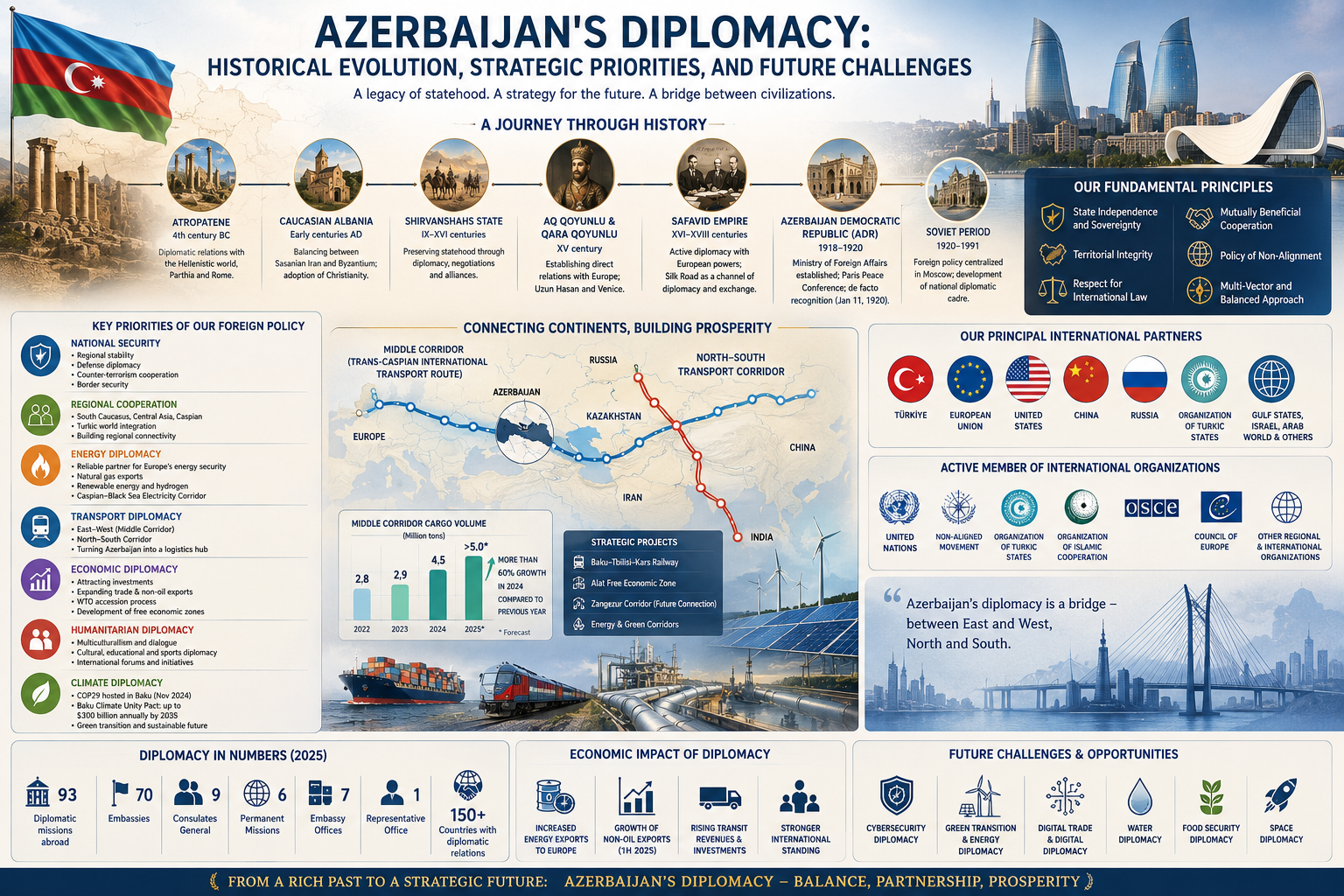
According to 2025 data, Azerbaijan maintained 93 diplomatic missions abroad, including:
- 70 embassies;
- 9 consulates general;
- 6 permanent missions;
- 7 embassy offices;
- 1 representative office.
Azerbaijan maintains diplomatic relations with more than 150 countries.
At the same time, a professional diplomatic service was established, while mechanisms for personnel training, rotation, and specialization were continuously improved.
Today, Azerbaijani diplomacy encompasses not only traditional bilateral relations but also specialized fields including multilateral diplomacy, energy diplomacy, transport diplomacy, humanitarian diplomacy, and digital diplomacy.
Fundamental Principles of Azerbaijan's Foreign Policy
Azerbaijan's official foreign policy doctrine is built upon a number of enduring principles.
These principles ensure the predictability of the country's international conduct and provide a unified framework of values governing its relations with diverse international partners.
- State Independence and Sovereignty – complete independence in decision-making and resilience against external influence.
- Territorial Integrity – the unconditional defense of sovereignty within internationally recognized borders.
- Respect for International Law – adherence to the Charter of the United Nations and the norms and principles of international law.
- Mutually Beneficial Cooperation – equal, pragmatic, and mutually advantageous relations.
- Policy of Non-Alignment – maintaining an independent position outside military-political blocs in accordance with the principles of the Non-Aligned Movement.
- Multi-Vector and Balanced Approach – maintaining a broad network of partnerships by preserving strategic balance among major powers.
The combination of these principles enables Azerbaijan to act as a flexible player capable of serving as both a bridge and a mediator among major powers.
Its policy of balance is not one of passive neutrality but rather an active and carefully calculated strategy designed to maximize the country's national interests.
Key Priorities of Azerbaijan's Foreign Policy
National Security
National security remains the central pillar of Azerbaijan's foreign policy.
This priority encompasses:
- preserving regional stability;
- developing defense diplomacy;
- strengthening international cooperation in combating terrorism and transnational threats;
- enhancing border security.
Military-technical cooperation and defense diplomacy have become essential components of Azerbaijan's strategic partnerships with a number of countries.
Regional Cooperation
Azerbaijan's regional cooperation agenda encompasses the South Caucasus, Central Asia, the Caspian region, and the Turkic world.
The country positions itself as a bridge between East and West as well as North and South, while seeking to play a leading role in strengthening regional connectivity.
The main priorities in this area include:
- deeper integration with the Turkic world;
- strengthening the legal framework governing the Caspian Sea;
- establishing logistics and energy bridges with the republics of Central Asia.
Energy Diplomacy
Energy diplomacy has historically been one of the strongest pillars of Azerbaijan's international influence.
What began with oil and natural gas exports has evolved into an important element of the European Union's energy security strategy.
Under the Strategic Partnership Memorandum signed in 2022, Azerbaijan committed itself to gradually increasing natural gas supplies to Europe.
At the same time, the country is diversifying into:
- renewable energy;
- electricity exports;
- hydrogen development.
The Caspian region and the Karabakh–East Zangezur area are being developed as major renewable energy hubs.
Transport Diplomacy
Leveraging its strategic geographical location, Azerbaijan has made transport corridor diplomacy one of the leading pillars of its foreign policy.
The East–West Corridor (the Middle Corridor / Trans-Caspian International Transport Route) and the North–South Transport Corridor are transforming the country into one of Eurasia's principal logistics hubs.
Cargo transportation along the Middle Corridor increased by more than 60 percent in 2024 compared with the previous year, reaching approximately 4.5 million metric tons.
Forecasts for 2025 project cargo volumes to exceed 5 million metric tons.
The opening of the Zangezur connection is regarded as the decisive link that will complete this transport network.
Economic Diplomacy
Economic diplomacy focuses on:
- attracting foreign investment;
- expanding international trade;
- advancing Azerbaijan's accession process to the World Trade Organization;
- developing free economic zones.
Increasing non-oil exports has been identified as a strategic objective.
During the first half of 2025, Azerbaijan's non-oil exports increased compared with the same period of the previous year.
Projects such as the Alat Free Economic Zone are intended to transform Azerbaijan into a regional center for trade and manufacturing.
Humanitarian Diplomacy
Humanitarian diplomacy is one of the principal vehicles of Azerbaijan's soft power.
The country's tradition of multiculturalism, initiatives promoting interfaith and intercivilizational dialogue, together with cultural, educational, and sports diplomacy, shape Azerbaijan's international image.
Baku has become a traditional venue for international humanitarian forums, interfaith dialogue initiatives, and major cultural events.
Climate Diplomacy
In recent years, climate diplomacy has become an increasingly important component of Azerbaijan's foreign policy agenda.
The pinnacle of this effort was Baku's hosting of the Twenty-Ninth Conference of the Parties (COP29) to the United Nations Framework Convention on Climate Change in November 2024.
The conference's principal achievement was the agreement known as the Baku Climate Unity Pact, which provides for tripling annual climate finance for developing countries to up to US$300 billion per year.
The event demonstrated Azerbaijan's emergence as an active participant in global climate governance while also reflecting its transition from the image of a traditional energy exporter toward that of a regional leader in the green transition.
Azerbaijan's Principal International Partners
Türkiye
Türkiye is Azerbaijan's closest strategic ally.
The Shusha Declaration, signed in 2021, elevated bilateral relations to the level of a formal alliance.
Cooperation encompasses:
- military and strategic affairs;
- energy projects (TANAP and TAP);
- transport infrastructure (the Baku–Tbilisi–Kars Railway);
- the defense industry.
The political and cultural foundation of this relationship is embodied in the formula "One Nation, Two States."
European Union
Relations with the European Union are centered on:
- energy;
- trade;
- the green transition.
Azerbaijan has established itself as a reliable partner in Europe's energy security by expanding natural gas exports and developing green energy corridors, including the Caspian–Black Sea Electricity Corridor.
United States
Relations with the United States focus on:
- security;
- energy;
- regional stability.
Progress in the Azerbaijan–Armenia peace process, facilitated by the United States in 2025, significantly enhanced the regional importance of this partnership.
China
Cooperation with China is built around the Belt and Road Initiative, the Middle Corridor, and investment cooperation.
In 2024, China became one of Azerbaijan's leading trading partners, and the two countries announced the establishment of a Strategic Partnership.
Russia
Relations with Russia continue to focus on:
- regional security;
- economic cooperation;
- the North–South International Transport Corridor.
Within the framework of its balanced foreign policy, Azerbaijan manages these relations pragmatically and in accordance with its national interests.
Organization of Turkic States
Within the Organization of Turkic States, cooperation with Kazakhstan, Uzbekistan, Turkmenistan, and other member states is deepening rapidly.
Priority areas include:
- logistics;
- energy;
- cultural integration.
The Middle Corridor, linking both shores of the Caspian Sea, serves as the backbone of this cooperation.
Other Partnerships
Investment cooperation with the Gulf states, energy and technological partnership with Israel, and relations with the Arab world within the framework of the Organization of Islamic Cooperation constitute important components of Azerbaijan's multi-vector foreign policy.
Azerbaijan's Role in International Organizations
Azerbaijan views multilateral diplomacy as an essential platform for advancing national interests and strengthening its international standing.
The country actively participates in numerous global and regional organizations while putting forward its own initiatives.
The most important of these is the United Nations.
Azerbaijan:
- served as a non-permanent member of the United Nations Security Council in 2011–2012;
- assumed the Chairmanship of the Non-Aligned Movement in 2019, successfully leading the organization of more than 120 member states during the COVID-19 pandemic.
The Organization of Turkic States is Azerbaijan's priority regional platform.
The country plays a leading role in:
- strengthening the organization's institutional development;
- shaping the regional connectivity agenda, including the Zangezur connection.
Within the Organization of Islamic Cooperation, Azerbaijan actively supports initiatives promoting Islamic solidarity and cultural cooperation.
The country also actively participates in:
- the Organization for Security and Co-operation in Europe (OSCE);
- the Council of Europe;
- GUAM;
- the Black Sea Economic Cooperation Organization (BSEC);
- the Economic Cooperation Organization (ECO).
Through these organizations, Azerbaijan promotes regional stability and economic integration.
This active multilateral engagement has become an important instrument in strengthening Azerbaijan's image as a "bridge country."
Azerbaijan–Iran Relations
Relations between Azerbaijan and Iran extend far beyond those of two neighboring states.
They constitute an important factor influencing the geopolitical balance of the South Caucasus, the Caspian region, and the Middle East.
Although historical ties and economic interdependence provide a solid foundation for cooperation, differences regarding security and regional geopolitical interests continue to shape a pragmatic and cautious relationship.
At the same time, the recent intensification of political dialogue and new economic initiatives have created additional opportunities for gradually strengthening mutual trust.
Azerbaijani Diplomacy in the Post-Karabakh Era
Following the 2020 war and the events of September 2023, which resulted in the restoration of Azerbaijan's territorial integrity, an entirely new geopolitical reality emerged in the South Caucasus.
This fundamentally shifted Azerbaijan's diplomatic agenda from conflict management toward post-conflict reconstruction and peacebuilding.
On August 8, 2025, the leaders of Azerbaijan and Armenia held a historic meeting in Washington, D.C., mediated by the United States, which resulted in the initialing of a peace agreement and the signing of a joint declaration.
One of the central elements of the agreement was a transport route connecting mainland Azerbaijan with the Nakhchivan Autonomous Republic.
International media have referred to the project as the Trump Route for International Peace and Prosperity (TRIPP).
The route is regarded as an important step toward reopening regional communications, unlocking transit potential, and ensuring long-term regional stability, although some regional actors continue to approach the initiative with caution.
This new phase places several major responsibilities on Azerbaijani diplomacy:
- consolidating a sustainable peace agenda;
- restoring regional transport and communication links;
- reintegrating and rebuilding the liberated territories ("reconstruction diplomacy");
- transforming the former conflict line into a new zone of economic cooperation.
The Great Return Program and the development of the Karabakh–East Zangezur region as a renewable energy and logistics hub represent the practical implementation of this diplomatic strategy.
Azerbaijan's Soft Power
Soft power—the ability to influence others through attraction rather than coercion—has become an important component of Azerbaijan's modern diplomatic toolkit.
The country strengthens its international standing through:
- culture;
- music (including mugham and the legacy of the Eurovision Song Contest);
- sports;
- humanitarian initiatives.
Azerbaijan's rich cultural heritage and model of multicultural society help project an attractive image to international audiences.
The country has earned international recognition as the host of major global sporting and cultural events, including:
- the Formula 1 Azerbaijan Grand Prix;
- the European Games;
- the Islamic Solidarity Games;
- major international forums.
These events present Azerbaijan as a modern, open, and dynamic country while simultaneously providing valuable platforms for expanding international networks and partnerships.
As a result, soft power has become not only an instrument of public diplomacy and image-building but also a force multiplier for Azerbaijan's broader foreign policy.
Digital Diplomacy
Digital transformation is reshaping the nature of diplomatic activity, and Azerbaijan has been actively adapting to this new environment.
Social media diplomacy is employed to communicate official positions rapidly and to help shape public opinion.
Artificial intelligence, data analytics, and cyber diplomacy are becoming increasingly important dimensions of international engagement.
On a practical level, Azerbaijan's achievements include:
- digital consular services;
- the ASAN Visa electronic visa system;
- the digitalization of public services for citizens.
The electronic visa platform has simplified travel to Azerbaijan, thereby contributing to the growth of tourism and business exchanges.
Data diplomacy and cybersecurity are expected to become decisive components of Azerbaijan's future diplomatic capabilities.
The Economic Impact of Diplomacy
The effectiveness of Azerbaijan's diplomacy is reflected most clearly in economic indicators.
Energy and transport diplomacy have translated directly into export revenues, enhanced transit capacity, and increased foreign investment.
The table below summarizes several key indicators.
| Indicator | Status / Trend |
| Diplomatic missions (2025) | 93 missions, including 70 embassies |
| Diplomatic relations | More than 150 countries |
| Middle Corridor cargo volume (2024) | Approximately 4.5 million metric tons (more than 60% growth) |
| Middle Corridor forecast (2025) | More than 5 million metric tons |
| Non-oil exports (First Half of 2025) | Year-on-year growth |
| COP29 Climate Finance Agreement | Up to US$300 billion annually (by 2035) |
| Energy diplomacy | Increased natural gas exports to Europe |
Note: The figures are based on publicly available sources and may change as new annual data become available.
These indicators confirm that diplomacy is not merely an instrument of "soft" engagement but a strategic resource that has a direct impact on the country's economic development.
The growing number of bilateral and multilateral agreements, rising transit revenues, expanding tourism flows, and Azerbaijan's improved standing in international rankings all provide measurable evidence of this impact.
Perspectives of International Experts
To better understand Azerbaijan's geopolitical role, it is useful to examine the views of leading scholars of international relations.
Zbigniew Brzezinski described Eurasia as the world's "grand chessboard" and regarded the South Caucasus and the Caspian Basin as critical strategic links. His framework provides a theoretical explanation for Azerbaijan's importance as an energy and transportation hub.
Henry Kissinger's concepts of the balance of power and Realpolitik offer an appropriate framework for understanding Azerbaijan's balancing strategy among major powers.
Joseph Nye's theory of soft power helps explain Azerbaijan's efforts to enhance its international influence through cultural, humanitarian, and sports diplomacy.
The work of Graham Allison, Professor at Harvard University, on great-power competition—particularly the concept known as the "Thucydides Trap"—and on the strategic maneuverability of middle powers highlights the value of flexibility for countries such as Azerbaijan in an increasingly multipolar international system.
In addition, leading think tanks such as:
- Chatham House;
- the Carnegie Endowment for International Peace;
- the Brookings Institution;
- the German Marshall Fund of the United States,
regularly analyze the evolving geopolitics of connectivity in the South Caucasus and Azerbaijan's regional role.
Their assessments of the Middle Corridor and the regional peace process occupy a prominent place in their research agendas.
A Critical Perspective
A balanced assessment requires acknowledging not only achievements but also the challenges that lie ahead.
First, the evolving geopolitical environment presents significant risks. Intensifying competition among major powers, expanding sanctions regimes, and persistent regional tensions are making Azerbaijan's balancing strategy increasingly difficult to manage.
For a country situated at the intersection of competing great-power interests, strategic flexibility is both a major advantage and a source of vulnerability.
Second, the structural dependence on energy exports underscores the need for further diversification of Azerbaijan's economic diplomacy. Expanding non-oil exports, increasing the contribution of the services sector, and fostering high-technology industries will be essential to ensuring the country's long-term economic resilience.
Third, relatively new areas such as climate diplomacy and digital diplomacy require sustained institutional development, specialized professional expertise, and advanced technological infrastructure.
Finally, the continuous improvement of diplomatic training, the strengthening of analytical diplomacy (including the development of think tank capacity), and the expansion of public diplomacy will be indispensable for maintaining Azerbaijan's international competitiveness in the years ahead.
The Diplomacy of the Future
The future of diplomacy will increasingly be shaped by emerging fields that extend well beyond the boundaries of traditional foreign policy.
Artificial intelligence is becoming an integral tool of diplomatic practice, supporting everything from negotiation preparation to strategic risk assessment.
For Azerbaijan, climate diplomacy—particularly following the country's experience in hosting COP29—will remain one of the central pillars of its international agenda.
In addition, the following areas are expected to define diplomatic priorities over the coming decade:
- cybersecurity diplomacy;
- energy transition and green diplomacy;
- digital trade diplomacy;
- water diplomacy;
- food security diplomacy;
- space diplomacy.
Early specialization in these emerging fields, combined with timely institutional preparation, will provide Azerbaijan with an important competitive advantage in an increasingly multipolar world.
Conclusion: The Middle Power Factor
Drawing upon its rich traditions of statehood, Azerbaijan has developed a contemporary foreign policy model based on balance, multi-vector engagement, and pragmatism.
The country's diplomatic evolution—from Atropatene and the Shirvanshah State, through the Safavid Empire and the Azerbaijan Democratic Republic, to today's independent Republic of Azerbaijan—has integrated the experience of different historical eras into a single diplomatic tradition.
Against the backdrop of profound geopolitical transformation, the combination of energy, transport, economic, humanitarian, and climate diplomacy has become one of the principal drivers of Azerbaijan's growing international influence.
The new realities that have emerged following the Karabakh conflict, together with the peace agenda and the reopening of regional communications, are positioning Azerbaijan as one of the leading actors promoting stability and connectivity in the South Caucasus.
If successfully managed, these strategic priorities—supported by continued investment in human capital and timely specialization in emerging diplomatic fields—will enable Azerbaijan to consolidate its position as a reliable, influential, and respected middle power in the evolving multipolar international order.


State-building
-
This rise can be explained by two opposing dynamics: stronger public trust, or the redirection of appeals to the highest available authority because “lower-level” channels such as local government and the courts are not functioning effectively. An...
-
The Fourth Shusha Global Media Forum, which opened on July 13, once again became the platform where Azerbaijani President Ilham Aliyev presented his vision of international politics and Azerbaijan's place in a changing global order. Over the course...
-
Since 2023, 254 new judges have been appointed to the courts of Azerbaijan. At present, approximately 705 judges are serving in the country, and the selection process continues. The official message is clear: the state is strengthening the...
-
A Legal, Economic, and International Comparative Analysis of the 2026 Reforms Diplomatic service is the operational mechanism of every state’s foreign policy, and its effectiveness depends directly on the professionalism of personnel, their...


Leave a review