


Generated by AI

Caspian Without Standards: Why Azerbaijan Has Yet to Turn Its Beaches Into a Tourism Brand
On sunny weekends in May, residents of the Azerbaijani capital once again head for the sea. The beaches of Bilgah, Mardakan, and Buzovna are already welcoming their first visitors. Children build sandcastles, fishermen cast their lines, and cars line the shoreline, some driving almost to the water’s edge.
The Caspian Sea has always been part of Azerbaijan’s identity. It gave the country oil, helped transform Baku into one of the world’s major energy centers, and made Azerbaijan an important link in international transport corridors. Yet there is one area in which the Caspian has never fully realized its potential: beach tourism.
This paradox is particularly striking when compared with neighboring Turkey, which has transformed its coastline into one of the world’s leading tourism destinations. Azerbaijan boasts nearly 900 kilometers of coastline, hot summers, and a climate that allows swimming from late May through late September. Yet the country remains known primarily for business, cultural, and event tourism rather than seaside vacations.
A Sea That Has Become Both Closer and More Distant
During the Soviet era, the official beach season on the Caspian ran from May 25 to September 25. Sanatoriums, holiday resorts, and enterprise-owned recreation centers welcomed hundreds of thousands of visitors every year. Nearly every beach had lifeguard stations, medical facilities, showers, and changing rooms. Preparations for the season began well before summer, and management was centralized.
Today, climatic conditions have changed little. Water temperatures in late May are already suitable for swimming, while September remains one of the most pleasant months for a seaside holiday. Nevertheless, the official beach season now begins only in mid-June and lasts considerably less time.
The reason is not the weather.
The problem is institutional.
A Coastline Without Rules
At first glance, the beaches of the Absheron Peninsula appear lively and popular. A closer look, however, reveals the consequences of the absence of a coherent coastal management policy.
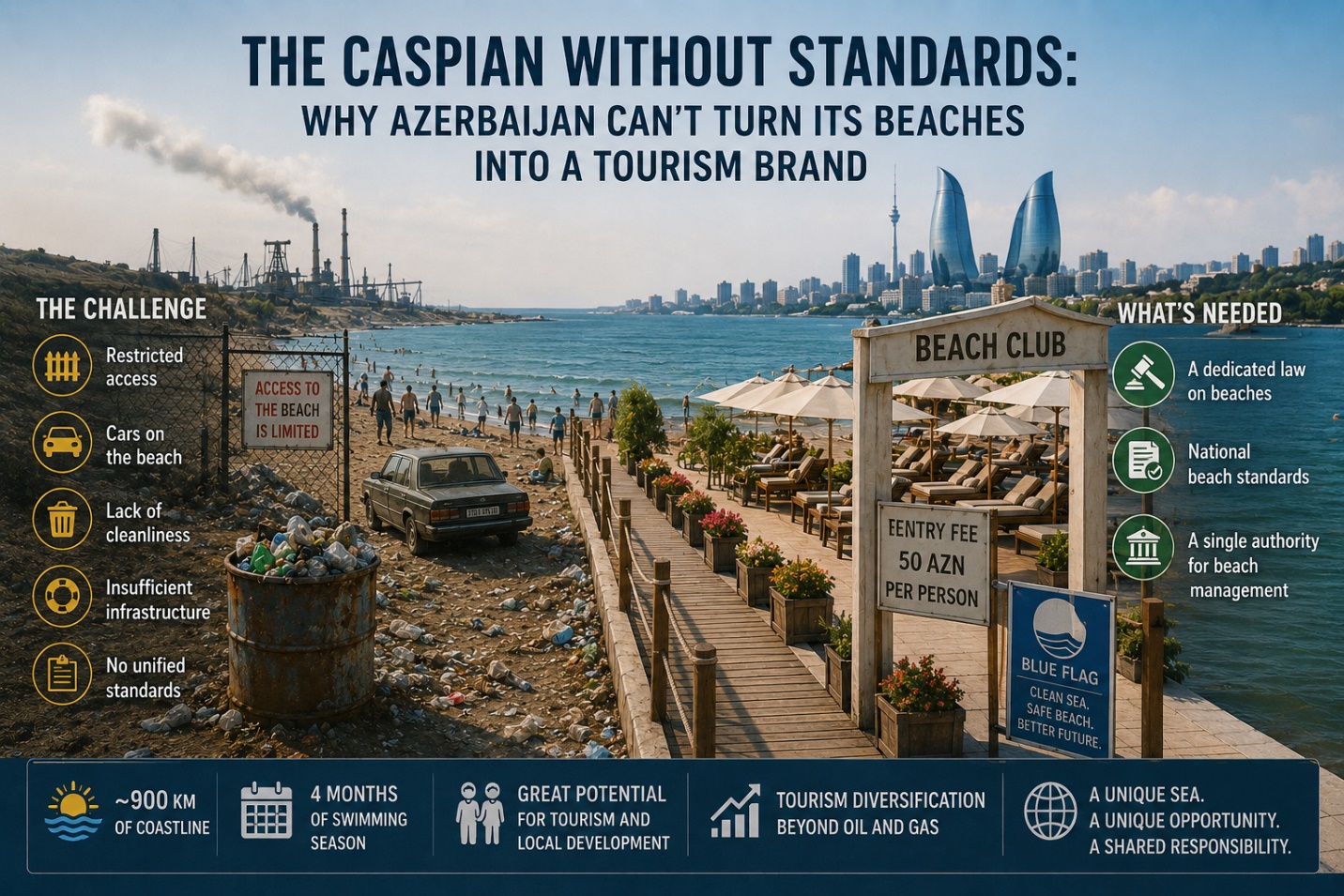
On some stretches of coast, visitors encounter fences that restrict access to the shore. Elsewhere, cars drive directly onto the sand. In some places, quad bikes move among beachgoers. Many public beaches lack sufficient waste bins, and cleaning services are often irregular.
The government formally recognizes citizens’ right to free access to the sea. In 2016, measures were introduced to remove illegal barriers and guarantee public access to the coastline. Later, a beach tourism development plan called for access points to the sea every 200 meters along the shore. Yet many of these issues remain unresolved.
Paid Beaches: When Comfort Becomes a Privilege
Over the past decade, many of the best-maintained sections of the coastline have effectively become part of the paid leisure sector. These commercial beach complexes offer modern amenities, including sun loungers, swimming pools, restaurants, security services, showers, and regular maintenance.
But as service quality has improved, prices have risen as well. During the peak summer season, entry fees at some popular beach resorts range from 20 to 50 manats per person, and can be considerably higher at premium locations. For a family of four, a single day at the beach can cost as much as a short domestic trip.
The gap between private and public beaches is becoming increasingly visible. Where businesses invest in infrastructure, visitors enjoy comfort and safety. On many free public beaches, however, problems with waste collection, parking, and sanitation remain unresolved.
As a result, the Caspian is gradually becoming a landscape of contrasts, where the quality of recreation increasingly depends on income.
The Missing Standard
Behind many of these challenges lies the absence of a unified framework for coastal development.
There are sanitary regulations, environmental requirements, and construction rules. Yet Azerbaijan still lacks a national beach standard defining what a modern beach should look like.
Today, each operator effectively follows its own model. Some invest heavily in safety and infrastructure; others do the minimum required. The state monitors water quality but has no unified standards governing service levels, accessibility, or beach facilities.
Why Tourists Choose Turkey
The beaches of Turkey, Spain, and Greece have long become tourism products in their own right. Their appeal extends far beyond sunshine and sea.
Tourists choose predictability. They know they will find clean beaches, organized parking areas, lifeguard services, sanitary facilities, reliable infrastructure, and clear rules governing coastal use.
In many cases, these guarantees are reinforced through the internationally recognized Blue Flag certification system. Azerbaijani beaches have yet to become part of this program, reducing their visibility and attractiveness to international visitors.
For a country seeking to diversify its economy beyond oil and gas, this represents a missed opportunity.
What Needs to Be Done
Three key conditions are essential for the development of beach tourism in Azerbaijan.
The first is the adoption of a dedicated law on beaches and coastal territories that clearly defines the status of public, leased, and private beaches, guarantees public access to the sea, and establishes liability for restricting that access.
The second is the creation of a National Beach Standard modeled on successful European and Turkish examples. Such a framework should regulate sanitation, waste management, showers and changing facilities, lifeguard services, accessibility for people with disabilities, wastewater treatment, and environmental monitoring.
The third is the establishment of a single coordinating authority responsible for beach management. At present, responsibilities are divided among numerous agencies, and no single institution oversees the development of the coastline as a whole.
Additional measures could include introducing the Blue Flag certification system on the most popular beaches of Absheron and northern Azerbaijan, as well as extending the beach season to better reflect the country’s favorable climate.
Time to Open the Caspian
For decades, Azerbaijan viewed the Caspian primarily as a source of oil, gas, and transportation opportunities.
The twenty-first century is gradually changing that perception. Around the world, coastlines are becoming not only natural resources but also engines of economic growth, job creation, and regional development.
Azerbaijan has already demonstrated its ability to implement ambitious infrastructure projects, from modern airports to international transport corridors. The next challenge is different but no less important: transforming the Caspian from a local recreation area into an internationally recognized tourism destination.
The Caspian has given Azerbaijan wealth, energy, and geopolitical significance. It can also become a source of sustainable tourism development. But achieving that goal will require more than new hotels and restaurants. It will require clear rules, modern standards, and effective management that make the coastline accessible, safe, and attractive for both citizens and international visitors.


Business
-
Construction has once again become one of the most visible sectors of Azerbaijan’s economy. Yet the overall rise in capital investment conceals an uneven picture: investment in oil, gas and transport infrastructure is accelerating, residential...
-
Over the past decade, the rapid development of digital technologies, expanding internet access and the formation of a cashless payment infrastructure have transformed e-commerce in Azerbaijan from an alternative to the traditional sales model into...
-
Ice cream production is one of the high-value-added segments of the food industry. Since this sector is closely connected with dairy farming, agriculture, the packaging industry, logistics, retail trade, and tourism, it contributes both to...
-
The Azerbaijani construction materials market maintained moderate price growth in May 2026, although the pace of increases slowed noticeably compared with the beginning of the year. Strong construction activity, supported by large-scale residential...


Leave a review