


Generated by AI

Three May Days of Freedom: Why the South Caucasus, 108 Years Later, Is Still Searching for a Common Destiny
At the end of May, the capitals of the South Caucasus once again immerse themselves in rituals of remembrance. The President of Azerbaijan symbolically marks Independence Day in liberated Karabakh. In Yerevan, speeches are delivered about the survival of the nation and the price of independence. In Tbilisi, thousands of people gather on Rustaveli Avenue carrying Georgian flags, turning Independence Day into a political demonstration.
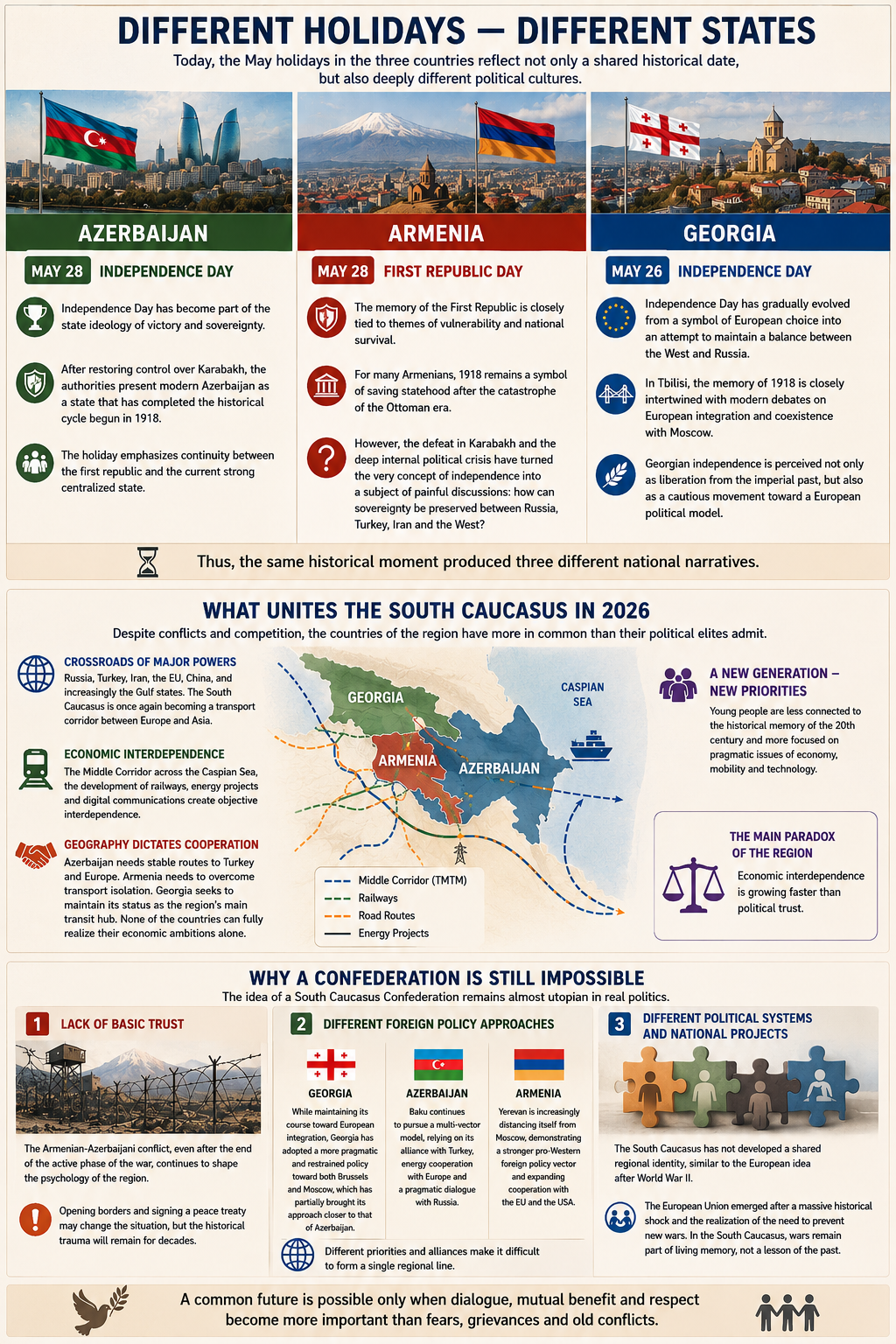
On May 28, Azerbaijan celebrates Independence Day — the date marking the establishment of the Azerbaijan Democratic Republic in 1918, the first parliamentary republic in the Muslim world. Armenia also celebrates May 28 as the day of the proclamation of the First Republic of Armenia. Georgia marks its Independence Day on May 26 in memory of the establishment of the Democratic Republic of Georgia.
These states were born almost simultaneously — on the ruins of the Russian Empire, amid the chaos of the First World War, revolutions, and ethnic conflicts. Back in May 1918, the leaders of the South Caucasus faced a historic choice: either attempt to preserve regional unity or build separate national states.
They chose the latter.
One hundred and eight years later, the question unexpectedly becomes relevant again: can the South Caucasus ever transform into a unified political or economic space — if not in the form of a full confederation, then at least as a stable alliance?
The Confederation That Never Happened
In the spring of 1918, Transcaucasia had already experienced a brief period of joint statehood. Following the collapse of the empire, Georgian, Armenian, and Azerbaijani political elites created the Transcaucasian Democratic Federative Republic — an attempt to unite the three peoples within a single state.
The experiment lasted only a few weeks.
The reasons for its collapse were fundamental. Georgia was oriented toward Germany and Europe. Armenia was in the process of shaping a “living space” outside the Ottoman Empire. Azerbaijani elites sought to preserve ties with the Muslim East and Turkey. Territorial disputes existed between the parties, while foreign policy interests and visions of the future state differed significantly.
National identity proved stronger than regional identity.
And yet, the very idea of the South Caucasus as a common space did not disappear. Throughout the twentieth century, Moscow effectively kept the region within a unified administrative system known as Transcaucasia. After the collapse of the Soviet Union in 1991, the three republics regained independence — but not unity.
Different Holidays — Different States
Today, the May holidays in the three countries reflect not only a shared historical date, but also deeply different political cultures.
In Azerbaijan, Independence Day has become part of the state ideology of victory and sovereignty. After restoring control over Karabakh, the authorities present modern Azerbaijan as a state that has completed the historical cycle begun in 1918. The holiday emphasizes continuity between the first republic and the current strong centralized state.
In Armenia, the memory of the First Republic is closely tied to the themes of vulnerability and national survival. For many Armenians, 1918 remains a symbol of saving statehood after the catastrophe of the Ottoman era. However, the defeat in Karabakh and the deep internal political crisis have turned the very concept of independence into a subject of painful debate: how can sovereignty be preserved between Russia, Turkey, Iran, and the West?
In Georgia, Independence Day has gradually evolved from a symbol of European choice into an attempt to maintain a balance between the West and Russia. In Tbilisi, the memory of 1918 is closely intertwined with modern debates over European integration and coexistence with Moscow. Today, Georgian independence is perceived not only as liberation from the imperial past, but also as a cautious movement toward a European political model.
Thus, the same historical moment produced three different national narratives.
What Unites the South Caucasus in 2026
Despite conflicts and competition, the countries of the region have more in common than their political elites are willing to admit.
All three states remain a crossroads for major powers: Russia, Turkey, Iran, the European Union, China, and increasingly the Gulf states. The South Caucasus is once again becoming a transport corridor between Europe and Asia — a role the region played centuries ago.
Economically, the countries are gradually becoming drawn into common processes. The Middle Corridor across the Caspian Sea, the development of railway routes, energy projects, and digital communications are creating objective interdependence.
Even geography dictates cooperation.
Azerbaijan needs stable routes to Turkey and Europe. Armenia needs to overcome transport isolation. Georgia seeks to preserve its status as the region’s main transit hub. None of the countries is capable of fully realizing its economic ambitions alone.
Moreover, the new generation of South Caucasus residents is becoming less connected to the historical memory of the twentieth century and more focused on pragmatic issues such as economics, mobility, and technology.
But here lies the region’s central paradox: economic interdependence is growing faster than political trust.
Why a Confederation Is Still Impossible
The idea of a South Caucasus Confederation periodically emerges in academic circles, diplomatic discussions, and intellectual commentary. In practical politics, however, it remains almost utopian.
The main reason is the absence of basic trust.
The Armenian-Azerbaijani conflict, even after the end of the active phase of war, continues to shape the psychology of the region. The opening of borders and the signing of a peace treaty could change the situation, but the historical trauma will remain for decades.
The second problem is the divergence of foreign policy approaches, although the positions of the South Caucasus states have noticeably evolved in recent years. While maintaining its course toward European integration, Georgia has adopted a more pragmatic and restrained policy toward Brussels and Moscow, partially bringing its approach closer to Azerbaijan’s. Baku continues to pursue a multi-vector policy based on its alliance with Turkey, energy cooperation with Europe, and pragmatic dialogue with Russia. Armenia, by contrast, is increasingly distancing itself from Moscow, demonstrating a stronger pro-Western orientation and expanding cooperation with the European Union and the United States.
The third reason is the difference in political systems and national projects. The South Caucasus has failed to develop a shared regional identity comparable to the European idea that emerged after the Second World War.
The European Union emerged after a massive historical shock and the realization that new wars had to be prevented. In the South Caucasus, wars still remain part of living memory rather than lessons of the past.
And Yet History May Repeat Itself Differently
In 1918, the South Caucasus was too weak, divided, and vulnerable to preserve unity. In 2026, the region once again finds itself between competing imperial interests — only now, instead of the Ottoman and Russian Empires, the main centers of power are China, the European Union, Turkey, Russia, and the United States.
History does not repeat itself literally, but it rhymes.
Today, the probability of creating a full confederation is minimal. However, the gradual formation of a regional economic space already appears less fantastical than it did just ten years ago. If transport corridors become operational, if the Armenian-Azerbaijani border opens, and if trade begins generating political dividends, the South Caucasus may eventually arrive at a form of pragmatic cooperation that its leaders failed to build in 1918.
Perhaps that will become the main lesson of the May anniversaries.
The three states that emerged almost simultaneously amid the chaos of imperial collapse are still trying to answer the same question: can they coexist alongside one another not only geographically, but politically as well?


Caucasus
-
For Russia, the South Caucasus is not only an important logistics corridor in the southern direction but also a traditional source of food supplies and one of the alternative trade platforms that helps preserve economic ties with foreign markets...
-
Predictions that the Armenian authorities would intensify their campaign against the country's pro-Russian opposition following the ruling party's victory in the June 7 parliamentary elections are beginning to materialize. During the election...
-
Why Ursula von der Leyen Is Travelling to Baku and Yerevan The visit of European Commission President Ursula von der Leyen to Baku on July 1, followed by Yerevan a day later, reflects far more than another diplomatic tour of the South Caucasus. For...
-
Armenia’s political landscape is entering a new phase. Against the backdrop of the formation of a new parliament and the implementation of the post-election agenda, visible кадровые changes within Prime Minister Nikol Pashinyan’s ruling team may...


Leave a review