


Generated by AI

Can the New Deal Between the United States and Iran End the War — and Reshape the Global Order?
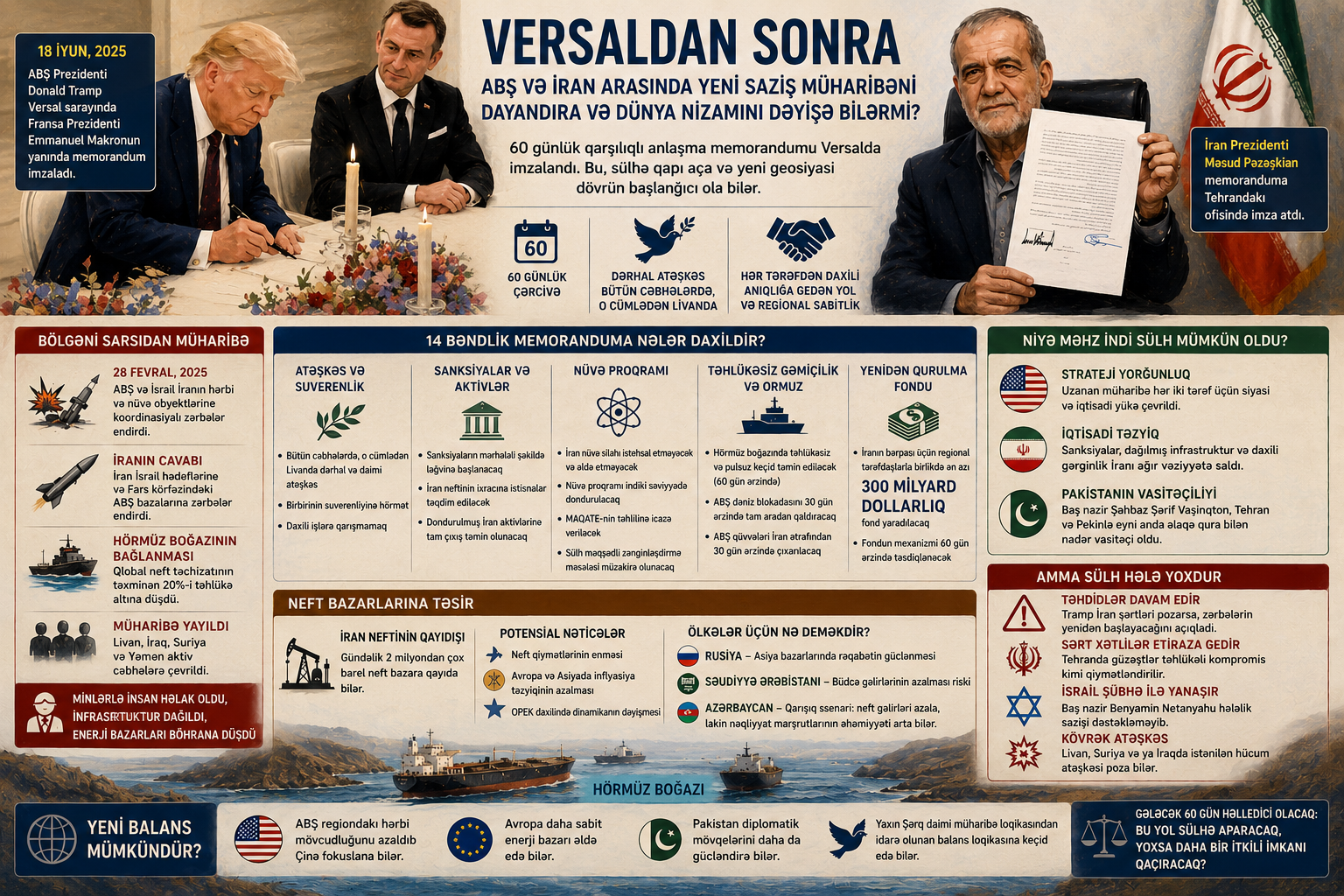
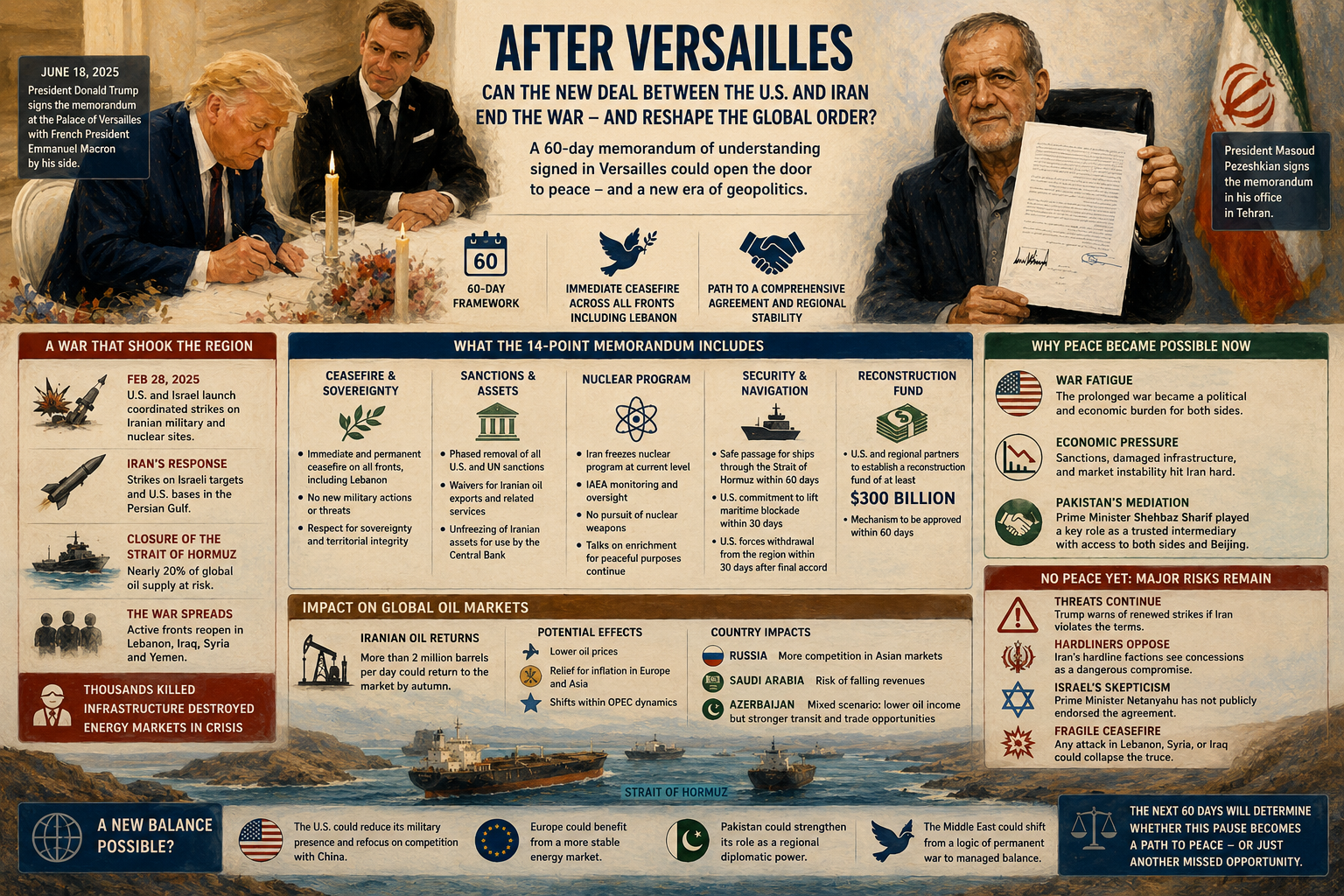
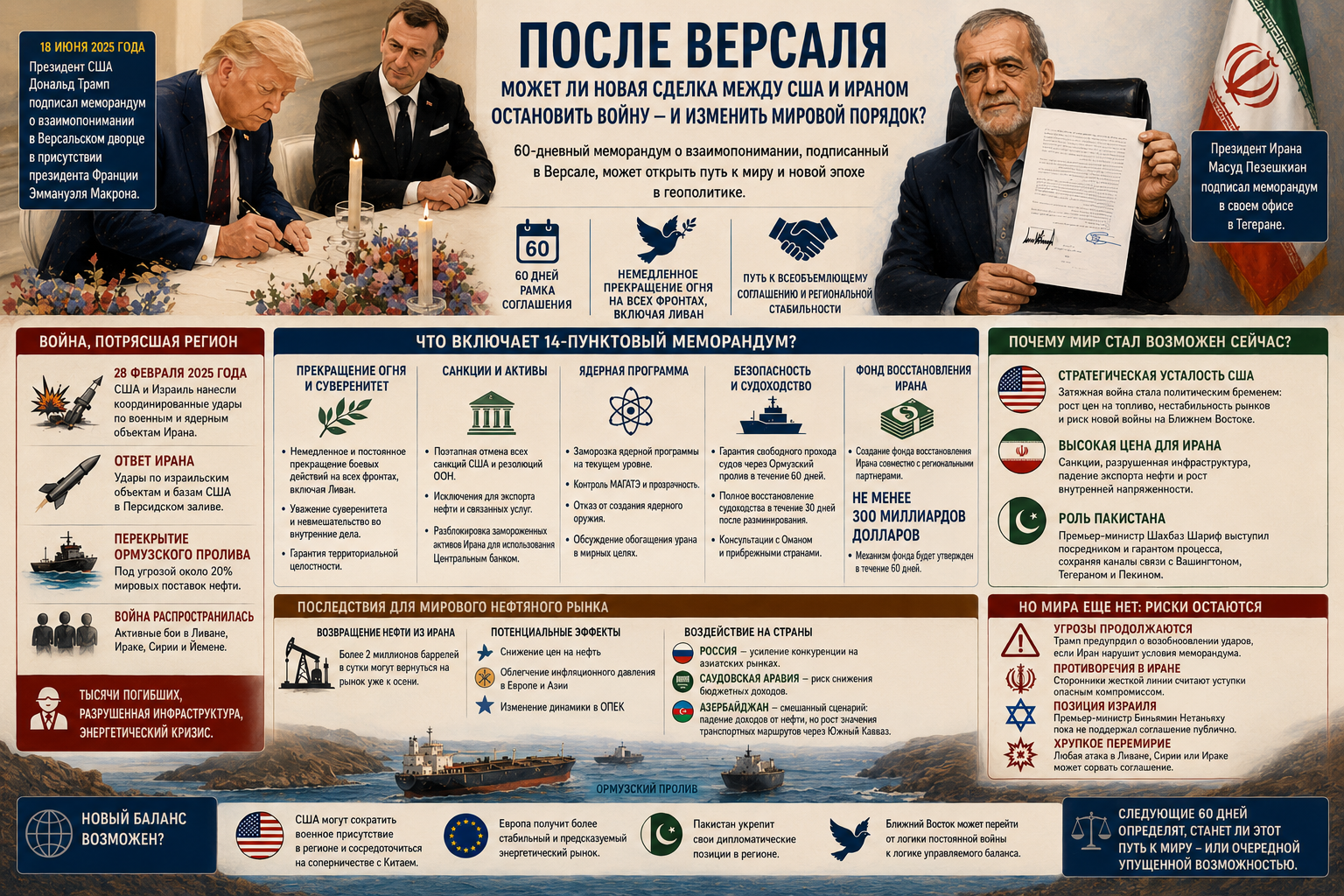
When President Donald Trump of the United States announced Thursday morning, standing beside French President Emmanuel Macron at the Palace of Versailles, that he had signed a memorandum of understanding with Iran, it sounded like an unexpected ending to one of the most dangerous crises of recent years.
“It is signed. Signed at Versailles. I just signed it,” Mr. Trump said, referring to the preliminary agreement that could mark the beginning of an end to the war between Washington and Tehran.
Iranian President Masoud Pezeshkian signed the memorandum from his office in Tehran.
But behind the diplomatic choreography lies a far more complicated reality: a war that lasted nearly four months has left thousands dead, infrastructure shattered, energy markets disrupted, and a region whose balance of power may now shift in unpredictable ways.
The agreement, designed to last for 60 days, does not end the conflict. It merely suspends it.
And it is in that pause, analysts say, that the future of the Middle East may now be decided.
A War That Became Too Costly for Everyone
The conflict began on February 28, when the United States and Israel launched a series of coordinated strikes on Iranian military and nuclear facilities. Washington insisted the campaign was aimed at preventing the accelerated advancement of Iran’s nuclear program.
Tehran’s response was broader than many Western strategists had anticipated.
Iran launched strikes against Israeli targets, as well as American bases and logistical hubs in the Persian Gulf. At the same time, Tehran effectively closed the Strait of Hormuz — the narrow maritime corridor through which nearly 20 percent of the world’s oil supplies pass.
That alone was enough to send global markets into panic.
Oil prices climbed above $105 a barrel. Shipping costs surged. Insurance premiums for commercial carriers multiplied. Europe once again faced the prospect of an energy shortfall.
But perhaps the most significant consequence was that the war quickly spilled far beyond Iran and Israel.
Lebanon, Iraq, Syria, and Yemen once again became active battlegrounds.
Why Peace Became Possible Now
On both sides of the conflict, a moment of strategic exhaustion had arrived.
For the United States, the prolonged war was becoming a political burden. Rising fuel prices, market instability, and fears of another long-term military entanglement in the Middle East intensified pressure on the White House.
For Iran, the price of war was even steeper.
Its economy, already weakened by sanctions, faced damaged port infrastructure, shrinking oil exports, and growing domestic unrest.
In that context, Pakistan’s mediation became critical.
Prime Minister Shehbaz Sharif of Pakistan, who also signed the memorandum as a guarantor of the process, emerged as a rare intermediary capable of maintaining channels of communication with Washington, Tehran, and Beijing simultaneously.
What the Agreement Includes
The 14-point document, published by Iran’s state agency IRNA, outlines a broad range of commitments.
The United States has pledged to begin the phased removal of sanctions, grant waivers for Iranian oil exports, and unblock frozen assets.
Iran, in turn, has agreed to freeze its nuclear program at current levels, allow international monitoring by the International Atomic Energy Agency, and guarantee safe shipping through the Strait of Hormuz.
A separate and striking element of the deal is a reconstruction fund for Iran worth at least $300 billion.
For many observers, this was the most unexpected provision.
Washington, in effect, is offering Iran integration into a new regional economic order in exchange for abandoning its “fortress under siege” strategy. The approach echoes America’s reconstruction of Germany and Japan after World War II — only this time adapted to a Middle Eastern framework.
What It Means for Oil Markets
If the agreement holds, the global oil market could begin shifting by autumn.
The return of Iranian oil could add more than 2 million barrels per day to global supply.
That could lower prices, ease inflationary pressures in Europe and Asia, and alter the internal dynamics of the Organization of the Petroleum Exporting Countries.
For Russia, it creates a new challenge: intensified competition in Asian markets.
For Saudi Arabia, it raises the risk of declining budget revenues.
For Azerbaijan, the outcome is more complex.
Lower oil prices could reduce state revenues, but the reopening of the Strait of Hormuz and the stabilization of the region could strengthen the strategic importance of transport routes through the South Caucasus.
But There Is Still No Peace
Despite the ceremonial nature of the agreement, both sides continue to speak in the language of threats.
Mr. Trump has already warned that the United States is prepared to resume strikes if Iran violates the terms of the memorandum.
In Tehran, hard-line factions within the government view the concessions as a dangerous compromise.
In Israel, Prime Minister Benjamin Netanyahu has so far stopped short of publicly endorsing the agreement.
That is why the next 60 days may prove to be the most fragile.
Any attack in Lebanon, Syria, or Iraq could collapse the cease-fire.
The history of U.S.-Iranian relations — from the 1979 Islamic Revolution to the 2015 nuclear agreement and its eventual collapse — suggests that diplomacy between these two countries is rarely linear.
A New Balance
If the memorandum survives the test of time, its consequences will extend far beyond Iran.
The United States could reduce its military footprint in the region and redirect strategic attention toward its rivalry with China.
Europe could gain a more stable energy market.
Pakistan could strengthen its diplomatic standing.
And for the first time in decades, the Middle East may begin shifting from a logic of permanent war toward a logic of managed balance.
But for now, that remains only a possibility.
And as is often the case in international politics, the future will depend not on the text of the agreement, but on how long adversaries can live with a peace they have not yet fully learned to trust.


Great East
-
One name stood out sharply among the Israeli television channels, Iranian opposition publications and foreign-based broadcasters on the extensive list of “hostile media” released by Iran’s Ministry of Intelligence: AzTV, Azerbaijan’s main state...
-
WASHINGTON, July 27 — U.S. President Donald Trump paused strikes on Iranian targets near the Strait of Hormuz after senior military leaders warned the White House about the limited effectiveness of further bombing and the risk of depleting...
-
Özgür Özel, the leader of Turkey’s main opposition force, announced on July 21 that he was leaving the Republican People’s Party and establishing a new political movement. The decision followed months of internal disputes and legal proceedings that threatened to paralyse the Turkish opposition.
-
The first five months of 2026 produced important indicators suggesting that Azerbaijan–Iran economic relations are entering a new phase. According to Azerbaijan’s State Statistical Committee, the country exported 45.703 million cubic metres of...


Leave a review