


Generated by AI

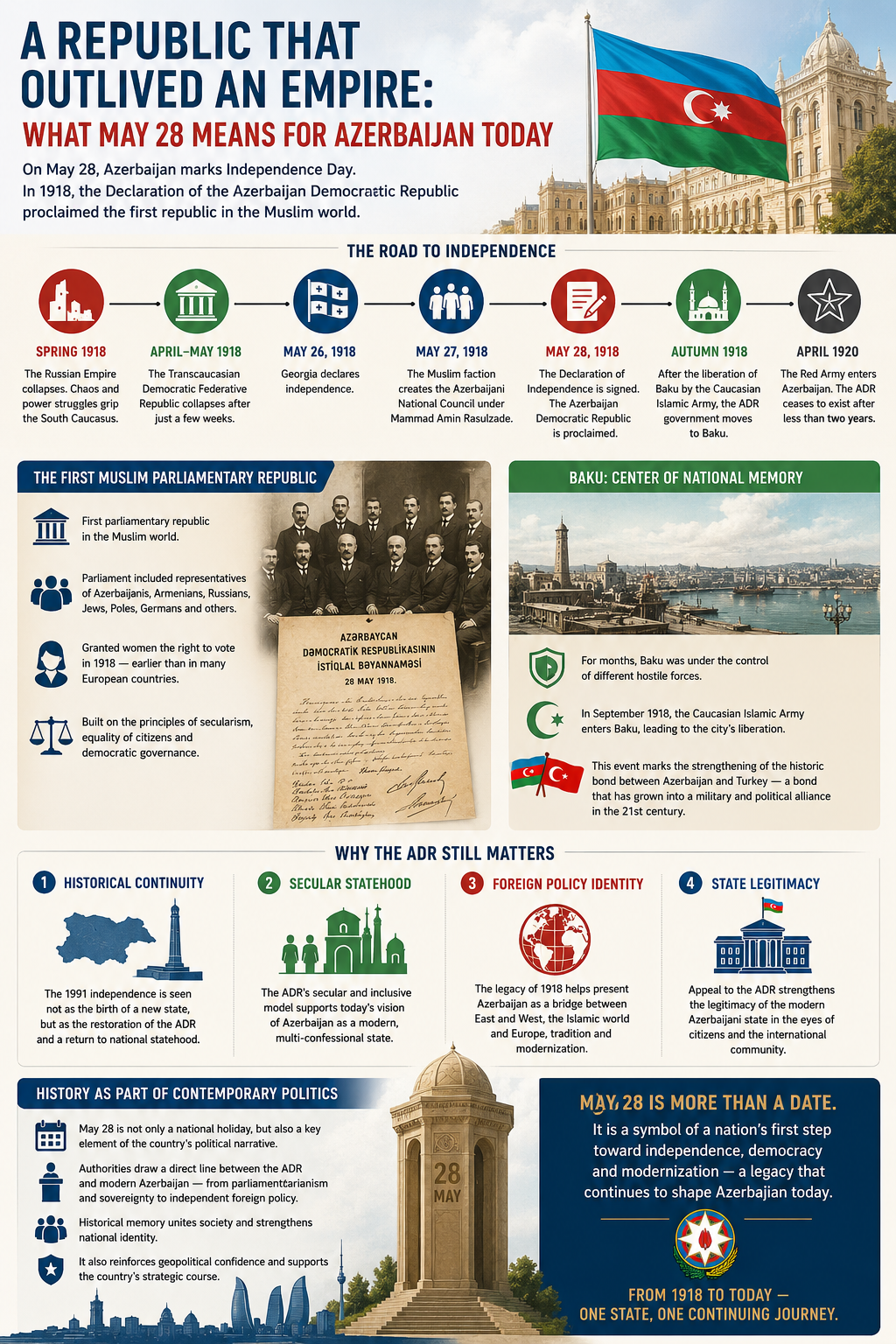
On May 28, Azerbaijan marks Independence Day. It was on this day, 108 years ago in 1918, that the Declaration of the Azerbaijan Democratic Republic proclaimed the establishment of the Azerbaijan Democratic Republic (ADR) — the first republic in the Muslim world.
For Azerbaijan, May 28 is not merely a date on the national calendar. It is the day the country first presented itself as a modern political project: a secular parliamentary republic seeking to combine Muslim identity, European models of statehood, and the idea of national self-determination. For contemporary Azerbaijan, the memory of the proclamation of the Azerbaijan Democratic Republic remains not only part of its historical legacy, but also a central element of state legitimacy, foreign policy identity, and national consciousness.
More than a century after its proclamation, Azerbaijan continues to view itself as the successor to that short-lived yet symbolically powerful era. This is why, in official rhetoric in Baku, the independence achieved in 1991 is framed not as the birth of a new state, but as the restoration of lost statehood.
The Birth of a Republic on the Ruins of an Empire
The spring of 1918 was a period of political chaos across the Caucasus. The Russian Empire had collapsed, the First World War was nearing its end, and the South Caucasus had become an arena of struggle among national movements, foreign armies, and revolutionary forces.
The Transcaucasian Democratic Federative Republic, created after the February Revolution, survived only a few weeks. Armenian, Georgian, and Muslim factions within the Transcaucasian Sejm failed to agree on the future of the region. On May 26, Georgia declared independence. The following day, the Muslim faction proclaimed the creation of the Azerbaijani National Council under the leadership of Mammad Amin Rasulzade.
On May 28, the Declaration of Independence was signed — a document that is still regarded in Azerbaijan today as the political manifesto of the national state. It affirmed the Azerbaijani people’s right to sovereignty and proclaimed the principles of parliamentary democracy and equality of citizens regardless of ethnic or religious background.
For the Muslim East, it was an almost revolutionary step.
The First Muslim Parliamentary Republic
Historians frequently emphasize that the Azerbaijan Democratic Republic became the first parliamentary republic in the Muslim world. Yet the significance of this fact extends far beyond symbolism.
Against the backdrop of collapsing empires and rising nationalism in Europe, the new republic attempted to build a state model based not on religious law, but on civic identity. The ADR parliament included representatives of various political parties and ethnic communities — Azerbaijanis, Armenians, Russians, Jews, Poles, and Germans.
One decision of the ADR government is especially remembered in modern Azerbaijan: granting women the right to vote. This occurred earlier than in many European countries, including France and Switzerland.
For today’s Azerbaijani authorities, this episode carries important ideological significance. It allows them to stress that the country’s tradition of secular governance and modernization has its own historical roots and was not solely a product of the Soviet period.
Baku as the Center of National Memory
During the republic’s first months, the government did not effectively control its own capital. Baku was under the authority of the Baku Commune led by Stepan Shaumyan, and later under the control of the so-called Central Caspian Dictatorship.
Only in the autumn of 1918, after the entry of the Caucasian Islamic Army of the Ottoman Empire into the city, did the ADR government relocate to Baku.
Today, this moment occupies a special place in Azerbaijani historical memory. The liberation of Baku is regarded as one of the key episodes in the formation of national statehood and, at the same time, as the beginning of the strategic connection between Azerbaijan and Turkey — a relationship that in the 21st century has evolved into a full-fledged military and political alliance.
This historical narrative became even stronger after the Second Nagorno-Karabakh War, when Turkish support played a significant role in Azerbaijan’s restoration of control over most of Karabakh.
Why the ADR Still Matters
Although the first republic survived for less than two years and was dissolved after the Red Army entered Azerbaijan in April 1920, its political legacy proved remarkably resilient.
Following the collapse of the Soviet Union in 1991, Azerbaijan officially declared itself the legal successor of the ADR. This decision carried not only symbolic but also strategic importance.
First, it allowed the independence of 1991 to be integrated into a longer historical continuum, demonstrating that modern Azerbaijan was not a post-Soviet creation, but a restored national state.
Second, the appeal to the legacy of the ADR helped shape the ideology of secular statehood. Despite having a Muslim-majority population, Azerbaijan consistently presents itself as a secular state with a multi-confessional model of society.
Third, the memory of the 1918 republic became part of the country’s foreign policy image. Azerbaijan seeks to portray itself as a bridge between East and West, the Islamic world and Europe, tradition and modernization.
History as Part of Contemporary Politics
Today, May 28 in Azerbaijan is not only a national holiday but also an important component of the country’s political narrative.
In official speeches, the authorities regularly draw a direct line between the ADR and the modern Azerbaijani state — from parliamentarianism and national sovereignty to the idea of an independent foreign policy.
Historical memory is also used as an instrument of social consolidation after decades of conflict, economic transformation, and war over Karabakh.
For many Azerbaijanis, the history of the first republic has become a symbol that national statehood was not granted from outside, but created by local political elites during one of the most chaotic periods in world history.
That is why May 28 in Azerbaijan is perceived not simply as the anniversary of a declaration signed in Tbilisi more than a century ago. It is the day the country reminds itself that the idea of an independent Azerbaijan survived empires, the Soviet era, wars, and the collapse of the USSR — ultimately becoming the foundation of the modern Azerbaijani state.
- Three May Days of Freedom: Why the South Caucasus, 108 Years Later, Is Still Searching for a Common Destiny
- The South Caucasus in 2050: How a Former Conflict Zone Became a Crossroads of the New World (A Report from the Future)


Social
-
Road traffic in central Buzovna is still being shaped by the consequences of an accident that has formally been addressed. The groundwater leak has been stopped, but the damaged road has not been restored. For nearly a month, buses and cars have...
-
Behind the high stone wall of an ordinary private home in Buzovna stand several ancient gravestones. They are not part of a decorative garden, nor were they moved there by archaeologists. The house simply happened to be built on the site of an old...
-
The participation of Armenian wrestlers in the U17 World Championships will test whether the cautious political dialogue between the two countries can move beyond negotiating rooms. If one of Armenia’s young wrestlers climbs to the top of the podium...
-
“Ali Ayaghi” in Buzovna: A Shrine, a Legend, and the Forgotten History of Absheron History on the Absheron Peninsula rarely lies on the surface. It hides beneath later buildings and survives in the names of neighbourhoods, ancient cemeteries, wells,...


Leave a review