


Generated by AI

The Rise of Micromobility in Azerbaijan: Opportunity, Risk, and the Search for Balance
Over the past decade, micromobility has expanded rapidly across the world, and Azerbaijan has not remained outside this global trend.
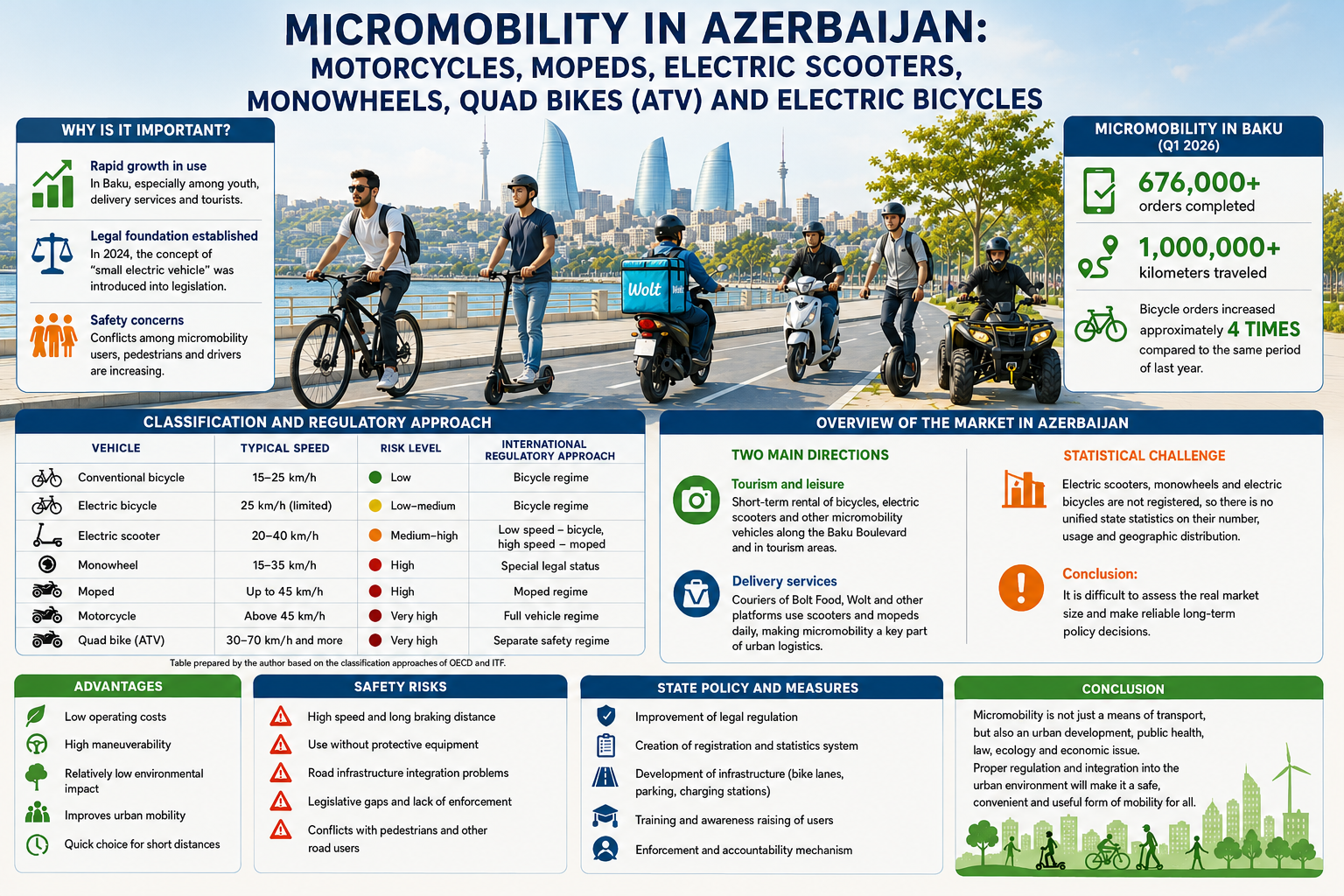
The International Transport Forum (ITF), operating under the Organisation for Economic Co-operation and Development (OECD), generally classifies micromobility as lightweight personal transport vehicles with a design speed of up to 45 km/h. This category includes bicycles, electric bicycles, electric scooters, mopeds, and monowheels. Although quad bikes (ATVs) technically fall outside this definition, they create similar safety and legal regulatory challenges as personal transport vehicles.
The principal advantages of these vehicles are their low operating costs, high maneuverability, and relatively limited environmental impact. At the same time, because they differ significantly in speed, weight, and handling characteristics, the associated safety risks also vary considerably. It is precisely this diversity that makes the regulation of micromobility one of the most complex areas of modern transport policy.
In Azerbaijan, the growing importance of this issue is determined by three main factors.
First, the use of electric scooters, mopeds, and bicycles—particularly in Baku—is increasing rapidly, primarily among young people, delivery service workers, and tourists. According to the Azerbaijan Land Transport Agency (AYNA), more than 676,000 trips were completed using micromobility vehicles in Baku during the first quarter of 2026, with users covering more than one million kilometers. During the same period, the number of bicycle rentals increased approximately fourfold compared with the corresponding period of the previous year.
These figures demonstrate that micromobility has already evolved from an alternative means of transportation into an essential component of everyday urban mobility.
Second, the introduction of the concept of a "small electric vehicle" into Azerbaijani legislation in 2024 established the foundation for a new stage in the legal regulation of this sector.
Third, against the backdrop of the development of a pedestrian-oriented urban concept, the growing number of conflicts between micromobility users, pedestrians, and motorists has made safety an even more pressing issue.
Consequently, micromobility has become not merely a transportation issue but also a matter of urban planning, public health, law, environmental policy, and economics.
Classification and Regulatory Logic
From an analytical perspective, it is important to understand that micromobility is not a single homogeneous category.
The International Transport Forum (ITF) recommends regulating low-speed electric scooters and electric bicycles under the same framework as bicycles, while higher-speed vehicles should be regulated as mopeds.
In Azerbaijan, however, this differentiation has not yet been fully established, creating certain gaps in the country's legal framework.
| Vehicle | Typical Speed | Risk Level | International Regulatory Approach |
| Conventional bicycle | 15–25 km/h | Low | Bicycle regulations |
| Electric bicycle | 25 km/h (speed-limited) | Low to medium | Bicycle regulations |
| Electric scooter | 20–40 km/h | Medium to high | Low-speed: bicycle regulations; high-speed: moped regulations |
| Monowheel | 15–35 km/h | High | Special legal status |
| Moped | Up to 45 km/h | High | Moped regulations |
| Motorcycle | Above 45 km/h | Very high | Full motor vehicle regulations |
| Quad bike (ATV) | 30–70 km/h or more | Very high | Separate safety regulations |
Table prepared by the author based on the classification approaches of the OECD and the International Transport Forum (ITF).
The Overall Market Landscape in Azerbaijan
The micromobility market in Azerbaijan is developing in two principal directions.
The first is the tourism and recreational segment. Along the Baku Seaside Boulevard, in addition to bicycle rental services, various private companies offer short-term rentals of electric scooters and bicycles.
The second—and much faster-growing—segment is delivery services. For couriers working with Bolt Food, Wolt, and other delivery platforms, scooters and mopeds have become indispensable daily work tools. This has significantly expanded the economic role of micromobility, transforming it into an important component of urban logistics. On the other hand, long working hours, tight delivery schedules, and intensive traffic also increase safety risks.
The Roadmap for Promoting the Circulation of Environmentally Friendly and Safe Vehicles, adopted in 2024, together with customs and tax incentives granted for the import of electric vehicles, provides favorable conditions for the future development of the market.
Nevertheless, the principal challenge in evaluating the market is the incompleteness of statistical data. While certain information is available regarding motorcycles and mopeds, electric scooters, monowheels, and electric bicycles are not subject to mandatory registration. Consequently, there is no unified national statistical database regarding their numbers, patterns of use, or geographical distribution.
As a result, assessing the actual size of the market and developing long-term public policies based on reliable data remains difficult.
Quad Bikes (ATVs): A Legal Gap in the Tourism Sector
One of the segments of the micromobility market that continues to receive insufficient attention is quad bikes (ATVs). In recent years, the use of gasoline-powered quad bikes (ATVs) has increased noticeably in the suburbs of Baku. This trend is raising growing concerns from the perspective of public safety.
The maximum speed of a gasoline-powered quad bike (ATV) depends on engine displacement, power output, and intended use. Typical performance characteristics are as follows:
| Engine Displacement | Typical Application | Maximum Speed |
| 50–90 cc | Children's models | 25–50 km/h |
| 110–150 cc | Youth and light utility models | 50–70 km/h |
| 200–300 cc | Recreational models | 70–90 km/h |
| 400–500 cc | Utility and touring models | 80–100 km/h |
| 600–700 cc | Sport and heavy-duty utility models | 100–120 km/h |
| 800–1,000 cc | High-performance sport models | 120–140 km/h (occasionally up to 150 km/h) |
The quad bikes most commonly used in Azerbaijan, particularly in tourist destinations such as Shahdag and Tufandag, are typically equipped with 200–500 cc engines. Their maximum speed generally ranges from 70 to 100 km/h. However, during guided tours and rental operations, operators usually restrict their speed to 30–50 km/h for safety reasons.
For this reason, their dynamic performance differs substantially from that of most micromobility vehicles. Consequently, they require a separate regulatory framework and more stringent safety requirements.
Their operation in parks, on beaches, in pedestrian areas, and in other places where large numbers of people gather is inconsistent with modern road safety principles. International practice generally limits the use of ATVs to designated off-road trails, tourist zones, or public roads, provided that all applicable legal requirements are fully met.
An ATV may be operated as a road vehicle only in compliance with legal requirements. This generally means that the vehicle must be subject to registration, display an official registration plate, and be operated by a driver holding the appropriate driver's license category (Category B1 for quadricycles, while other vehicle types may be subject to different licensing requirements). In addition, the vehicle must be operated on public roads in full compliance with traffic regulations.
This approach is consistent with international classification practices and does not overstate the actual technical capabilities of modern gasoline-powered ATVs.
This situation creates additional safety risks. In practice, there are frequent cases in which teenagers—and even children—operate high-powered quad bikes without adequate supervision. This indicates that future regulatory reforms should cover not only urban micromobility but also ATVs used in tourism areas.
Another issue of particular concern is the noise generated by gasoline-powered quad bikes. Unlike electric micromobility vehicles, ATVs are equipped with internal combustion engines, whose noise levels can reach 80–100 decibels.
When operated in residential neighborhoods, parks, beaches, and other public recreational areas, such noise can cause significant acoustic disturbance and, where established limits are exceeded, may conflict with Azerbaijan's sanitary regulations governing permissible environmental noise levels in places where people live and gather.
In Azerbaijan, environmental noise standards are established by Presidential Decree No. 796 and apply to residential and public buildings, residential areas, and other places where people congregate.
For Reference
- Residential areas during daytime (07:00–23:00): approximately 50 dB(A);
- Residential areas during nighttime (23:00–07:00): approximately 40 dB(A).
These values are used in Azerbaijan's national equivalent noise standards.
Comparative Noise Levels
| Noise Source | Approximate Noise Level |
| Quiet park | 35–45 dB |
| Typical urban street | 55–65 dB |
| Passenger car in motion | 65–75 dB |
| Gasoline-powered quad bike (ATV) | 80–100 dB |
| Motorcycle with a sport exhaust system | 90–105 dB |
If a quad bike is operated through residential courtyards, parks, or beaches where people are present, the noise it generates may exceed the permissible environmental noise limits, thereby becoming not only a road safety issue but also a matter subject to sanitary and public health oversight.
From this perspective, the operation of gasoline-powered quad bikes in populated areas and public recreational spaces should be assessed not only in terms of traffic safety but also with regard to environmental noise pollution and compliance with public health and sanitary regulations.
Infrastructure: Expanding but Still Fragmented
International experience demonstrates that the primary factor determining the safety of micromobility is the availability of continuous and dedicated traffic lanes.
In recent years, the Azerbaijan Land Transport Agency (AYNA) has taken significant steps to expand bicycle and micromobility lanes throughout Baku. Connecting newly constructed lanes with existing routes is intended to establish an integrated citywide network.
Nevertheless, the existing infrastructure remains fragmented. Because many individual lanes do not form continuous routes, users are frequently forced to enter motor vehicle traffic lanes or ride on sidewalks. Consequently, the risks of collisions with automobiles and conflicts with pedestrians increase.
The law requires small electric vehicles to use bicycle lanes or, where such lanes are unavailable, to travel along the right edge of the roadway. However, this legal requirement can function effectively only where appropriate infrastructure exists. The incomplete nature of the current infrastructure therefore makes full compliance with legal requirements considerably more difficult.
Road Safety: Visible and Hidden Risks
The principal concern associated with micromobility is safety.
According to the Baku City State Traffic Police Department, during the first five months of the current year, six road traffic accidents involving motorcycles and mopeds occurred in the capital. As a result, five people lost their lives, while one person sustained injuries of varying severity. During the same period, numerous motorcycles and mopeds operated by individuals without valid driving licenses or in violation of regulatory requirements were removed from service.
According to the Ministry of Internal Affairs, the primary causes of these accidents include running red lights, failure to maintain a safe following distance, and dangerous driving maneuvers.
However, these figures do not fully reflect the actual state of micromobility safety.
First, official statistics primarily cover motorcycles and mopeds. Incidents involving electric scooters and monowheels are not recorded as a separate statistical category.
Second, a substantial proportion of injuries resulting from single-vehicle falls are recorded only in hospital databases rather than in police statistics.
Third, the absence of a unified nationwide statistical system makes it impossible to objectively assess the situation across the country's regions.
As a result, policymakers are compelled to rely on information that does not fully capture the risks associated with micromobility. Yet the effectiveness of road safety policy depends, above all, on the availability of reliable statistical data.
International Comparison
International research demonstrates that the challenges faced by Azerbaijan are common to many other countries.
According to the International Transport Forum (ITF) and the Organisation for Economic Co-operation and Development (OECD), electric scooters generate between 87 and 251 emergency medical visits per one million trips, while approximately 10 percent of injured riders require hospitalization.
Experience from Denmark indicates that the risk of injury for electric scooter users is approximately eight times higher than for cyclists.
At the same time, international experience shows that the principal causes of safety problems are not micromobility itself, but rather inadequate infrastructure, insufficient speed control, failure to use protective equipment, and incomplete data collection systems.
For this reason, developed countries increasingly focus not on prohibitions but on implementing the Safe System approach.
Legal Regulation: A New Stage, but an Incomplete System
The amendments introduced in 2024 to the Law on Road Traffic and the Code of Administrative Offenses established Azerbaijan's first comprehensive legal framework governing micromobility.
The amendments introduced into national legislation such concepts as:
- small electric vehicle;
- bicycle lane;
- dedicated parking areas;
- electric vehicle charging stations.
Under the new regulations, shared mobility operators are required to:
- limit vehicle speed through technical means;
- provide GPS monitoring;
- prevent defective vehicles from being placed into service.
Pursuant to Article 338.4-1 of the Code of Administrative Offenses, drivers of small electric vehicles who violate traffic regulations are subject to a fine of 40 Azerbaijani manats.
Renting out a defective vehicle carries significantly greater financial liability for operators.
During the first eight months of 2024, 1,864 administrative offenses were recorded in this area, demonstrating that the new regulatory framework has entered the stage of practical implementation.
Legal Gaps: The Agenda for the Next Stage of Reform
Despite the legislative measures already adopted, the system has not yet been fully developed.
First, the rules concerning the minimum age for using small electric vehicles, the mandatory use of helmets, and, in certain cases, rider training have not been defined with sufficient precision. Meanwhile, the World Health Organization emphasizes that helmets are among the most effective safety measures for reducing traumatic brain injuries.
Second, applying the same fine to all violations does not fully reflect their differing levels of danger to the public. For example, running a red light and riding without holding the handlebars are subject to the same financial penalty.
Third, there is no separate statistical information system for micromobility. Because police, emergency medical service, and hospital data are not integrated, the true scale of accidents remains only partially visible.
Finally, the legal status of quad bikes used in tourism zones, minimum age requirements, the use of protective equipment, and operator liability also require separate regulation.
Economic Effects: A New Market and a New Employment Model
In recent years, micromobility has begun to create a new economic segment in Azerbaijan.
The import and sale of electric vehicles, technical maintenance services, the spare parts market, and shared mobility services are developing rapidly. In particular, the expansion of delivery platforms has created additional employment opportunities for thousands of people.
Customs and tax incentives introduced by the state for electric vehicles are also among the important instruments stimulating market development.
At the same time, it remains difficult to assess the actual size of the market. The absence of a registration system for electric scooters and other micromobility vehicles makes it impossible to calculate the economic turnover of this sector accurately.
Environmental Impact: Expectations and Reality
Micromobility is generally regarded as a more environmentally sustainable form of transport. However, international research recommends a more cautious assessment.
According to analyses by the International Transport Forum and the Organisation for Economic Co-operation and Development, electric scooters often replace walking, cycling, or public transport rather than private car journeys. In such cases, the reduction in carbon emissions is not as substantial as expected.
In other words, the environmental advantage of micromobility depends not on its mere existence, but on the type of transport it replaces.
When these vehicles reduce private car journeys, they can make a significant contribution to lowering both emissions and urban congestion. Otherwise, their environmental benefit remains limited.
Public Health: The Hidden Burden
Micromobility accidents also create a new challenge for the healthcare system.
International studies show that the most common injuries in such accidents include traumatic brain injuries, facial injuries, and fractures of the wrist, arm, and shoulder.
According to assessments by the World Health Organization and other international organizations, helmet use significantly reduces the risk of severe head injuries.
In Azerbaijan, however, hospital admissions related to electric scooters and other small electric vehicles are not recorded as a separate statistical category. As a result, it is impossible to assess the true burden placed on the healthcare system.
This lack of data complicates both the planning of preventive measures and the evaluation of the effectiveness of public policy.
International Experience: Integration Is More Effective Than Prohibition
Global experience in the field of micromobility demonstrates that the most successful model is neither a complete ban nor unrestricted use without oversight. An effective approach is based on integrating safety, infrastructure, and legal regulation into a single, coherent system.
The Netherlands, Denmark, and Germany have made micromobility an integral component of urban transportation by developing extensive cycling infrastructure, establishing clear speed limits, and introducing comprehensive technical standards.
In the United Kingdom, the use of electric scooters is regulated through phased pilot programs combined with stringent safety requirements.
An example of the opposite approach is Paris. Following the 2023 referendum, the city prohibited shared electric scooter services. However, this decision did not apply to privately owned scooters, while the relatively low voter turnout has continued to fuel debate regarding the effectiveness of the ban.
Copenhagen also initially introduced restrictions but later returned to a more balanced regulatory model.
These examples demonstrate that the future of micromobility lies not in prohibitions but in implementing the International Transport Forum's Safe System approach, which focuses on:
- developing safe infrastructure;
- effective speed management;
- public education and awareness;
- the introduction of technical standards;
- the establishment of reliable statistical data systems.
International Regulatory Models
| Model | Example | Key Characteristics |
| Integration | Netherlands, Germany | Well-developed infrastructure and clear legal regulation |
| Pilot Model | United Kingdom | Phased implementation combined with strict safety requirements |
| Prohibition | Paris | Ban on shared electric scooter services |
| Reintegration | Copenhagen | Return to a balanced regulatory model following earlier restrictions |
Source: Author's compilation based on ITF, ETSC, and international best practices.
Priority Areas for Reform in Azerbaijan
The current situation demonstrates that micromobility has already become an important component of Azerbaijan's transportation system. During the next stage of development, greater emphasis should be placed not on market expansion itself, but on improving safety and governance.
From this perspective, the Turan Analytical Service identifies the following priorities:
- developing a dedicated national strategy for micromobility;
- establishing a legal classification of electric scooters, monowheels, and other small electric vehicles based on their speed characteristics;
- introducing clear regulations governing mandatory helmet use, minimum age requirements, and rider safety standards;
- creating a unified national micromobility statistics system integrating police, emergency medical service, and hospital data;
- expanding continuous networks of dedicated micromobility lanes in urban areas;
- introducing unified safety and insurance standards for shared mobility operators and ATV rental services operating in tourism zones;
- implementing continuous road safety education programs in schools, universities, and delivery service companies.
Strategic Directions for Development
Micromobility in Azerbaijan is no longer an alternative mode of transportation. It has become one of the fastest-growing components of urban mobility.
The rapid increase in usage, the establishment of a legal framework, and government incentive measures introduced in recent years confirm the considerable development potential of this market.
At the same time, fragmented infrastructure, incomplete statistical information, remaining legal gaps, and persistent safety risks continue to represent the principal obstacles to the sustainable development of micromobility.
International experience demonstrates that safety cannot be achieved simply by imposing stricter penalties. A more effective approach is a comprehensive policy based on the Safe System principle.
This model integrates the development of safe infrastructure, improvements to legal regulation, the integration of information systems, public awareness campaigns, and user responsibility into a single governance framework.
Azerbaijan's advantage lies in the fact that its micromobility market is still in the formative stage. This creates an opportunity to draw upon the experience of more developed countries, avoid repeating the problems they encountered, and build a safer, more sustainable, and more modern model of urban mobility.


Security
-
maliyyə intizamını gücləndirə; beynəlxalq audit standartlarının tətbiqini sürətləndirə; iri investisiya layihələrinin maliyyələşdirilməsini asanlaşdıra; beynəlxalq maliyyə institutlarından kredit və investisiya cəlbini genişləndirə; satınalma və...
-
Patriot, yoxsa Arrow? Possible Iranian strike on Ukraine creates new risks for Azerbaijan Reports that Iran considered launching a ballistic missile strike against one of Ukraine’s Black Sea ports have raised concerns that the confrontation between...
-
On July 28, representatives of the Commissioner for Human Rights of the Republic of Azerbaijan — the Ombudsman — met with 16 Azerbaijani citizens, including seven women and nine children, who had been repatriated from Syria on July 18–19 and placed...
-
Corruption is one of the most persistent structural problems of modern public administration. It is not merely an individual ethical violation but a systemic phenomenon affecting the functional integrity of state institutions. Corruption places...


Leave a review