


Generated by AI

What the Absheron tragedy says about Azerbaijan’s healthcare system
The death of a 17-year-old girl following a road accident on the Baku–Sumgait highway has once again brought one of the most sensitive questions of Azerbaijan’s healthcare system into public focus: how prepared are regional state hospitals to provide emergency care in critical situations.
According to local media reports, the victim was taken in critical condition to the Absheron Central District Hospital. The nature of her injuries made transportation to another medical facility medically unsafe. In such cases, speed of diagnosis becomes decisive. Yet it was precisely at this stage that the system encountered a fundamental limitation: the hospital did not have a computed tomography scanner.
The response from the State Agency for Mandatory Health Insurance and the medical administration bodies under its authority was predictably institutional. Officials stated that the priority of the system is not to equip every hospital with a full range of radiological equipment, but to create a unified framework of accessibility to medical services.
On paper, this approach appears rational. High-technology medical equipment is expensive, requires qualified personnel, constant maintenance and complex infrastructure. Centralization allows costs to be optimized and resources to be concentrated. But the tragedy in Absheron has once again raised a painful question: how effective is such a model when time is measured not in days, but in minutes.
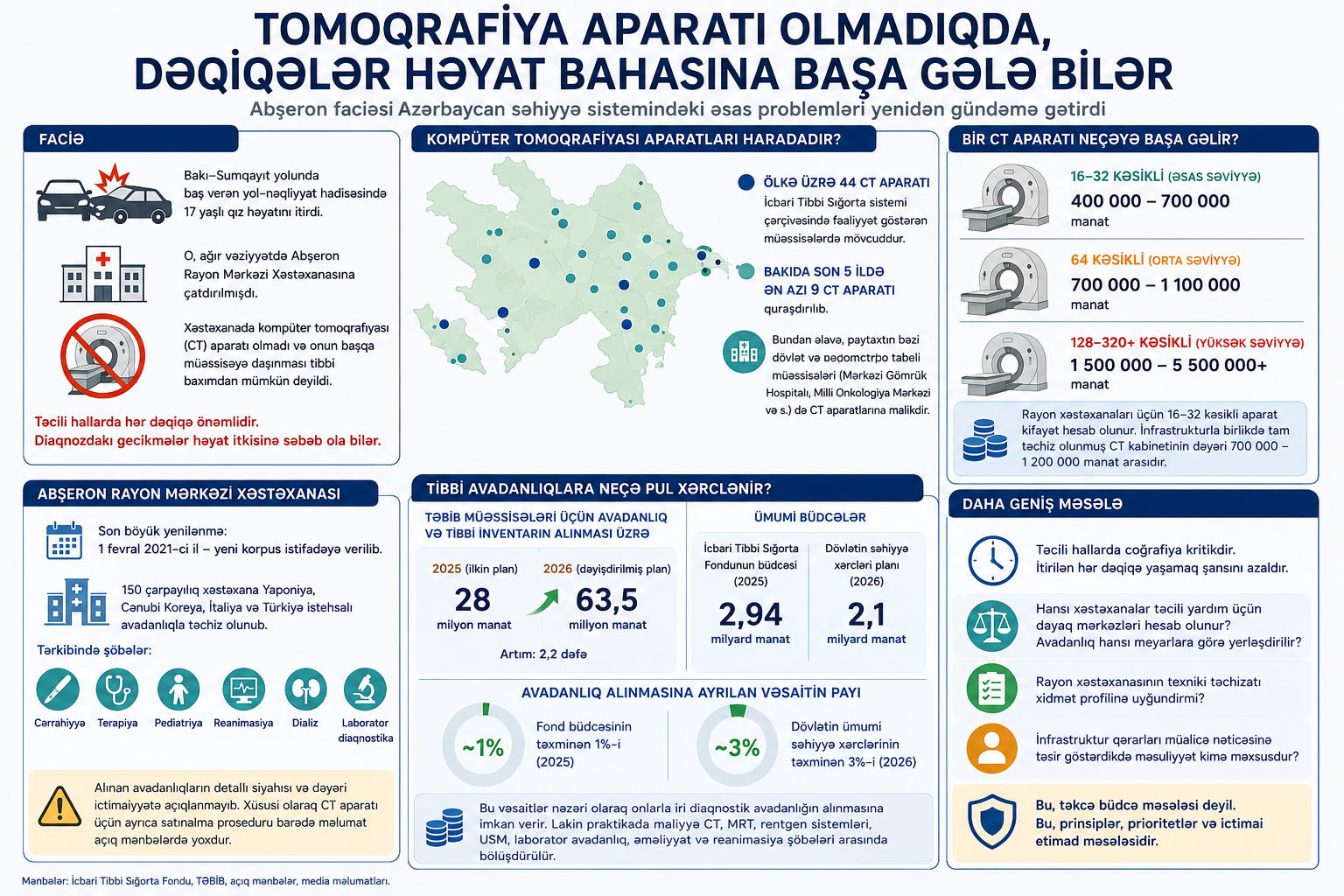
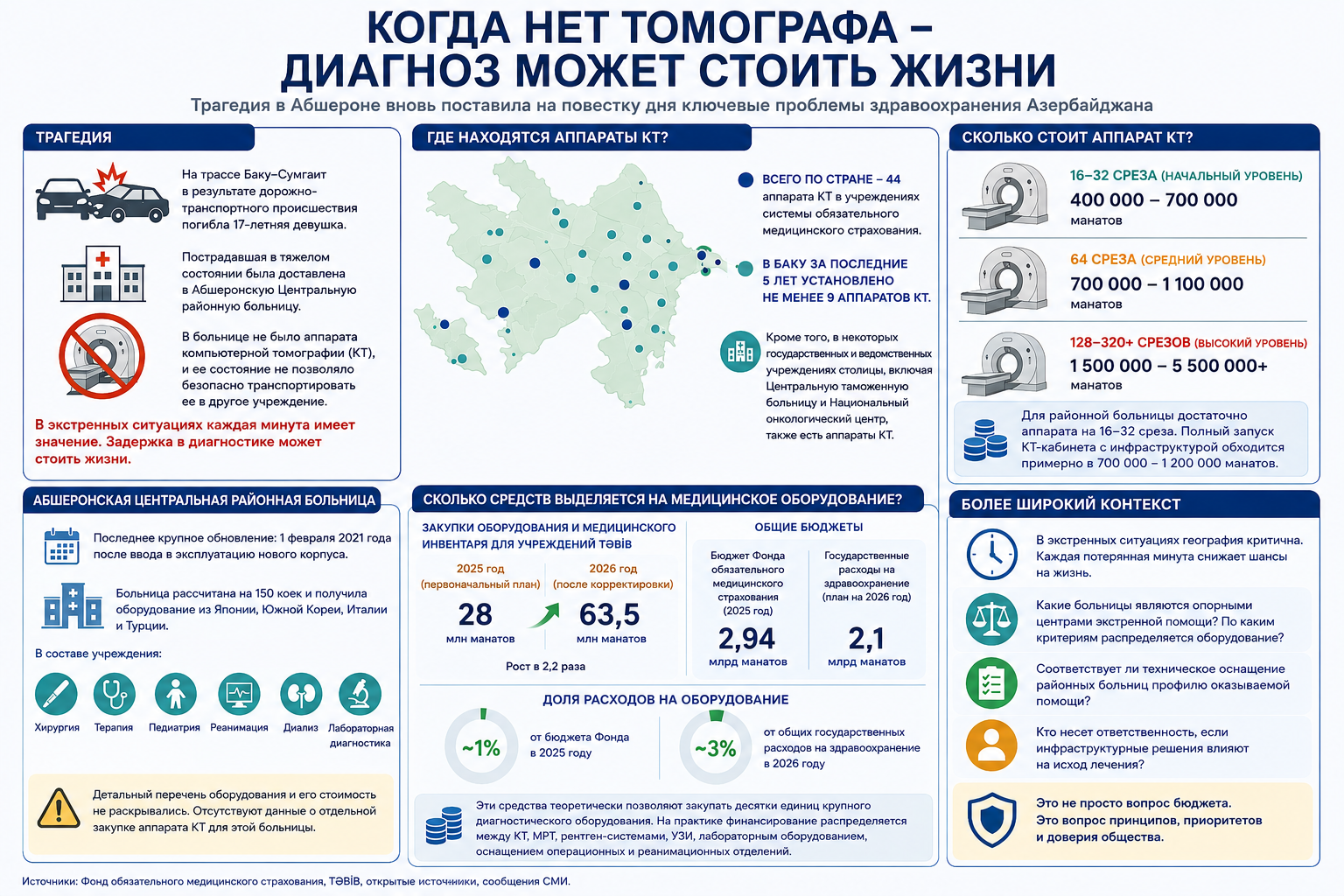
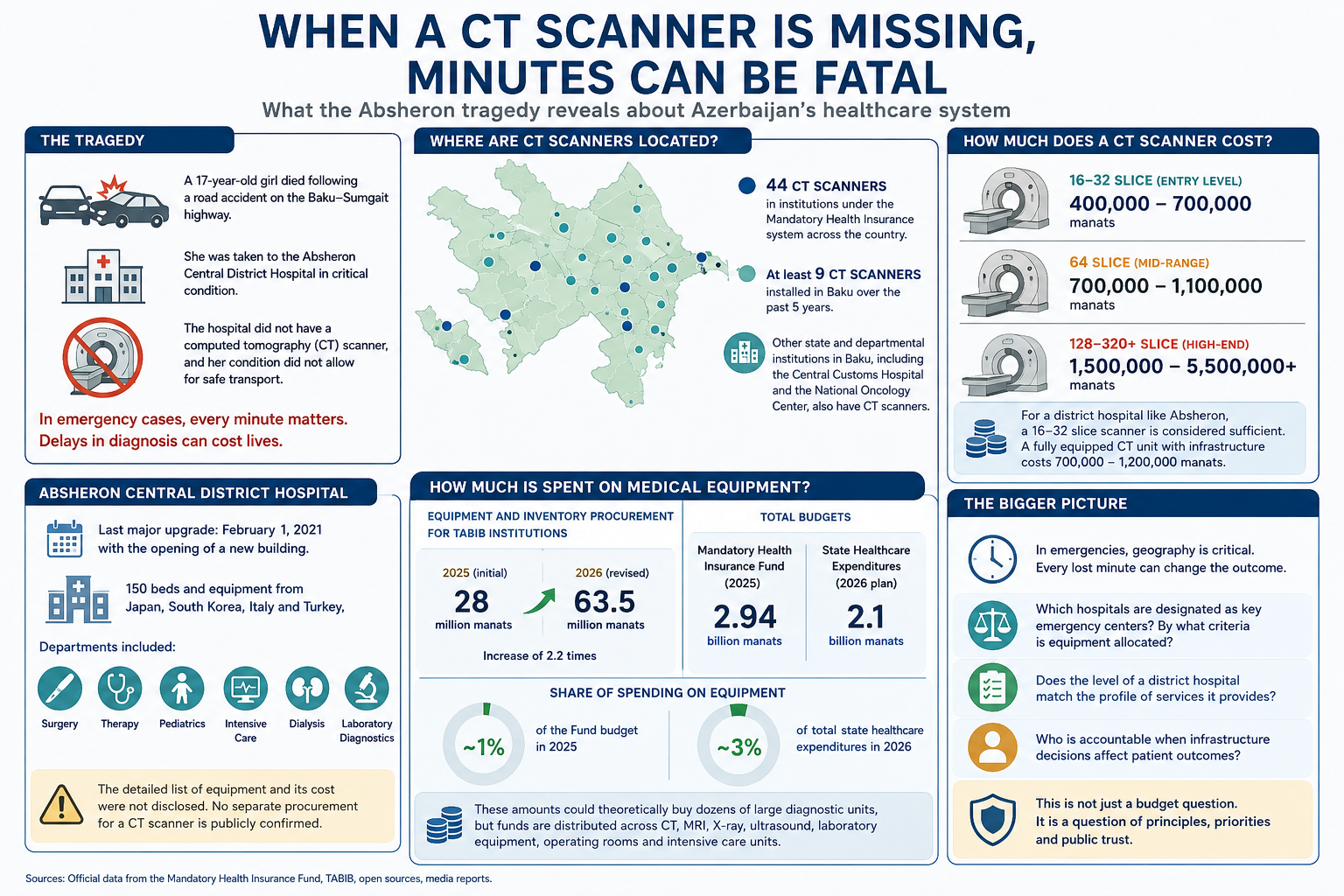
According to the latest available data, over the past five years at least nine computed tomography scanners have been installed in state medical institutions in Baku under the Mandatory Health Insurance system. Across the country, a total of 44 computed tomography scanners are currently operating within this network.
Beyond this system, separate state and ведомственный medical institutions in the capital, including the Central Customs Hospital and the National Oncology Center, also operate their own tomography equipment. Formally, this creates the impression of broad coverage. But the geography of equipment and the actual logistics of emergency care are not the same thing.
The Absheron Central District Hospital last underwent a major publicly confirmed infrastructure upgrade in February 2021, when a new building was officially opened.
At the time, authorities stated that the 150-bed hospital had been equipped with modern medical devices manufactured in Japan, South Korea, Italy and Turkey. The facility included departments for surgery, therapy, pediatrics, intensive care, dialysis and laboratory diagnostics. The district hospital, outpatient clinic, children’s clinic and ambulance service were all relocated into the new building.
Yet despite these public statements, no detailed inventory of the purchased equipment or its cost was ever disclosed. Open sources also contain no information about a separate procurement procedure specifically for a computed tomography scanner for this hospital. That, in turn, raises broader questions about transparency in public healthcare procurement.
The cost of computed tomography equipment varies significantly depending on its technical class. Entry-level systems, offering between sixteen and thirty-two slices, are generally priced between 400,000 and 700,000 manats. More advanced sixty-four-slice systems can cost between 700,000 and 1.1 million manats, including software, installation and maintenance.
Expert-grade systems designed for specialized clinics can cost between 1.5 million and 5.5 million manats or even more.
According to specialists, for a district hospital at the level of Absheron, a basic sixteen- or thirty-two-slice scanner would generally be sufficient. The full launch of a tomography unit, including infrastructure preparation, is usually estimated at between 700,000 and 1.2 million manats.
Against this backdrop, the budget figures are striking.
In 2025, 28 million manats were allocated for the purchase of medical equipment and inventory for institutions within the Mandatory Health Insurance system. After budget revisions in 2026, this figure was increased more than twofold to 63.5 million manats.
The total budget of the Mandatory Health Insurance Fund for 2025 stood at 2.94 billion manats. Meanwhile, total state healthcare expenditures for 2026 were planned at 2.1 billion manats.
This means that direct spending on equipment represents a relatively small share of the overall healthcare budget — around one percent of the fund’s budget in 2025 and roughly three percent of the total state healthcare expenditure in 2026.
From a purely mathematical perspective, these sums are sufficient to purchase dozens of large-scale diagnostic units. But in practice, funding is distributed across computed tomography, magnetic resonance imaging, radiological systems, ultrasound devices, laboratory equipment, operating theatres and intensive care units.
This is why the question today is no longer simply why one specific hospital lacked a tomography scanner.
The issue is about principles.
Which hospitals are designated as key emergency care institutions? By what criteria are decisions made about the placement of expensive equipment? How well does the profile of a district hospital match its level of technical readiness? And who carries responsibility when infrastructure decisions influence the outcome of treatment?
For planned healthcare, accessibility at a regional level may be sufficient. But in emergency medicine, geography becomes a biological factor. Every lost minute can alter the chances of survival.
The case in Absheron alone does not allow for sweeping conclusions about the entire healthcare system of Azerbaijan. But it once again exposes the central structural tension of modern medicine: the balance between the efficiency of centralized resource management and the need to guarantee a minimum technological standard at the very point where emergency care is first delivered.
It is at this point that public policy ceases to be merely a matter of budgets and becomes a matter of trust.


Security
-
It is 8:10 in the morning. Kamran, who lives in one of Baku's new residential complexes, opens the door of his apartment and heads to work. The moment he locks his door, a camera installed on the floor records him. Another camera captures him inside...
-
The NATO summit in Ankara, which concluded on July 8, will be remembered not for dramatic statements or new political declarations. Its significance lies elsewhere. The Alliance has completed its transformation from an organization attempting to balance crisis management, counterterrorism, and global security into a military alliance preparing for a prolonged confrontation with Russia and the possibility of a high-intensity conflict.
-
Wars rarely reshape only the front lines. More often, they transform institutions, strategies and the very assumptions upon which security systems are built. That is precisely what is happening to NATO today. The summit in Ankara was notable not for...
-
A brief power outage on Suleyman Rahimov Street in Baku on July 3 was not, in itself, an extraordinary event. Since the authorities have not yet identified the cause, it would be premature to attribute the incident to excessive pressure on the power...


Leave a review