


Construction of a 300-metre pipeline designed to drain groundwater in the centre of Buzovna, a settlement in Baku, has continued for about three months — roughly twice the technically justified timeframe. Hydraulic tests have already been completed, but the damaged road remains unpaved, while information about the project’s client, cost and environmental parameters has not been disclosed. Moreover, the work began a month and a half late, only after members of the public raised concerns about the critical situation that had developed in central Buzovna.
The pipeline is intended to replace an earlier one installed five years ago that became unusable because of poor-quality construction.
An information request has been sent to the Ministry of Ecology and Natural Resources, the State Water Resources Agency, the State Committee for Urban Planning and Architecture, and the Khazar District Executive Authority. A copy of the document has been sent to Human Rights Commissioner Sabina Aliyeva.
According to available information, the project involves laying a gravity-fed plastic pipe at a depth of about 1.3 metres. The pipe has a diameter of 300 millimetres and a length of approximately 300 metres. The system includes four manholes and five connections and is believed to be intended to discharge groundwater into the Caspian Sea.
There is no information board at the construction site. As a result, the public does not know the project’s official name, client, designer or contractor, its source of financing, cost, permits or approved construction schedule.
One month instead of three
A preliminary engineering assessment indicates that, with the necessary machinery, materials and workforce in place, such a project could be completed within 20–30 working days, or four to six weeks.
| Type of work | Standard timeframe |
| Surveying, preparation and opening the road surface | 1–3 days |
| Trench excavation, foundation preparation and pipe laying | 7–12 days |
| Construction of four manholes | 3–6 days |
| Installation of five connections | 2–5 days |
| Gradient checks and hydraulic testing | 1–3 days |
| Backfilling and layer-by-layer compaction | 3–5 days |
| Road-base preparation and asphalt laying | 3–7 days |
Some of these operations can be carried out simultaneously. Even where groundwater levels are high, unidentified underground utility lines are discovered or other complications arise, a reasonable timeframe for completing the project would not usually exceed one and a half to two months.
This assessment is preliminary. A definitive conclusion can be reached only after the project documentation, geological data and approved work schedule have been examined.
However, the completion of hydraulic testing means that the pipeline’s principal technical parameters should already have been checked. The next stages would normally include backfilling, mechanical soil compaction, restoration of the road base and resurfacing with asphalt. If the soil is properly compacted in layers, it is generally unnecessary to wait several months for natural settlement.
The delay may therefore be linked less to the technical complexity of the structure than to the organisation of the work, financing, supplies or coordination between the client and the contractor. It is impossible to establish the precise cause without disclosure of the relevant documents.
Questions for the authorities
The information request asks the state bodies to provide the construction start date and planned completion date, explain the reasons for the delay and identify who is responsible for restoring the road. It also seeks the contract with the contractor, the work schedule, test certificates, the asphalt-restoration plan and details of any measures taken in response to missed deadlines.
A separate group of questions concerns environmental safety. If groundwater is indeed being discharged into the Caspian Sea, the authorities should disclose the coordinates of the outlet structure, the results of chemical and bacteriological water tests, the existence of an environmental assessment and permits, and the procedures for subsequent monitoring.
The authorities should also explain how sewage and other contaminated effluent will be prevented from entering the system. Without this information, it is impossible to assess the project’s impact on the coastal zone and marine environment.
Why the ombudsman was notified
Article 50 of the Constitution of Azerbaijan guarantees the right to seek, receive, transmit and disseminate information. The Law on Access to Information requires information holders to provide access to the information in their possession. As a rule, a request must be answered within no more than seven working days. If additional time is required, the deadline may be extended by a further seven working days. These requirements are established by the Constitution of Azerbaijan and the Law on Access to Information.
A copy of the request was sent to the ombudsman to ensure that the right of access to information is respected. According to guidance issued by the commissioner’s office, the ombudsman may examine whether an information holder has complied with the law and demand that a violation be remedied if a request has been unlawfully rejected or improperly handled.
The demand for disclosure of information about the project is also based on Article 7.0.6 of the Urban Planning and Construction Code, which establishes the principle of informing the public, and Clause 6.1.9 of the AzDTN 1.6-2 construction standards, which requires information about construction work and its completion date to be displayed.
The protracted project has already moved beyond the bounds of a local construction problem. It affects road safety, the living conditions of Buzovna residents, the public’s right to information and, if the water is being discharged into the sea, the environmental condition of the Caspian coast. The client and contractor must explain why the work has continued into a third month and when the damaged road will be fully restored.
It should be noted that these state bodies and the Azerbaijan Trade Unions Confederation did not respond to an earlier information request dated May 25. The matter is currently under the ombudsman’s supervision.
04.08.2026
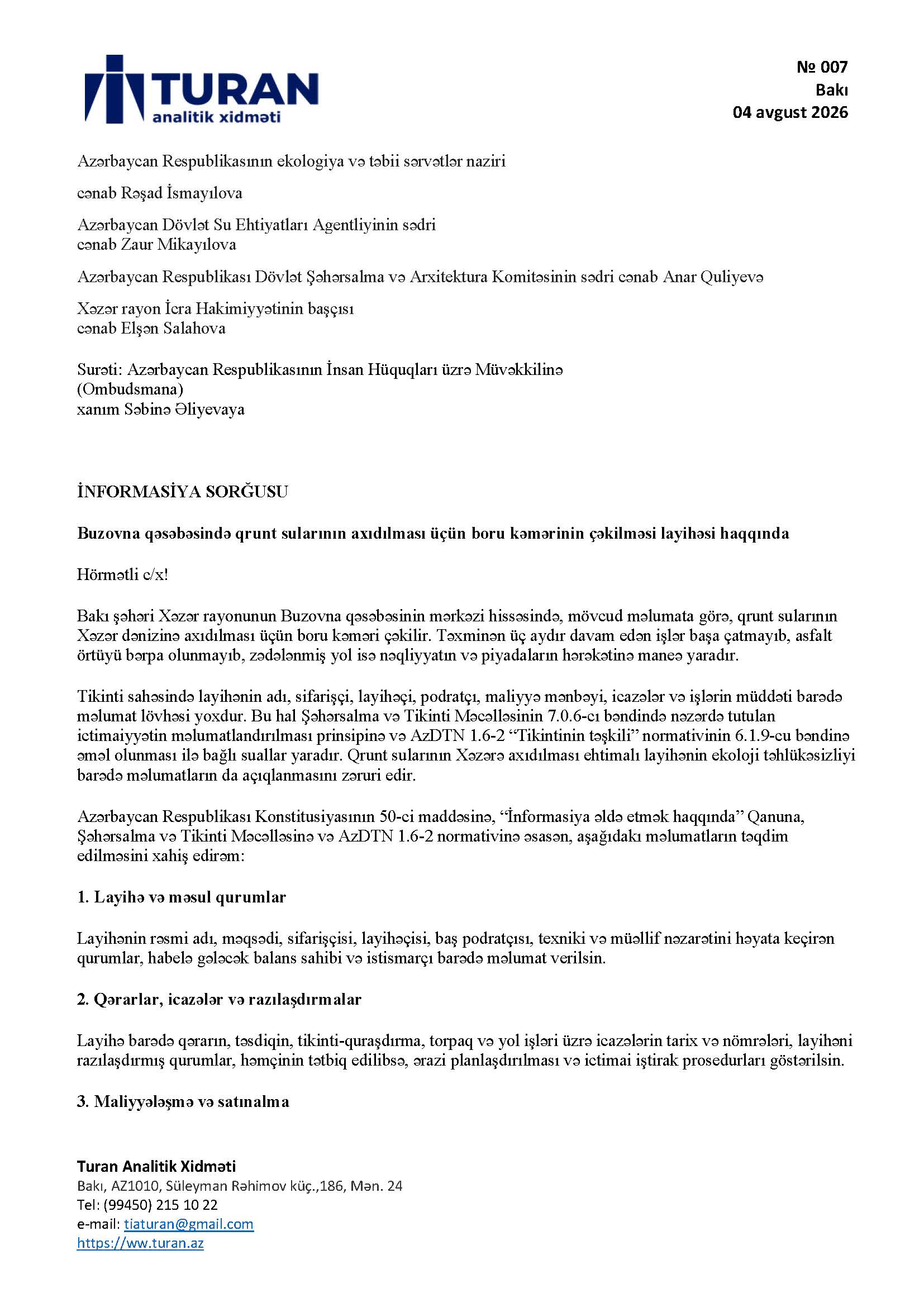
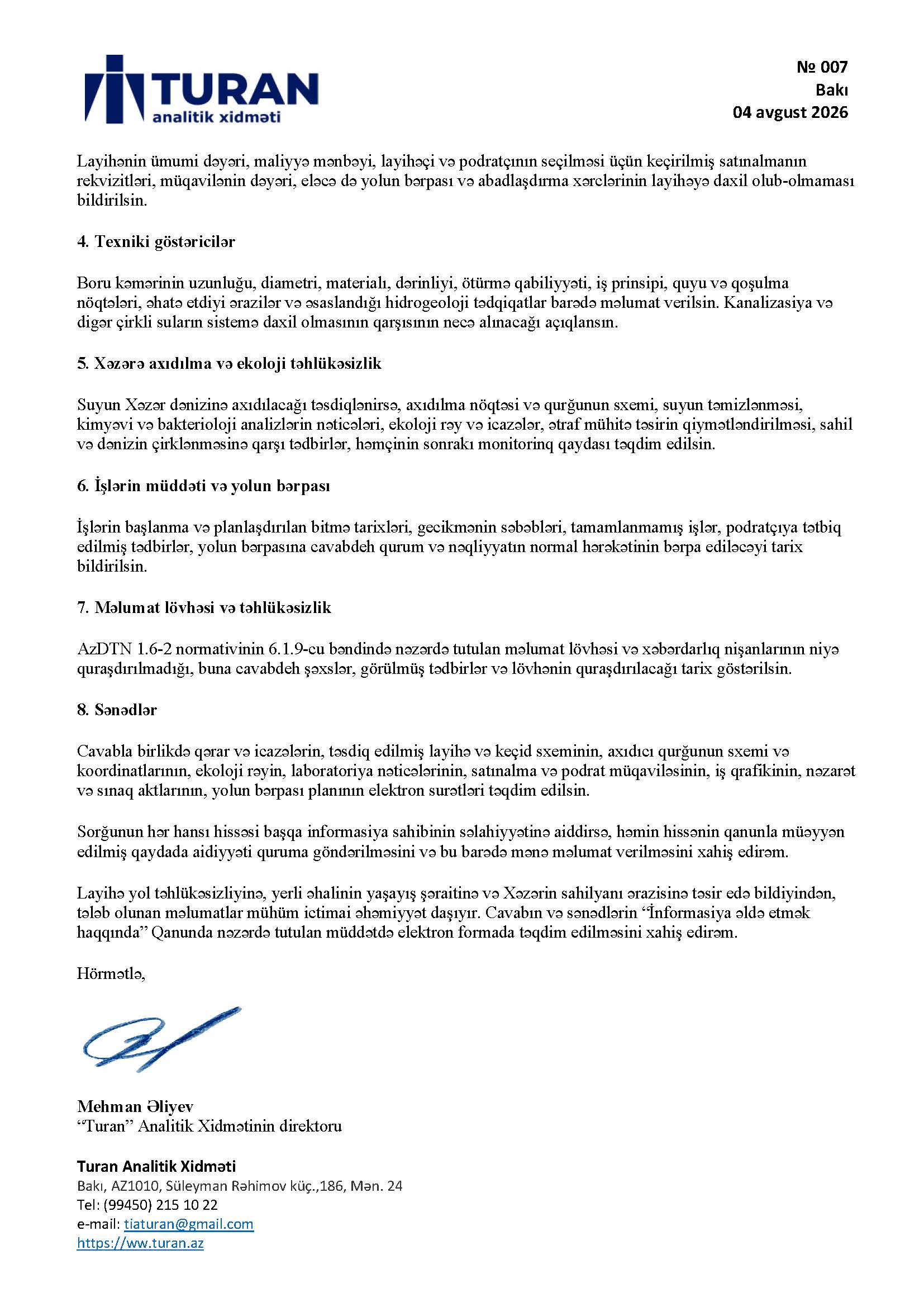
To the Minister of Ecology and Natural Resources of the Republic of Azerbaijan Mr Rashad Ismayilov
To the Chairman of the State Water Resources Agency of Azerbaijan Mr Zaur Mikayilov
To the Chairman of the State Committee for Urban Planning and Architecture of the Republic of Azerbaijan Mr Anar Guliyev
To the Head of the Khazar District Executive Authority Mr Elshan Salahov
Copy to: Commissioner for Human Rights of the Republic of Azerbaijan (Ombudsman) Ms Sabina Aliyeva
INFORMATION REQUEST
Concerning the pipeline project for the drainage of groundwater in the Buzovna settlement
Dear Sir/Madam,
According to available information, a pipeline is being laid in the central part of the Buzovna settlement in Baku’s Khazar district to discharge groundwater into the Caspian Sea. The work, which has continued for approximately three months, has not yet been completed. The asphalt surface has not been restored, and the damaged road is obstructing the movement of vehicles and pedestrians.
There is no information board at the construction site providing details about the project’s name, client, designer, contractor, source of financing, permits or work schedule. This raises questions about compliance with the principle of informing the public, as stipulated in Article 7.0.6 of the Urban Planning and Construction Code, and with Clause 6.1.9 of the AzDTN 1.6-2 “Construction Organization” standard. The presumed discharge of groundwater into the Caspian Sea also makes it necessary to disclose information about the project’s environmental safety.
Pursuant to Article 50 of the Constitution of the Republic of Azerbaijan, the Law on Access to Information, the Urban Planning and Construction Code, and the AzDTN 1.6-2 standard, I request that the following information be provided:
1. The project and responsible bodies
Please provide the project’s official name and purpose, information about its client, designer, general contractor, the bodies responsible for technical and design supervision, as well as the future asset holder and operating organisation.
2. Decisions, permits and approvals
Please provide the dates and reference numbers of the decision and approval relating to the project, the permits for construction, installation, excavation and roadworks, and the names of the bodies that approved the project. Please also specify any territorial-planning and public-participation procedures that were applied.
3. Financing and procurement
Please provide the project’s total cost, its source of financing, details of the procurement procedure used to select the designer and contractor, the contract value, and confirmation of whether the costs of restoring the road and improving the surrounding area are included in the project.
4. Technical specifications
Please provide information about the pipeline’s length, diameter, material, installation depth, capacity and operating principle, the manholes and connection points, the areas covered by the system, and the hydrogeological studies on which the project is based. Please also explain how sewage and other contaminated wastewater will be prevented from entering the system.
5. Discharge into the Caspian Sea and environmental safety
If it is confirmed that the water will be discharged into the Caspian Sea, please provide the location of the discharge point and a diagram of the outlet structure, information about water treatment, the results of chemical and bacteriological analyses, the relevant environmental assessment and permits, the environmental impact assessment, measures to prevent pollution of the coastline and the sea, and the procedures for subsequent monitoring.
6. Work schedule and road restoration
Please provide the dates on which the work began and is planned to be completed, the reasons for the delay, a list of the outstanding work, any measures taken against the contractor, the name of the body responsible for restoring the road, and the date on which normal traffic will be restored.
7. Information board and safety
Please explain why the information board and warning signs required under Clause 6.1.9 of the AzDTN 1.6-2 standard have not been installed. Please identify those responsible, specify the measures taken and provide the date on which the information board will be installed.
8. Documents
Please provide, together with the response, electronic copies of the relevant decisions and permits, the approved project and pipeline route plan, the diagram and coordinates of the outlet structure, the environmental assessment, laboratory test results, procurement documents and the contract with the contractor, the work schedule, inspection and testing certificates, and the road-restoration plan.
If any part of this request falls within the competence of another information holder, please forward that part to the relevant body in accordance with the procedure established by law and notify me accordingly.
As the project may affect road safety, the living conditions of the local population and the Caspian coastal area, the requested information is of significant public interest. I request that the response and documents be provided electronically within the timeframe stipulated by the Law on Access to Information.
Yours faithfully,
Mehman Aliyev Director of the Turan Analytical Service
Previous articles:
Three-month drainage works in Buzovna prompt an appeal to the ombudsman
Buzovna Awaits Answers: State Authorities and Trade Unions Continue Playing Hide-and-Seek
Sewerage, water supply and Illegal pipes
Monument to Corruption: A Rusted Bin in Buzovna Exposes Azerbaijan’s Systemic Failures
The problem is that the government is Executive, not Proactive
Coastal Crisis in Azerbaijan: Hidden Sewage Discharges at Zagulba-Buzovna Beaches
Azerbaijan Marks National Press Day with Sewage Fountain
Is it possible to raise the standards of beach recreation amidst environmental issues?
Environmental crisis in Azerbaijan: sewage scandals and inactivity of state structures
Silence speaks volumes: Azerbaijan's struggle with transparency and accountability
Will Azerbaijani beaches raise "Blue flags"?
Construction of Immoral Water Supply System in Buzovna Accelerated
Construction of "immoral" water pipeline is suspended
Third Lawsuit against Azersu on Turan News Agency's Information Request


Social
-
Azerbaijan has established an extensive institutional framework to support youth education, employment and digital skills. However, demographic decline, a mismatch between education and labour market needs, declining housing affordability and the...
-
The Bronze Age burial-mound field is officially protected by the state. On the ground, however, the ancient mounds are being damaged, encroached upon by construction and gradually erased from the landscape. On the northeastern edge of the...
-
BAKU, July 31 — Azerbaijan faces a difficult choice between the two main power centres in world football after the Union of European Football Associations (UEFA) threatened to boycott all competitions organised by the International Federation of...
-
Traffic in central Buzovna continues to be shaped by the consequences of an accident that has formally been resolved. The groundwater leak has been stopped, but the damaged road has not been restored. For nearly a month, buses and cars have been forced to bypass the closed section by using other streets in the settlement.


Leave a review